


DC Fuse, Switch and Surge Arrester Protection in Solar Energy Systems

The line between the solar panel, charge controller, battery and inverter operates on direct current (DC), and this line is more dangerous than most people assume. The panel produces voltage as long as there is daylight. The battery can deliver very high current in a short circuit. A DC arc also does not extinguish on its own the way it does with alternating current. For this reason, the fuse, switch and surge arrester on the DC side are selected differently from their AC counterparts that we are used to.
This guide is intended for owners of homes, country houses, businesses and small facilities, as well as technical managers and purchasing departments. It explains, with numerical examples, which protection is needed at which point, what a gPV fuse is, how to read the utilization category on a DC switch, why breaking capacity is decisive on the battery line, and where and on what basis a DC surge arrester is installed.
This article is not an installation guide. Connections, fuse replacement and panel work in DC circuits must be carried out by authorized electrical personnel. The aim is to help you ask the right questions at the quotation and design stage.
Why is DC-side protection a separate topic?
Alternating current passes through zero 100 times per second, which helps extinguish the arc. DC current has no such zero crossing. As long as the source keeps supplying energy, a DC arc does not extinguish on its own and continues. For this reason, an ordinary AC breaker or fuse may fail to extinguish the arc at DC voltage even if its contacts open.
The second difference is the nature of the source. A PV array behaves like a current source and delivers only slightly more than its rated current even in a short circuit. As a result, the large fault current needed for a conventional fuse to "blow quickly" does not develop. The third difference is on the battery side: a battery is an energy storage device that can deliver very high current in a short circuit.
These three characteristics call for three separate protective devices on the DC line: a fuse against overcurrent, a disconnector that safely opens and closes the circuit, and a surge arrester against transient overvoltage. If you would like to recall the general operating logic of the system, you can take a look at the article describing the components of a solar energy system .
Where are the protection points? Which device goes where?
Protective devices are not placed randomly; they are installed at every stage the energy passes through, each with a purpose. The table below summarizes the DC line of a typical battery-based system. The number of stages varies with the size of the system.
| Location | Hazard | Typical protection | Point to note |
|---|---|---|---|
| PV array (string) | Reverse current from parallel strings | gPV fuse | Maximum series fuse rating permitted by the panel |
| PV array output | Need for isolation during maintenance | DC isolator switch | DC-PV1 / DC-PV2 category, voltage, current |
| Charge controller / inverter input | Surge voltage from lightning and switching | DC surge arrester (Type 2) | IEC 61643-31 compliance, short connection leads |
| Main battery line | Short circuit, high current | Battery fuse and main DC switch | Breaking capacity (AIC), location close to the battery |
| Battery branches (parallel) | Current flowing from one battery to another | Fuse or breaker per branch | Current balance and cable length |
| DC loads | Cable overheating | Fuse according to cable cross-section | The fuse must blow before the cable is damaged |
The most common mistake in this chain is assuming that one device will do the job of another. A switch does not provide protection, a fuse does not serve as an isolator, and a surge arrester does not protect against overcurrent. Each one addresses a separate risk.
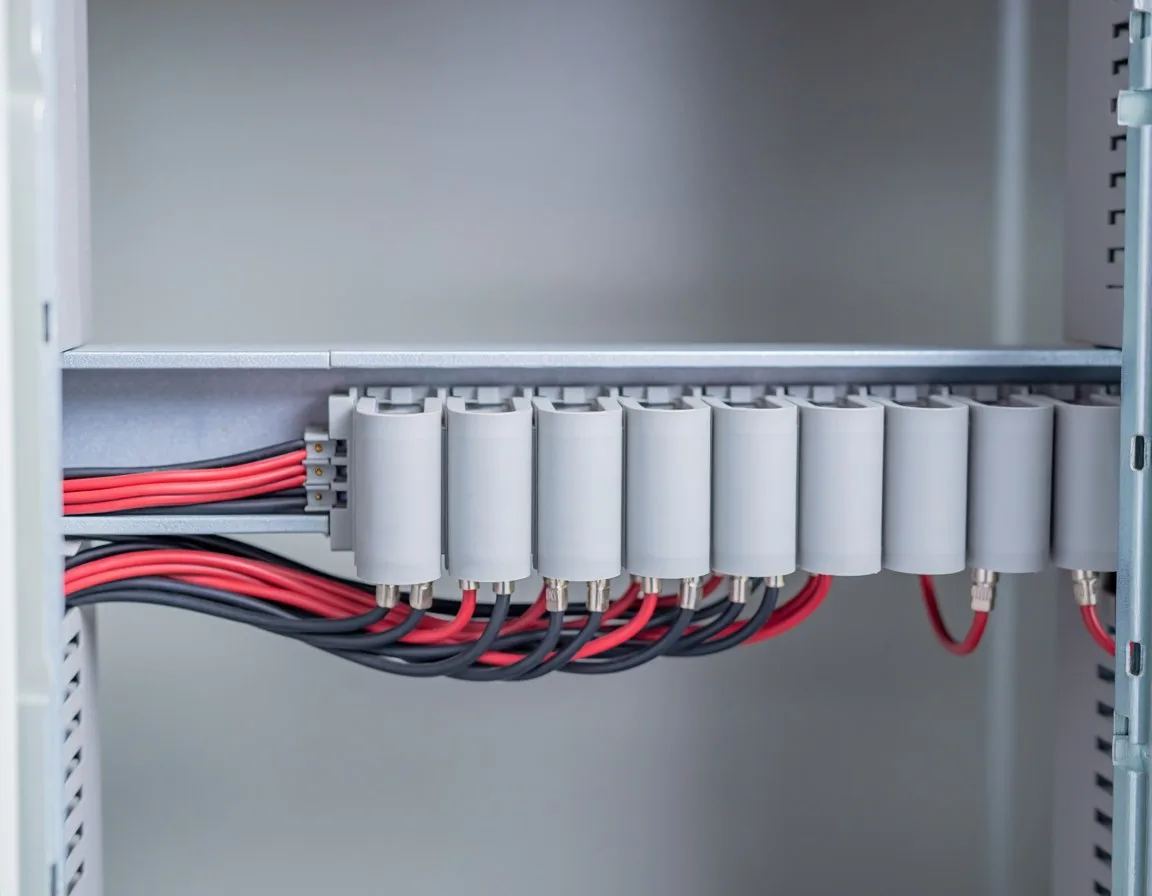
PV string fuse: what is gPV and how is it selected?
What makes a gPV fuse different?
gPV is a fuse class defined for photovoltaic systems. IEC 60269-6 sets additional requirements for fuse links that protect PV strings and string groups in circuits up to 1500 V DC. The distinguishing feature of this class is that it also provides protection against the low, long-duration overcurrents produced by the panel. A gPV fuse is expected to detect and interrupt fault currents of roughly 1.35 to 1.5 times the string short-circuit current. A standard DC fuse may not behave reliably in this range.
When purchasing, general statements such as "DC compatible" on the fuse datasheet are not enough. The datasheet must clearly state compliance with IEC 60269-1 and IEC 60269-6. The fuse holder must also be suitable for the same voltage and current class.
The 1.56 × Isc rule and a numerical example
A common approach to sizing string fuses is to apply two safety factors to the panel's short-circuit current (Isc). The 1.56 factor comes from multiplying 1.25 for continuous load by 1.25 for high irradiance above STC. This is a rule originating from North American practice. On the IEC side, manufacturers and the standard (IEC 62548) give their own ranges, so the final decision is made according to the panel and fuse datasheets.
Assumptions: the panel datasheet gives Isc = 13 A, and the panel's maximum series fuse rating is 25 A.
- Minimum fuse current: 13 A × 1.56 ≈ 20.3 A.
- The standard value above this: 25 A.
- Check: 25 A does not exceed the 25 A limit on the panel datasheet, so it is suitable.
- Voltage check: the fuse's DC voltage rating must exceed the string's open-circuit voltage (Voc) in cold weather. For example, with 3 panels in series at Voc = 49 V each and a cold-weather correction of about 12%, this gives 3 × 49 × 1.12 ≈ 165 V. A 600 V or 1000 V class fuse is more than sufficient in this respect.
If, in the calculation, a panel has a 20 A limit and the 1.56 × Isc value exceeds 20 A, that panel and fuse combination is incompatible. The panel, the fuse or the string configuration must be changed.
When is a string fuse required?
With a single string, reverse current usually cannot occur. The situation changes when two or more strings are in parallel. In parallel strings, healthy strings can feed reverse current into a faulty string, and this can exceed the value the panel can withstand. Panel manufacturers usually specify this limit as the maximum series fuse rating. Therefore, a "two strings in parallel, no fuse" design should be questioned in terms of panel warranty and safety.
A common misconception in small systems is believing that the protection inside the charge controller or hybrid inverter replaces the string fuse. Internal protection protects the device; it does not guarantee protection against reverse current between panels. You should check what the device manual requires for parallel string connections. You can find details on string current and voltage and charge controller compatibility in the charge controller selection article .
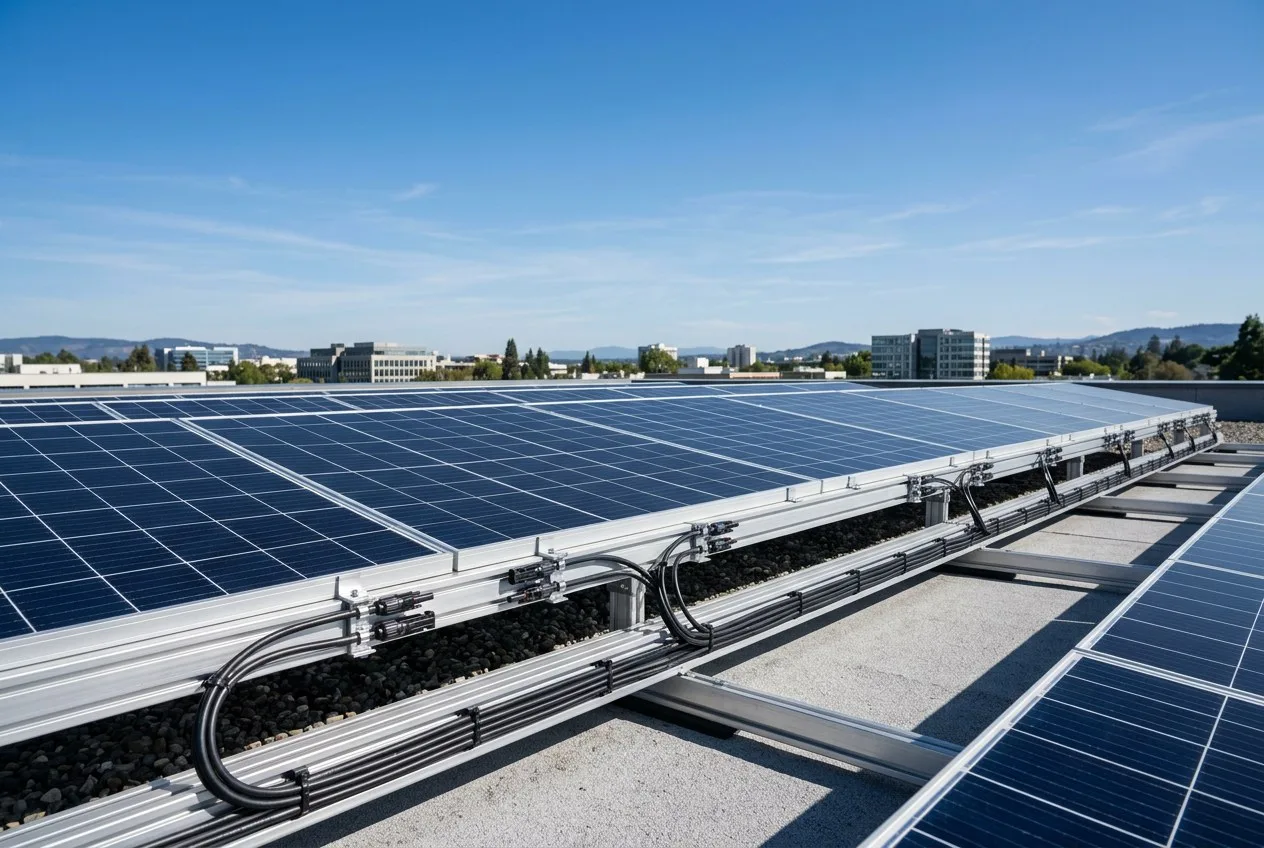
DC isolator switch vs. DC circuit breaker: what is the difference?
The two devices are often confused. A DC isolator opens the circuit manually and under load, but provides no protection on its own; a DC circuit breaker can be opened manually and also trips automatically on overcurrent. A breaker is more expensive and can also serve as an isolator, but only if the product is also rated for isolation. A device that is only a "DC overcurrent breaker" does not always provide safe isolation.
DC-PV1 and DC-PV2: reading the label
The utilization category on the switch label tells you under which conditions switching was tested. DC-PV1 is for single-string circuits with no reverse current; DC-PV2 is tested for cases where current can flow in both directions, i.e. parallel strings or a battery in the same circuit. The test current also differs: for DC-PV2 the switching test is performed at four times the rated current, while for DC-PV1 the ratio is one and a half times. In a system with batteries or parallel strings, choosing the more comprehensive category is a sensible choice.
It is not enough for the label to say just "32 A". The values to check are:
- Rated DC voltage: must be higher than the string's Voc in cold weather.
- Rated current: must be above the string current, selected with a margin for temperature and enclosed-panel effects.
- Number of poles and wiring diagram: in some DC switches the poles are connected in series to achieve the voltage rating. Incorrect wiring invalidates the ratings. The wiring diagram must be followed exactly.
- Standard: IEC 60947-3 reference and the PV category in the manufacturer's datasheet.
- Lockability and protection class: a high IP rating and a lockable handle for outdoor use.
A switch being in the "off" position does not mean the panel side is de-energized. There is voltage on the panel side in sunlight. The de-energizing procedure before maintenance is the responsibility of authorized personnel; the authorized personnel principles in the article on occupational safety in UPS and battery work also apply to DC solar systems.
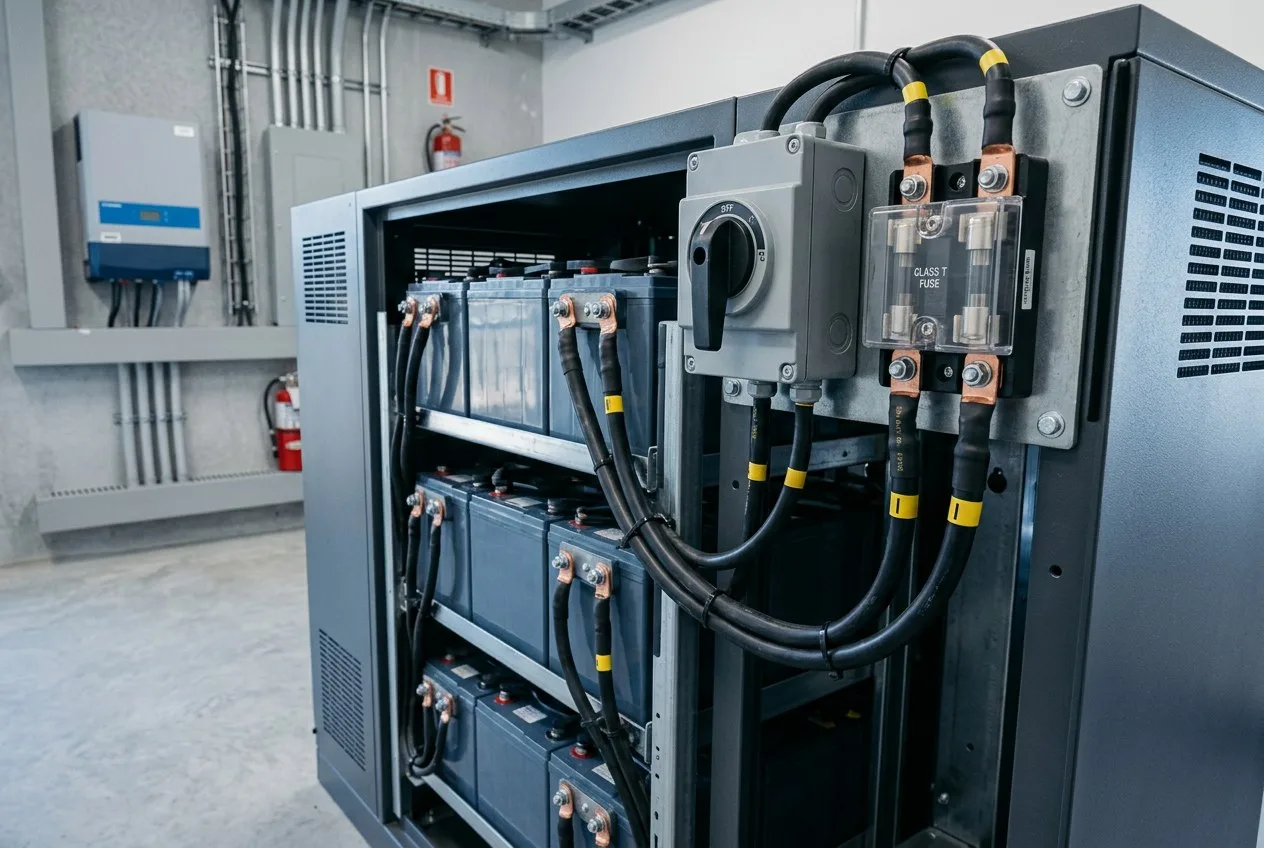
Battery line: fuse, breaking capacity and DC main switch
The battery is the element of a solar system that can deliver the highest current. While the panel string current is limited to a few tens of amperes, a battery bank can deliver thousands of amperes within a few milliseconds in a fault. For this reason, the battery line fuse must meet two separate requirements: protecting the cable at normal operating current and safely interrupting the possible short-circuit current.
Fuse current: it must blow before the cable is damaged
Example: take a 5 kW inverter in a 48 V system. Assumptions: inverter efficiency 92%, battery voltage 44 V near end of discharge.
- Battery line current: 5,000 W ÷ (0.92 × 44 V) ≈ 124 A.
- With a margin for continuous current: 124 A × 1.25 ≈ 155 A.
- Selected standard fuse: approximately 160 A. The cable must be sized to carry at least the rating of this fuse.
- The inverter's short-term starting current (surge) should also be checked; the fuse's time-current curve must withstand it.
If the cable's current-carrying capacity is lower than the fuse rating, the fuse cannot protect the cable. For cable cross-section and voltage drop calculations, see the article on DC cable cross-section
Breaking capacity (AIC): the value that is often overlooked
The fuse's current rating indicates normal operation, while its breaking capacity indicates its ability to safely extinguish a short circuit. In battery circuits, especially lithium, the fuse's DC breaking capacity must not be lower than the circuit's possible short-circuit current. Lithium batteries require special attention in this respect, because they can deliver very high short-circuit currents due to their low internal resistance.
A simple preliminary estimate: for a 48 V bank, if the sum of battery internal resistance and cable resistance is assumed to be about 3 mΩ, the short-circuit current comes to about 48 V ÷ 0.003 Ω ≈ 16,000 A (16 kA). The actual value is the short-circuit current stated by the battery manufacturer. This example is only meant to show the order of magnitude.
| Fuse type | Typical DC breaking capacity | Suitability |
|---|---|---|
| ANL / MEGA type | Approx. 2–5 kA (varies by manufacturer) | May be insufficient for large lithium banks |
| MRBF | Approx. 10 kA | Small and medium banks; short-circuit value must be checked |
| Class T | 20 kA level at 125 V DC | Common choice for lithium banks; requires a special holder |
The values in the table are typical ranges. The DC voltage and breaking capacity of each fuse must be verified from the datasheet. In parallel battery strings, each string has its own fuse, and these fuses are selected according to the short-circuit current of that string. For current balance and busbar layout, the article on battery bank installation is a good complement. The BMS protection in lithium batteries does not replace the fuse; you can find what the BMS does in the BMS article
The battery fuse is placed as close to the battery as possible; this minimizes the length of unprotected cable before the fuse. In a large battery line, this fuse and the main switch are usually installed in the order shown in the manufacturer's documentation. Because of the high energy on the battery side, connection work must always be left to authorized personnel.
DC surge protector: protecting the panels and inverter from transient overvoltage
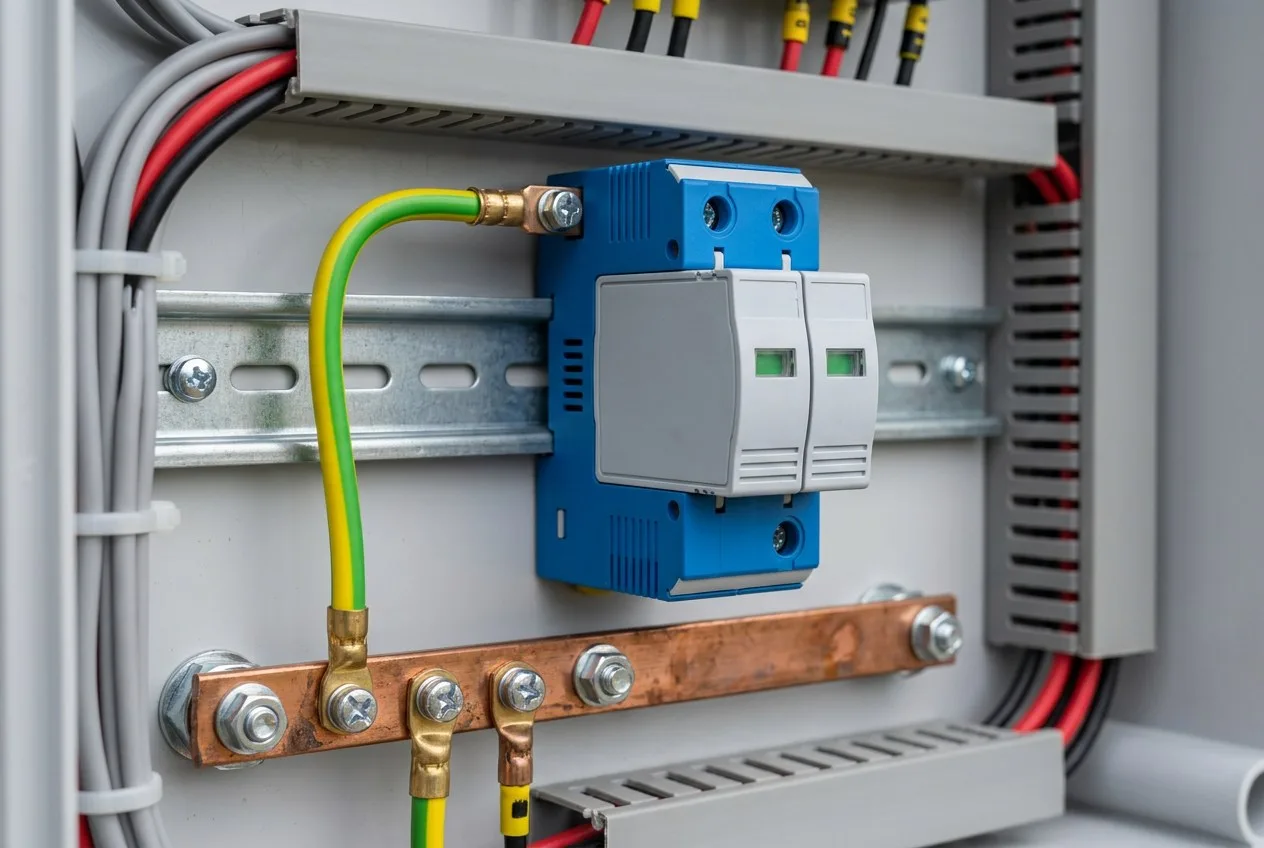
Even if lightning does not strike directly, a nearby strike induces a short high-voltage surge on the line. The large panel array on the roof and the long cables act like an antenna that collects this surge. The surge protective device (SPD) diverts this surge to ground and protects the inverter and charge controller input. For the general principle of surge protectors, see the article on voltage surges and surge protectors
Type 1, Type 2 and standard compliance
The surge protector used on the DC side is tested to a different standard than the AC-side one. A DC surge protector must be certified to IEC 61643-31 for photovoltaics, not IEC 61643-11, which is for AC. Type 2 devices are generally used at the inverter DC input or in the combiner box. Type 2 is installed at the inverter DC input or inside the combiner box and limits transient overvoltages. If the building also has an external lightning protection system, Type 1 or Type 1+2 devices that withstand direct lightning current come into play. In installations without a lightning protection system, a Type 2 PV surge protector is generally considered sufficient.
What to check when choosing a surge protector
- Continuous operating voltage (Ucpv): must be higher than the string's maximum Voc in cold weather.
- Discharge current (In, Imax): is evaluated according to the lightning density of the region and the cable length.
- Replaceable module and status indicator: when the protective element reaches the end of its life, the window changes color. In this case the device no longer provides protection.
- Connection leads: must be short and direct. Long connection leads create additional voltage drop during a surge and weaken the protection.
- Grounding: a surge protective device (SPD) only works if it is connected to a low-impedance grounding system. For details, see the article on grounding and lightning protection should be read.
- AC side: For complete protection, a DC SPD on the string side and an AC SPD at the grid connection should be considered together.
An SPD does not replace a fuse or a circuit breaker. Whether an upstream protective device is required to disconnect the SPD in case of failure is stated in the manufacturer's manual; this information varies by device. The order and wiring in the enclosure must comply with the manufacturer's diagram.
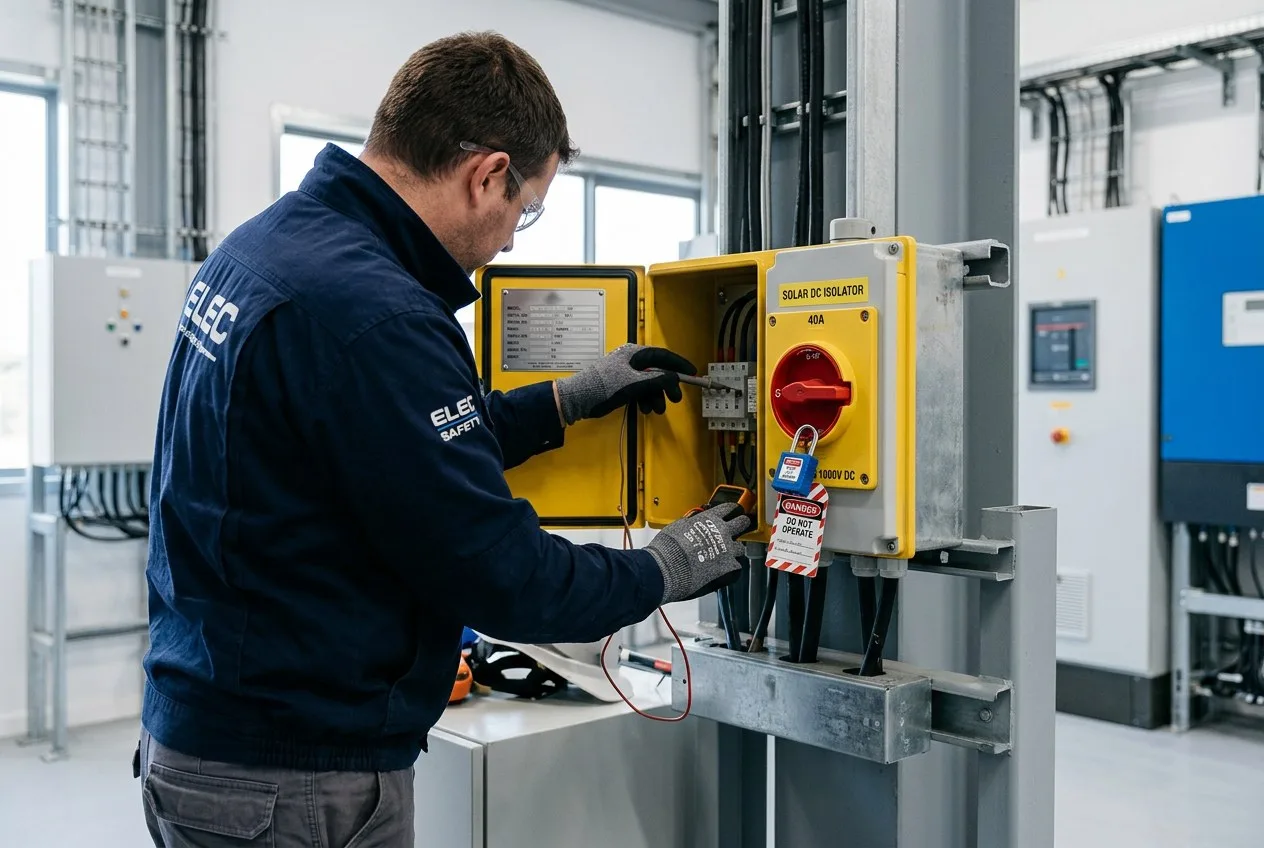
DC arc fault: why aren't fuses and breakers enough?
A loose connector, a broken cable, or an incorrectly tightened cable end can create a series arc. The arc burns at a very high temperature, but the current flowing through the circuit may remain below normal current. Since the operating current during an arc stays below the system's nominal current, conventional overcurrent protection devices cannot detect the arc. This situation, in which fuses and breakers stay silent, is the main source of fire risk.
For this reason, some regulations require arc fault detection and interruption for PV circuits above a certain voltage. For example, NEC 690 in the USA requires PV systems operating at more than 80 V between two conductors to be protected by an arc fault protection device. For the requirements applicable in Türkiye, the current opinion of the relevant authorities and the project designer should be taken as the basis. When selecting a product, you should ask whether the inverter or charge controller has an arc fault detection feature, together with the standard stated in the datasheet. According to an NREL report, the certified products on the market with this feature were initially mainly string inverters and charge controllers.
Signs that may be noticed at home or at work include: discoloration or melting at a connector, a burning smell, unexplained production loss in a string, and repeated arc or insulation fault warnings from the inverter. If you notice these signs, shut down the system safely and call an authorized technical service. For other causes of reduced production, see the troubleshooting and checklist article.
Checklist for the quotation and purchasing stage
When evaluating a quotation or a project, the following questions quickly reveal missing protection elements.
| Question | Why is it important? | What does a good answer look like? |
|---|---|---|
| What is the type and standard of the string fuse? | An AC fuse may not be able to extinguish a DC arc | gPV, IEC 60269-6 compliance, DC voltage rating specified |
| Has the panel's maximum series fuse rating been checked? | Reverse current damages the panel | Calculation and datasheet record available |
| What is the utilization category of the DC switch? | Load-breaking duty and reverse current | DC-PV1 / DC-PV2, with voltage and current margin |
| What is the DC breaking capacity of the battery fuse? | Lithium short-circuit current is high | Higher than the battery manufacturer's short-circuit value |
| Is the SPD rated for DC? | An AC SPD does not operate safely on DC | IEC 61643-31 certified, Ucpv higher than Voc |
| Is there arc fault detection? | Conventional protection does not detect a series arc | Device feature certified or justified in the project |
| Are there labels and a diagram? | Safety for service personnel | Single-line diagram, isolation points labeled |
Common mistakes
- Trying to protect a PV string with an automotive fuse: automotive-type fuses have DC voltage and breaking ratings unsuitable for high-voltage panel lines.
- Cable rated lower than the fuse: the cable heats up without the fuse blowing. First determine the cable cross-section, then the fuse current.
- Never asking about breaking capacity: in a lithium bank, a fuse with a low AIC rating may have its casing burst in a short circuit. This is a risk that is not visible when only looking at the current rating.
- Using an AC breaker on DC: some small breakers require a specific pole arrangement and voltage rating for DC. A device without a stated DC rating must not be used on DC.
- Neglecting the grounding of the SPD: a good SPD is rendered ineffective by poor grounding.
- Not accounting for temperature inside the enclosure: in an enclosure in direct sun, fuse and switch ratings drop. A margin should be left, and the derating curve in the datasheet should be read.
- Not updating the protection for a battery or string added later: when the system grows, fuse, breaker and cable ratings must be reviewed again.
Periodic inspection: what is checked, and who does it?
Protection devices are easily forgotten once installed. The annual inspection is mostly carried out visually and with measuring instruments. Since voltage is present while the panel string is exposed, the work must be done by authorized personnel. The inspection items you should have carried out as the user are as follows:
- Is there any discoloration, melting or looseness in the fuse holders and connectors, and has a hot-spot scan been performed with a thermal camera?
- Are the surge arrester status indicators normal, and is there any module that needs replacing?
- Does the DC switch handle operate smoothly, can it be locked, and is there any water ingress into the enclosure?
- Have the battery fuse and terminals been checked for tightness, corrosion and overheating?
- Are the labels, the single-line diagram and the emergency isolation points up to date?
For a comprehensive checklist, see the article periodic maintenance checklist for solar energy systems The fire safety aspect of systems with lithium batteries should also be assessed separately; fire safety in lithium battery storage covers this topic.
Standards: which document should you refer to?
In DC protection equipment, the word "standard" can turn into marketing language. For this reason, the following reference points should be kept in mind:
- IEC 60269-6: PV string and string group fuses. It covers circuits up to 1500 V DC.
- IEC 60947-3: switches and isolators; DC-PV utilization categories are defined in this standard.
- IEC 61643-31: surge protective devices connected to photovoltaic systems.
- IEC 62548: PV array design requirements. Its scope includes DC array wiring, protection devices, switching and earthing arrangements. The current edition also contains additional protection requirements for arrays connected directly to batteries at DC level. The 2023 edition of the standard was published as IEC 62548-1; its content also includes an overcurrent protection section for battery-connected PV systems.
Which documents should be requested for the product and the system is explained in the article on documents and standards in a broader context. Because regulations and permitting processes change over time, please verify the current requirements on the official websites of EPDK, the Ministry of Energy and Natural Resources, and your distribution company.
UPS, battery and inverter side: where does Bempower come in?
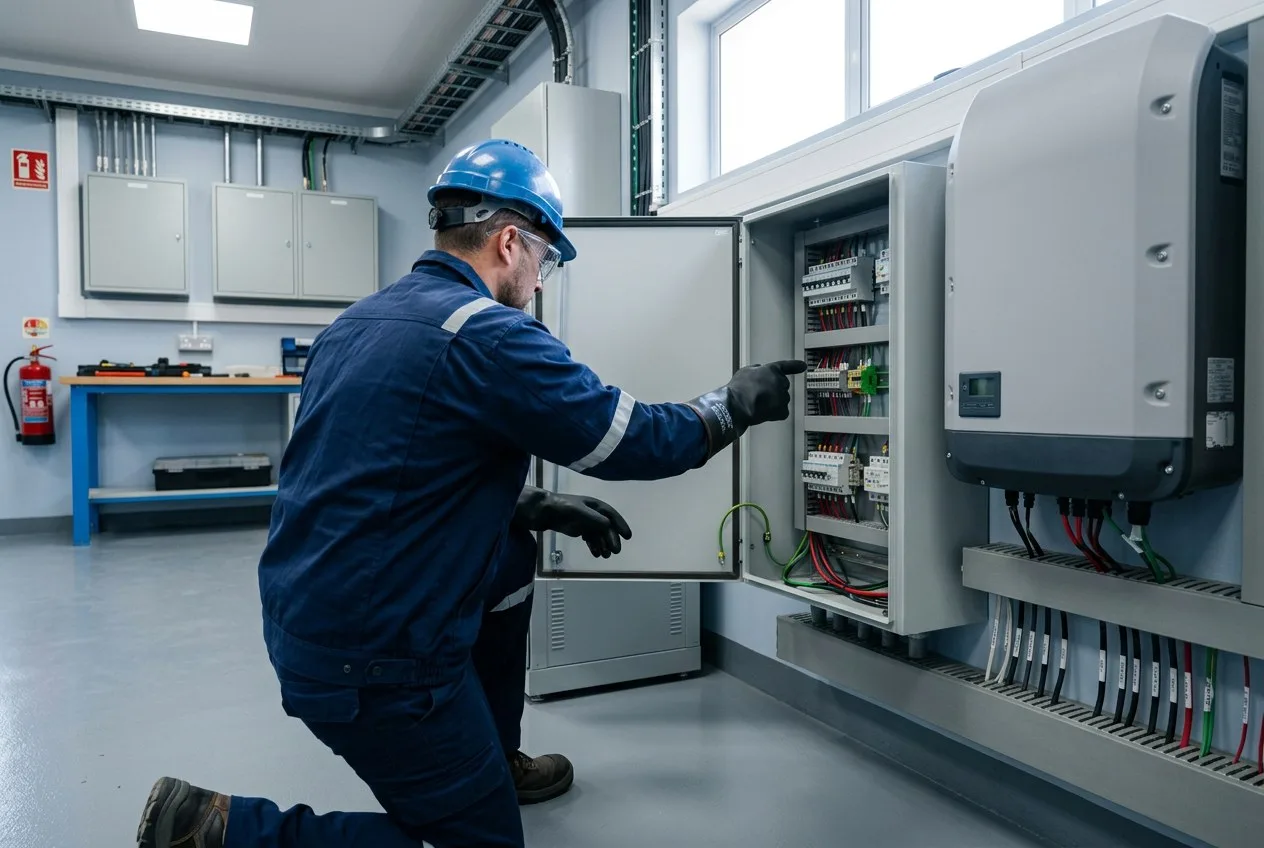
Solar panel installation and GES (solar power plant) application processes are outside Bempower's scope of service. However, in a system with batteries, the battery, inverter and UPS side of the job falls within this scope: the condition of the battery bank, checking the battery fuses and connection points, and supplying critical loads with a hybrid inverter or UPS. For how a battery inverter operates during an outage, see the article on hybrid inverters
If you would like to have the connections, fuses and test status of your existing battery group checked, or to plan periodic maintenance of your UPS and inverter system, you can reach us for Bempower's survey, installation, periodic maintenance and technical service through the contact page for Bempower's survey, installation, periodic maintenance and technical service. We provide on-site service in Istanbul and the surrounding provinces.
- IEC 60269-6:2010 – Low-voltage fuses – Part 6: Supplementary requirements for fuse-links for the protection of solar photovoltaic energy systems — IEC Webstore, 2010. https://webstore.iec.ch/en/publication/1245
- IEC 62548-1:2023 – PV Array Design Requirements (table of contents and scope) — iTeh Standards, 2023. https://standards.iteh.ai/catalog/standards/iec/33cdf36d-fec8-4138-b036-9dd5c0caccc7/iec-62548-1-2023
- What is a gPV Fuse and Why Does Your Solar System Need One? — Lawson Fuses, 2026. https://www.lawsonfuses.com/what-is-a-gpv-fuse-and-why-does-your-solar-system-need-one/
- How to Select DC Fuses and DC Circuit Breakers — Renogy, 2026. https://www.renogy.com/blogs/learn-center/dc-fuse-dc-circuit-breaker-selection
- Solar Surge Protection: 3-Layer DC SPD Guide for PV Systems — TrilPeak, 2026. https://trilpeak.com/solar-surge-protection-guide/
Sources
