Commissioning after battery replacement: what tests are performed?

When new batteries are installed and the battery warning on the UPS's screen goes out, the job seems to be done. However, whether the new battery group will give the expected time in the outage and whether it will have a long life is secured by the controls after the replacement.
Change itself How to replace a UPS battery We explained in our article. In this article, we tell you what checks and tests are carried out in the commissioning of new batteries and in what order.
1. Connection and Polarity Check
Before the battery switch is switched on, all connections are checked one last time:
- The positive and negative terminals of each battery are in accordance with the wiring diagram
- That the connecting screws are tightened to the torque specified by the manufacturer
- Terminal caps are installed, wires are fixed and free from sharp edges
- In parallel arrays, each string is connected towards its own protection element
2. Voltage Measurements
The total voltage of the array is measured before it is connected to the UPS and compared to the expected value based on the number of batteries. A significantly lower than expected total often indicates a reversed or faulty battery. The voltages per battery are then measured; new batteries of the same type should give similar readings.
3. Battery Settings on the UPS
For many UPSs that use an external battery bank, the battery information is entered into the device. During commissioning, the following settings are checked against the new batteries:
| Setting | Why is it important? |
|---|---|
| Number of batteries in the array | The UPS calculates the end of charge and discharge voltages based on this number. |
| Number of arrays or total capacity | The charging current limit and remaining time estimation are made accordingly. |
| Date of battery installation | Some models calculate the battery replacement reminder from this date. |
| Temperature compensation | In supporting models, the charging voltage is adjusted according to the battery temperature. |
How the wrong number of batteries damages the batteries Battery Array We explained it with an example in our article. If the number of batteries setting is incorrect, the UPS will charge the new batteries with the wrong voltage. In some models, this setting is entered from the menu without activating the battery switch, and in others while the device is running; checking the settings and activating the battery switch in the order in the manufacturer's instructions, by authorized technical personnel and after the number of batteries in the string is verified on site.
4. Charging Voltage and Initial Charge
The charging voltage applied by the UPS to the batteries is measured and compared to the value recommended by the battery manufacturer. Too high voltage heats and dries the batteries, while too low voltage causes the batteries to never be fully charged.
New batteries may be slightly discharged while waiting in storage. Therefore, it is charged for the time recommended by the manufacturer; long-term load tests are only meaningful after the batteries are fully charged. During charging, the temperature of the batteries and the voltage differences between them are also checked.
At the end of the charge, the voltages per battery are measured again. If there is a battery that is noticeably separated between new and batteries of the same type, it is evaluated according to the battery manufacturer's recommendation so that it does not become a weak link in the series in the future. Since the battery life is usually given for an ambient temperature of 20–25 °C, the temperature of the room is also noted at this time; how the battery area should be Battery Room Ventilation and Safety We explained it in our article.
5. Initial Internal Resistance Measurement: Reference Value
After the batteries are fully charged and the charge voltage stabilizes, the internal resistance of each battery is measured and recorded. A partially empty battery gives a higher value; therefore, the measurement is made after the batteries are full, not immediately after the first charge. Some manufacturers recommend remeasuring the reference after the batteries have been charged for a while; in this case, the measurement from the first maintenance is also written next to the reference. These values are for the life of the battery pack Reference Subsequent measurements are taken and compared with the same type of device under the same conditions and, if possible, with the same type of device. Why reference is so important What is battery internal resistance? We explained it in detail in our article.
6. Function Test: Switching to Battery
When the mains input is interrupted, the UPS is tested to transfer the load to the batteries without interruption and returns to normal operation when the mains returns. The test is planned in advance in terms of loads; if the batteries are not yet fully charged, they are kept short. If the model has one, the UPS's own battery test is also run. During the test, the following is checked:
- Not affecting loads during transit
- Accurate display of alarms on the display and monitoring software
- Email alerts and server auto-shutdown settings are compatible with the new battery time
7. Discharge Test as Needed
The most accurate method to show that a new battery pack really gives the expected time is the controlled discharge test. This test for newly installed or renewed battery groups Acceptance test It is called. After the batteries are fully charged, it is planned in advance for the loads. Detail How to perform a battery discharge test You can find it in our article.
8. Registration and Tag
When the commissioning is not recorded, it remains unfinished. The installation date and sequence number are written on the batteries; the same number is used in subsequent maintenance. The report includes the type, capacity and production date of the batteries, UPS settings, voltage and internal resistance values and the results of the tests.
This report is the first page that shows how the batteries have changed during the next maintenance. Our member customers can view their service records and reports in My Account → My Devices and Maintenance. How to read the report How to read a UPS maintenance report We discussed it in our article.
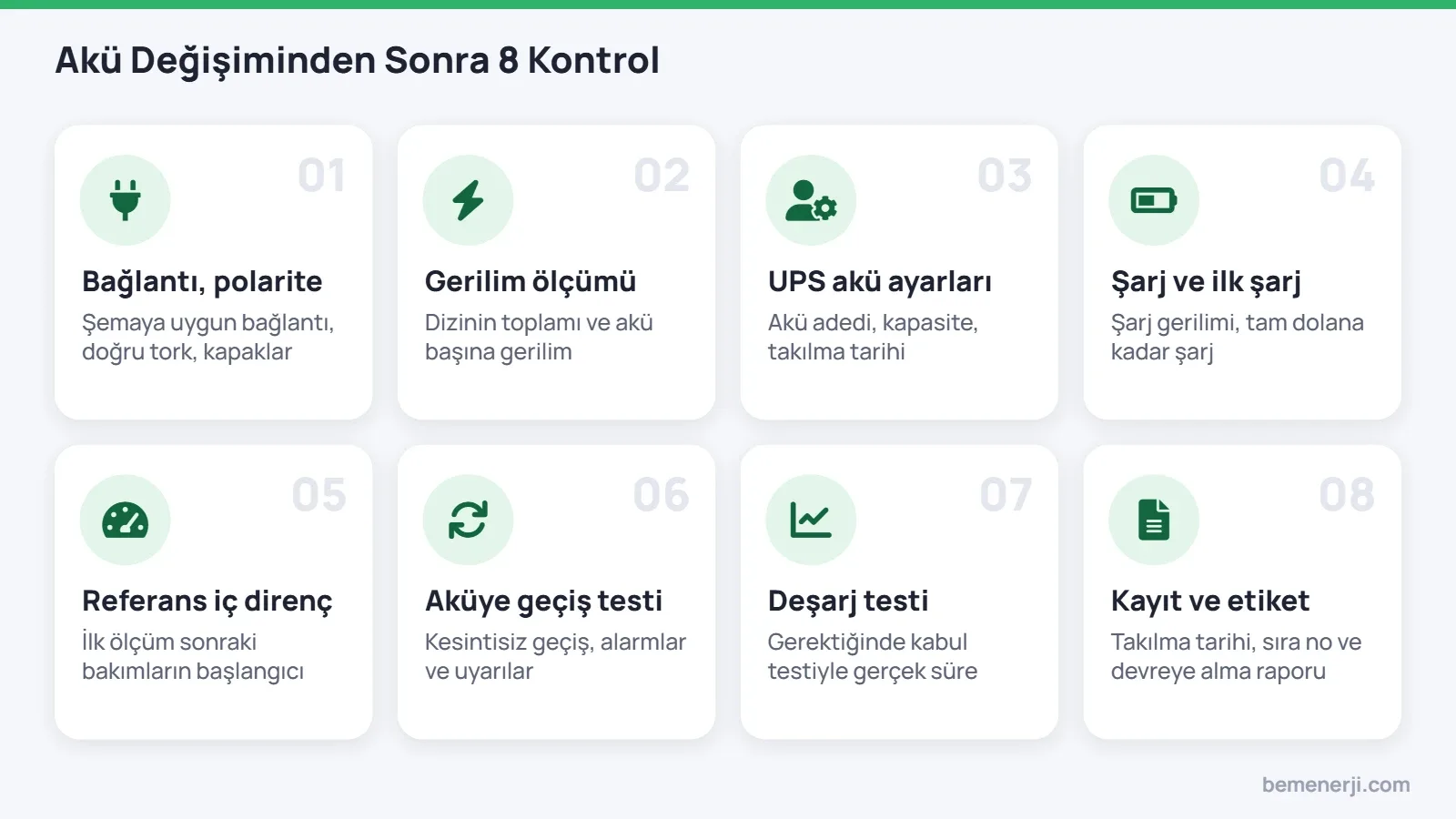
Commissioning at a glance
The commissioning of new batteries consists of eight successive steps, from connection check to registration.

The first four steps indicate that the batteries are correctly connected and charged correctly, the last four steps give the expected time and can be monitored.
Frequently Asked Questions
01Can I rely on immediate backup time when new batteries are installed?
02Is it necessary to adjust the UPS after the battery is replaced?
03Should a discharge test be performed after every battery replacement?
04Why is the first internal resistance measurement recorded?
05What should I do if the UPS continues to alert the battery after replacement?
Let's Commissioning Your New Batteries Together
We perform battery replacement, commissioning and tests in UPS of all brands and models throughout Istanbul and surrounding provinces. Process Battery Replacement and Reconditioning, acceptance test Discharge and Load Tests We explained it on our page. Your UPS model and battery information Send us; Let's plan together.