


Choosing 12 V, 24 V or 48 V Battery Voltage in Solar Energy Systems

When planning a solar energy system, battery capacity, number of panels and inverter power are discussed; but the underlying decision often remains: will the system work with 12 V, 24 V or 48 V? This choice determines the thickness of the cables, the types of fuses and switches, the panel that the charge controller can carry and which inverters can be used. It is not easy to change it later; because when the voltage changes, the inverter, charge controller and battery arrangement change together.
In this guide, we explain step by step how the same power converts into different currents at three voltages, where the losses come from, how battery groups are installed in series and parallel, and which voltage makes sense for which size system. Article; It is aimed at home users, business owners and technical officers who are planning a battery bank for a vineyard house, caravan, boat, home hybrid system or a small business.
Note: The calculations in the article are rounded examples to help you decide. In high-current DC circuits, there is a risk of arcing, short circuit and fire; therefore, connection, fuse and commissioning should be carried out by authorized electrical personnel.
What is system voltage and why is it so important?
The system voltage is the nominal (rated) DC voltage of the battery pack. A 2V monobloc battery consists of six cells, as a lead-acid battery cell delivers about 12 V; when you connect two in series, you get 24 V, and when you connect four in series, you get 48 V. Lithium iron phosphate (LiFePO4) batteries, on the other hand, are typically sold with nominal values of 12.8 V, 25.6 V, and 51.2 V; in everyday speech, they are again called 12, 24, and 48 V.
The importance of voltage comes from a simple relationship: power is the product of voltage × current (P = V I). If the voltage rises for the same power, the current decreases. Current is the actual magnitude that determines the heating of the cable, voltage drop, fuse and switch size, and the load drawn from the battery. In the Florida Solar Energy Center's publication on standalone PV systems, it is stated that the battery bank voltage is often chosen according to the load voltage requirement, 12 or 24 V is common in small and remote systems, and if possible, it is preferred to go to a higher voltage to reduce the current.
If you have not yet tidied up the general structure of the system (panel, charge control, battery, inverter) How the solar system works You can take a look at the article that explains.
12 V, 24 V and 48 V at the same power: current comparison
The most tangible effect of voltage selection is seen in current. In the example below, let's assume that a 3,000 W inverter operates at full load, we take the inverter efficiency to approximately 90% and the voltages to nominal values (12/24/48 V). The power that the inverter will draw from the DC side is approximately 3,000 ÷ 0.90 ≈ 3,330 W.
| System voltage | DC power (approx.) | Battery current (approx.) | Rated capacity for 10 kWh |
|---|---|---|---|
| 12 V | 3,330 W | 278 A | 833 Ah |
| 24 V | 3,330 W | 139 A | 417 Ah |
| 48 V | 3,330 W | 69 A | 208 Ah |
The logic of the calculation: current = power ÷ voltage (3,330 ÷ 12 ≈ 278 A); capacity = energy ÷ voltage (10,000 Wh ÷ 12 V ≈ 833 Ah). As seen in this example, a circuit carrying 278 A at 12 V requires thick copper wire, a high-current capacity fuse, and robust busbar. At 48 V, the same work is done with about 69 A. Comparisons in the field give the same result: a 3 kW load draws 250 A at 12 V, 125 A at 24 V, 62.5 A at 48 V (excluding inefficient losses).
Note the capacity line: 833 Ah, 417 Ah, and 208 Ah refer to the same energy. The Ah value is not a standalone measure of energy; it should be read in conjunction with the voltage. What Ah actually means Battery capacity (Ah) in our guide We also explained.
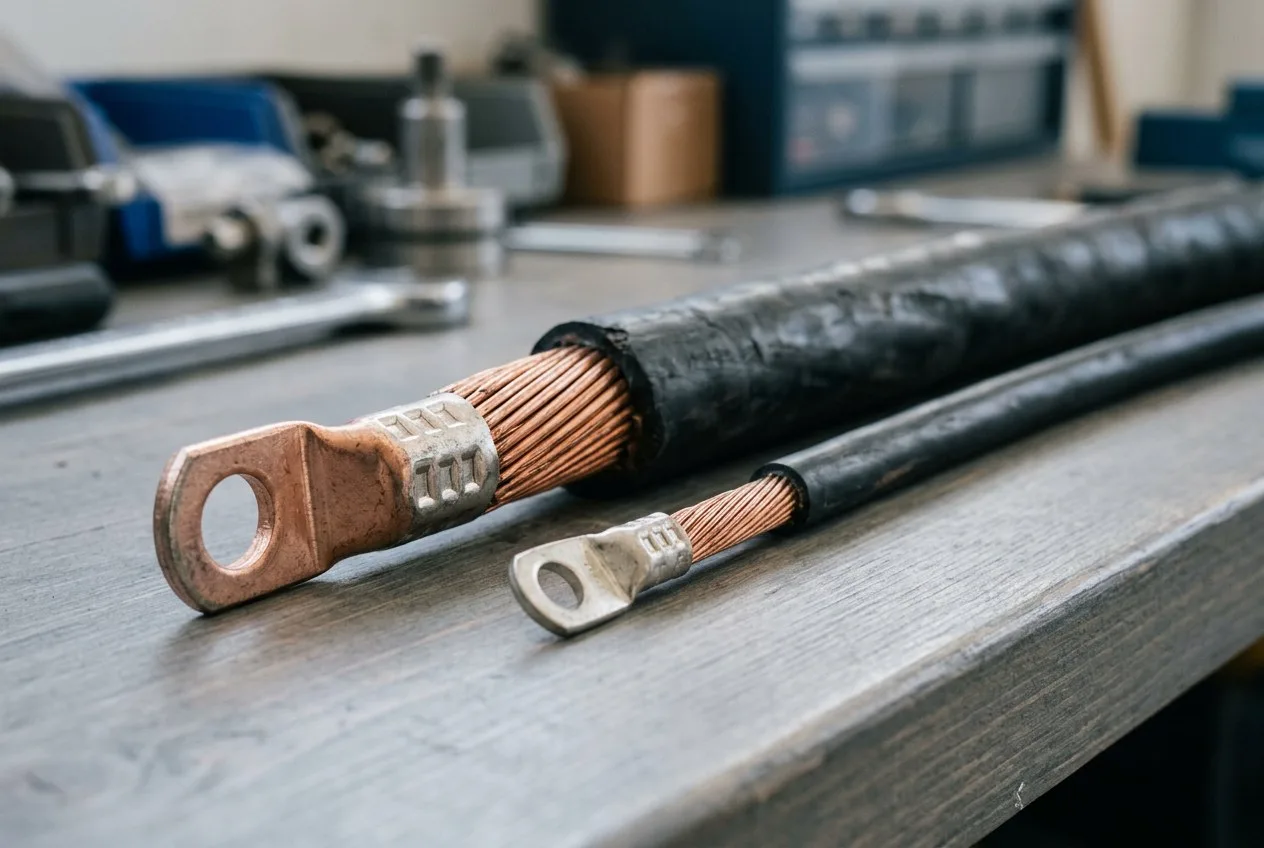
Cable cross-section, voltage drop and losses
When more current flows through the same cable, two things happen: the voltage drops between the two ends of the cable and the cable loses power as heat. The choice of voltage has a very strong effect here, as the loss increases with the square of the current (P = I² × R).
Example calculation (assumptions): Cable between battery and inverter 5 m one way, 10 m round trip; cross-section 16 mm² copper; copper resistivity approx. 0.0175 Ω·mm²/m. Cable resistivity R = 0.0175 × 10 ÷ 16 ≈ 0.011 Ω.
| System voltage | Current | Voltage drop (I × R) | Ratio of drop to system voltage | Heat loss in the cable (I² × R) |
|---|---|---|---|---|
| 12 V | 278 A | ≈ 3.0 V | ≈ %25 | ≈ 850 W |
| 24 V | 139 A | ≈ 1.5 V | ≈ %6 | ≈ 210 W |
| 48 V | 69 A | ≈ 0.76 V | ≈ %1,6 | ≈ 53 W |
The same cable is comfortably sufficient at 48 V and practically unusable at 12 V; at 12 V, the cross-section must be increased several times. When the current is halved, the heat loss is reduced to a quarter. In addition, a 1 V drop means a loss of about 4% in a 24 V system and about 2% in a 48 V system; low-voltage systems are therefore very sensitive to cable length. Manufacturer and field sources also often emphasize that very thick cables and large cable lugs are required to carry strong loads at low voltage.
It is necessary to calculate the cable cross-section separately according to the voltage drop limit and current-carrying capacity; for the detailed method DC cable cross-section and voltage drop calculation You can check our article.
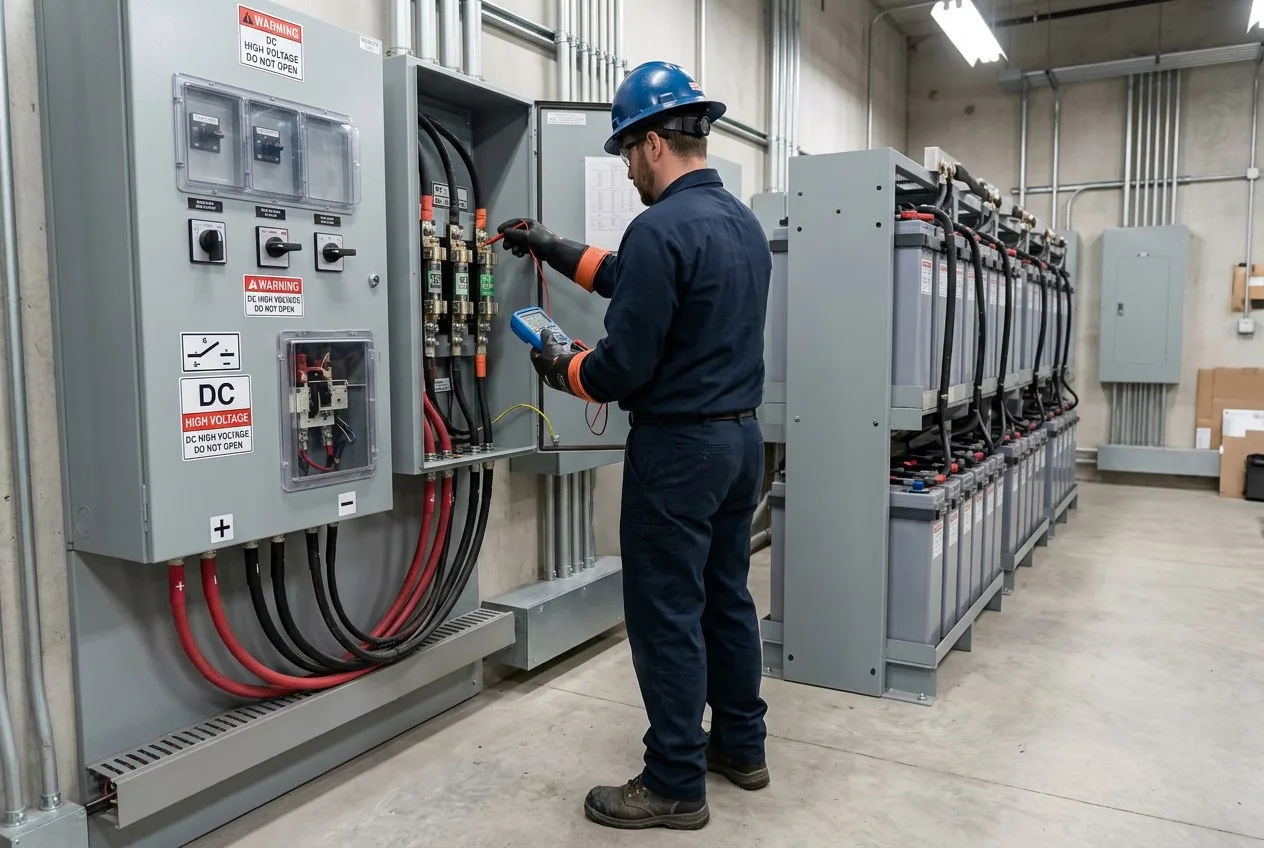
Inverter, charge controller and voltage matching
In practice, the system voltage is often determined by the inverter you choose, not you. The DC input voltage of an inverter must be the same as the nominal voltage of the battery bank; you cannot connect a 48 V inverter to a 24 V battery. Many inverters and hybrid devices of 5 kVA and above are already produced as 48 V on the market. Therefore, first subtract the required inverter power from the load list and then select the appropriate voltage for that power. For the basic operating logic of the inverter What is an inverter, what is the difference with UPS for hybrid devices Hybrid inverter guide useful.
Effect of voltage on the charge controller
The charge controller has a current limit on the battery side (e.g. 60 A). With the same current, the higher the battery voltage, the more panel power can be transferred to the battery. For a 60 A device with an approximate nominal calculation:
- 12 V battery: 60 A × 12 V ≈ 720 W panel power
- 24 V battery: 60 A × 24 V ≈ 1,440 W
- 48 V battery: 60 A × 48 V ≈ 2,880 W
In reality, a little more power can be carried because the battery goes to a voltage above the nominal value during charging; the exact value should be read from the panel power table in the manufacturer's data sheet. The bottom line is this: Several charge controllers are required to connect a 3 kW panel area to a 12 V system, while at 48 V one device may be sufficient. This reduces the cost.
The panel array voltage must also be compatible with the battery voltage. In MPPT devices, the panel array voltage must be significantly above the battery voltage; in 48V systems, it is common to achieve higher string voltage by connecting panels in series. These topics MPPT vs. PWM by Choice of charge controller We also discussed it in his articles; here we only remind him of his relationship with tension.
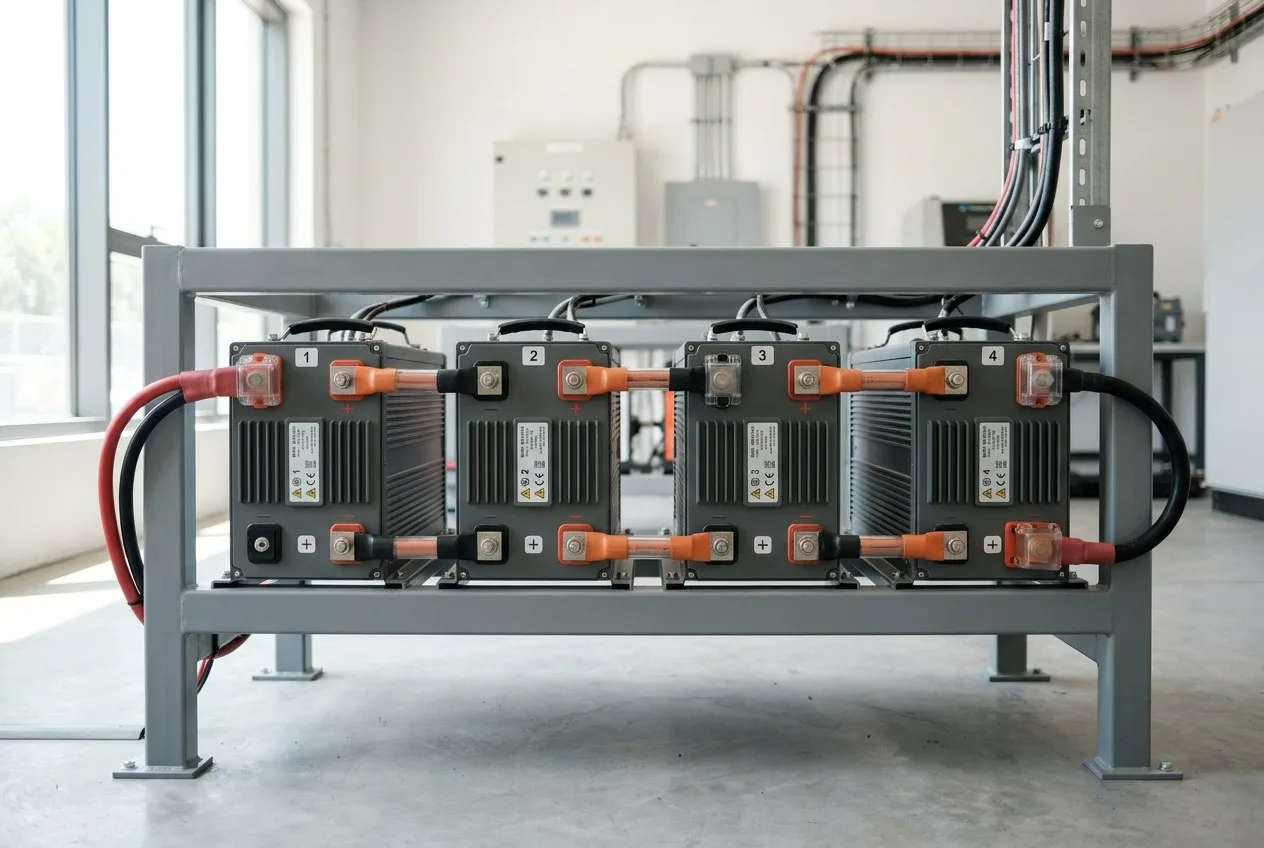
Pros and cons of 12 V, 24 V and 48 V systems
12V: small, DC-weighted and mobile systems
The biggest advantage of 12 V is its simplicity. In caravans, boats and small warehouse systems, many loads such as lamps, pumps, refrigerators and USB chargers operate directly at 12 V DC; no additional converter is required. Alternator charging in vehicles is also done over 12 V (24 V in some vehicles). The disadvantage is that the current increases rapidly as the power increases; even a 1,000 W inverter draws about 83 A and above from the battery. The general tendency is to accept around 1,000–1,500 W as the limit for 12 V.
24 V: middle ground
24 V halves the current compared to 12 V; it is easily created by connecting two 12 V batteries in series and is a reasonable balance for medium-sized cabin, workshop, large caravan and small vineyard house systems. Some practitioners consider 24 V to be the "in-between" option; because if there is a possibility of future growth, it may make more sense to go straight to 48 V. In addition, a DC-DC converter is required to supply 12 V DC devices.
48V: household and grow-out systems
48 V draws a quarter of the current of 12 V at the same power; thinner cable means less heating, less voltage drop and fewer charge controllers. Most of the home hybrid inverters and rack-mounted lithium battery modules are in the 48 V class; therefore, the product choice is wide and the system is suitable for future expansion. Cons: the fully charged group increases to about 56–58 V, so DC fuses and switches must be of a DC-compatible type that can safely interrupt the current at this voltage; 12 V and 24 V DC devices require a converter; in small systems, the initial cost may be unnecessarily high.
What voltage for what size system?
There is no strict boundary unity between sources; because the decision depends on equipment and cable distance. However, typical thresholds are similar: going from 12 V at continuous powers above about 1–1.5 kW, and looking at 48 V at around 3 kW is the common approach. The table below collects these thresholds as a starting point; the data sheet and project calculation always take precedence.
| Scenario | Typical inverter power | Daily energy (roughly) | Recommendation |
|---|---|---|---|
| Caravan, boat, small cabin | Up to 1,000 W | Around 1 kWh/day and below | 12 V (if loads are DC-weighted) |
| Large caravan, workshop, small vineyard house | 1,000–3,000 W | 1–3 kWh/day | 24 V |
| Cottage, villa, house backup | 3,000 W and above | 3 kWh/day and above | 48 V |
| Enterprise / farm / telecom field | 5 kVA and above | High | 48 V (or high-voltage storage; according to product data sheet) |
| System to be expanded in the future | Variable | Variable | 48 V from the beginning |
A small warning: Daily energy consumption is not the same as instantaneous peak power. Motor loads such as washing machines, water pumps or air conditioners initially draw several times their nominal value. Therefore, when choosing voltage, look not only at the daily kWh, but also at the total peak power of the loads that can operate at the same time. Detailed calculation for loads such as refrigerators, combi boilers and air conditioners Solar Refrigerator, Combi Boiler and Air Conditioner You can find it in the article.
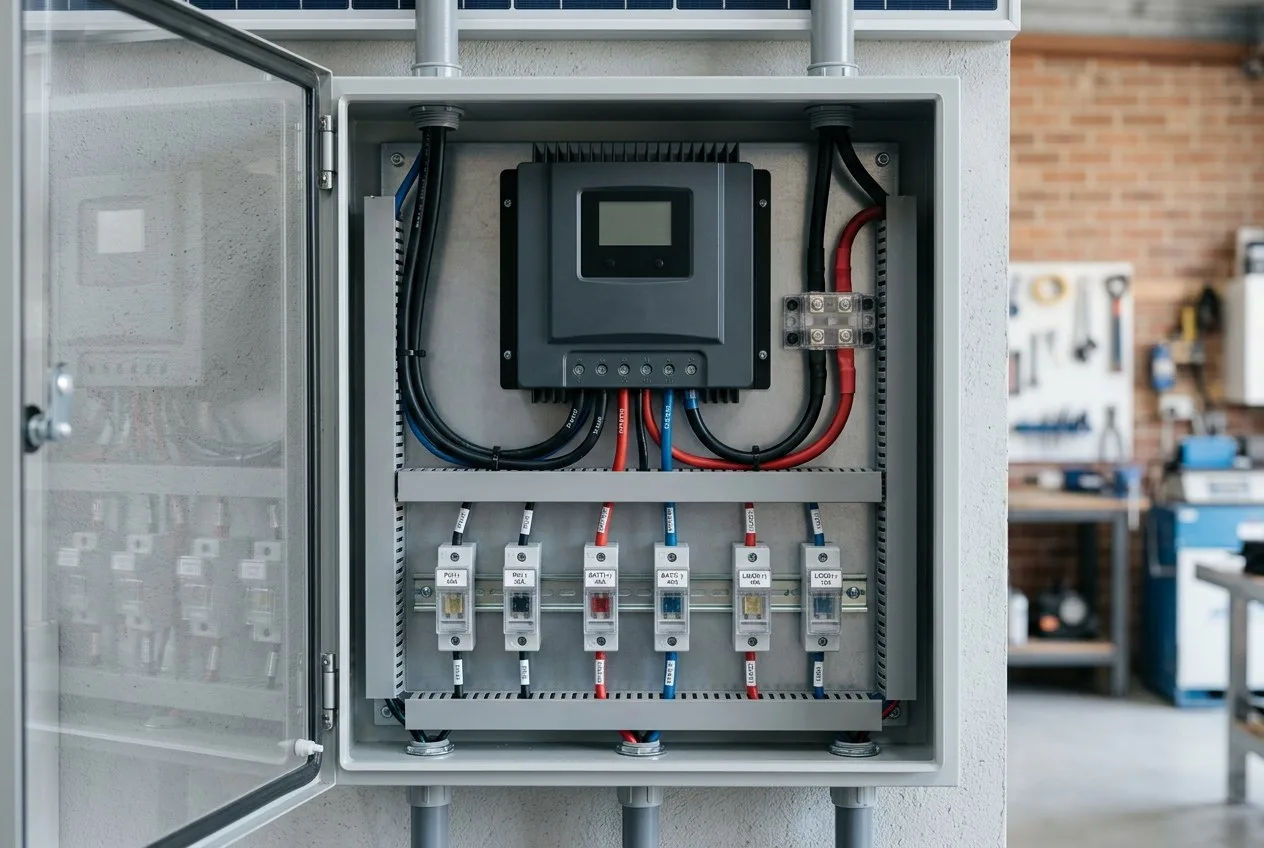
To achieve the desired voltage by connecting battery groups in series and parallel
In a series connection, the voltages are summed up, the capacitance (Ah) remains the same; in a parallel connection, the capacitances are summed up, the voltage remains the same. Examples:
- 24 V, 200 Ah (lead-acid): connecting two 12 V 200 Ah batteries in series. Energy ≈ 24 × 200 = 4,800 Wh nominal.
- 48 V, 100 Ah (LiFePO4): connecting four 12.8 V 100 Ah modules in series. Rated voltage ≈ 51.2 V, energy ≈ 51.2 × 100 = 5,120 Wh.
- 48 V, 200 Ah: parallel connection of two above 48 V 100 Ah strings; energy ≈ 10 kWh.
Increasing the voltage to receive high energy is often healthier than increasing the number of parallel arms; because a large number of parallel arms can lead to current imbalance and monitoring becomes difficult. Batteries connected in series must be of close age, the same capacity and the same production group; otherwise, the voltages will be distributed unevenly. The basis of the array Battery Array and Series-to-Parallel Connection In our article, the balancing and current balance specific to solar energy Battery Bank Installation You can find it in the guide.
When calculating capacity, the sequence is as follows: determine the daily consumption in Wh, divide by the permissible depth of discharge and efficiency, then divide the result by the system voltage of your choice to find the Ah value. For example, for 6,000 Wh of usable energy, 125 Ah at 48 V and 250 Ah at 24 V are required; step-by-step method Battery capacity calculation You can find it in the article.
How does battery chemistry affect voltage selection?
The battery type does not change the choice of nominal voltage, but it does affect the charging settings and practical options. For 12 V lead-acid monobloc batteries, the charging voltage is roughly around 14.2–14.4 V depending on the temperature; The IEA PVPS battery guidelines specify not to exceed approximately 2.39 V per cell at 25 °C (roughly 14.3 V for a 12 V battery), lowering this limit as the temperature rises. These values are multiplied by voltage: approximately 2 times in a 24 V system, approximately 4 times in a 48 V system. In the case of a lithium battery, the charging voltage depends on the cell chemistry and the setting of the BMS (battery management system); In the 48 V LiFePO4 group, the exact charge point is usually set at around 55-56 V, the exact value is determined by the manufacturer.
Therefore, it is necessary to adjust the battery type and charging profile according to the voltage you choose; if the charge controller or inverter charging unit is set to the wrong voltage profile, the battery will be damaged. For details of charging stages bulk, absorption and float settings see the To choose between battery types gel, AGM, OPzV and lithium comparison, cell protection and balancing in lithium groups BMS inscription You can read it.
Another practical point: Most off-the-shelf lithium modules on the market are sold in 12.8 V, 25.6 V and 51.2 V classes. Rack-mounted 51.2 V modules offer easy expansion in 48 V systems; connecting 12 V modules in series, on the other hand, should only be done if the manufacturer explicitly supports it and the BMS complies with it.
Safety: fuse, switch and arc risk
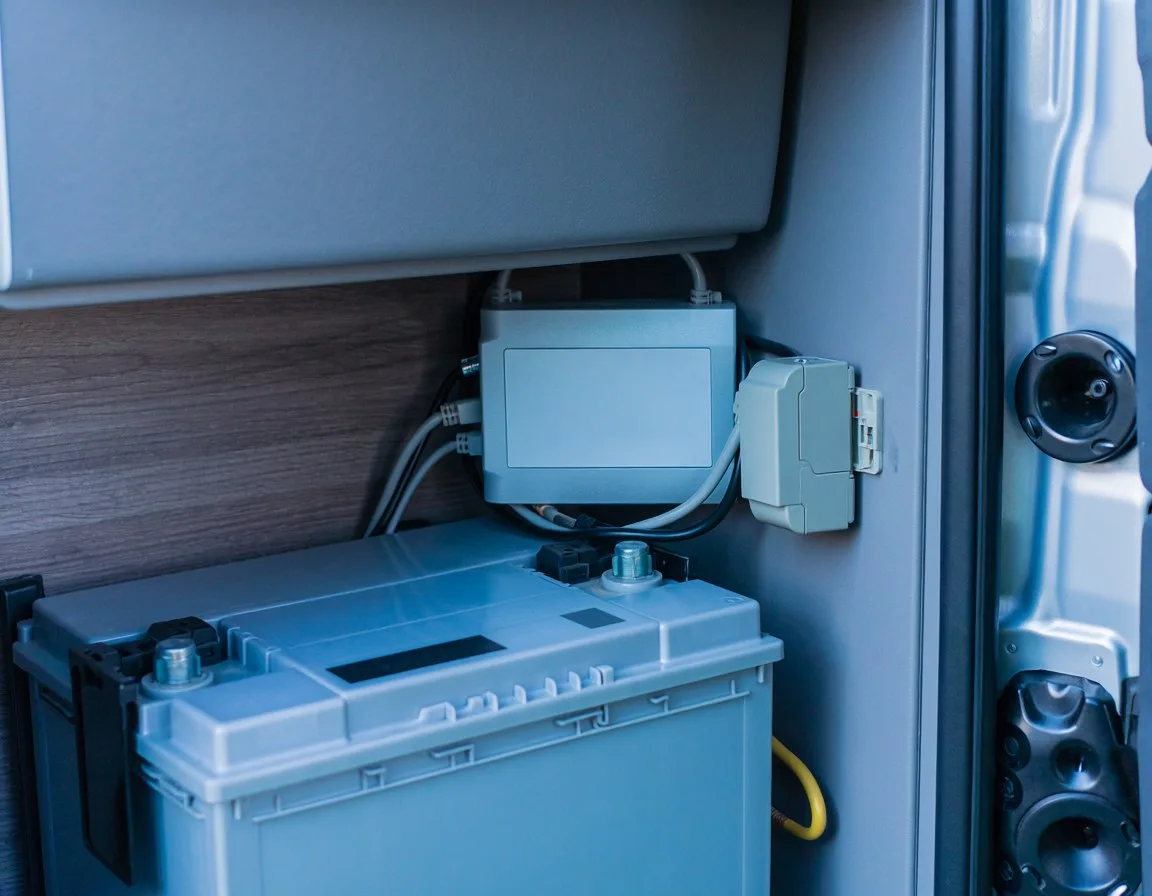
Regardless of the voltage, the battery short-circuit current is very high; therefore, the DC circuit must be protected by a fuse that is as close to the battery positive as possible. The fuse and switch must be suitable for DC, capable of interrupting the current at this voltage, and have sufficient short-circuit breaking capacity; the use of AC switches in DC poses a risk of fire. Note that in a 48 V system, the fully charged group increases to around 56–58 V. In addition, if even a single battery is short-circuited in a series-connected group, the entire group will energize; exposed terminals, loose connections, and improper tools pose a risk of arcing and serious injury.
Fuse, switch and surge arrester selection DC protection We discussed it in detail in the article. For the use of insulated tools, gloves and goggles in battery work, the requirement of authorized personnel and the limits of the "do-it-yourself" approach Occupational safety in UPS and battery work Check out the article as well.
Common mistakes and checklist
| Error | Conclusion | What to do? |
|---|---|---|
| Choosing 12 V for household loads | Hundreds of amps, extremely thick cable, high loss | Calculate peak power; Around 3 kW and above, switch to 24 V/48 V |
| Selecting the inverter voltage later | The battery pack and the inverter remain incompatible | First, determine the inverter DC input voltage, install the batteries accordingly |
| Connecting batteries of different ages/capacities in series | Unbalanced voltage, premature failure | Use batteries of the same brand, model, capacity and age |
| Using the AC switch or fuse in DC | Arc, fire risk | Choose parts that are DC compatible, voltage and breaking capacity |
| Making the small system 48 V from the beginning and forgetting the DC loads | Need for additional converters and loss | Extract the DC load list; plan the DC-DC converter if necessary |
| Not planning for growth | Refurbishment of the entire system to change voltage afterwards | If power will increase in the future, start with 48 V from the beginning |
| Not adjusting the charging profile according to voltage | Overcharging or undercharging | Scale the battery manufacturer's values to the system voltage |
It's a good idea to answer this checklist in order before making a decision:
- How many watts is the total peak power of the loads that can run simultaneously?
- Are there motor loads (pump, compressor) with high starting current?
- What are the cable distances between the panel and the battery, the battery and the inverter?
- Is the rate of DC operating devices high (caravan, boat)?
- Will the system be expanded in the future?
- Which battery voltages do the selected inverter and charge controller support?
- Is the battery type and BMS approved by the manufacturer for this voltage?
Application examples: three different systems
Example 1: Caravan (12V)
Assumption: 600 W inverter, daily consumption of about 1 kWh, 12.8 V LiFePO4 battery. At 600 W, the DC current is about 600 ÷ 0.9 ÷ 12 ≈ 56 A. This level can be managed with reasonable wiring and fuse; it is a natural fit with the vehicle alternator and 12 V DC devices. For more information Solar panel and battery system for caravan and boat See the article.
Example 2: Vineyard house (24 V or 48 V)
Assumption: 2,000 W inverter (peak 3,000 W), 3–4 kWh per day. At 24 V, the current at full load is approximately 2,000 ÷ 0.9 ÷ 24 ≈ 93 A, at 48 V ≈ 46 A. Both are feasible; however, the possibility of enlargement and the variety of products highlight 48 V. For the installation process Vineyard House and Hobby Garden The article is useful.
Example 3: Off-grid home or small business (48V)
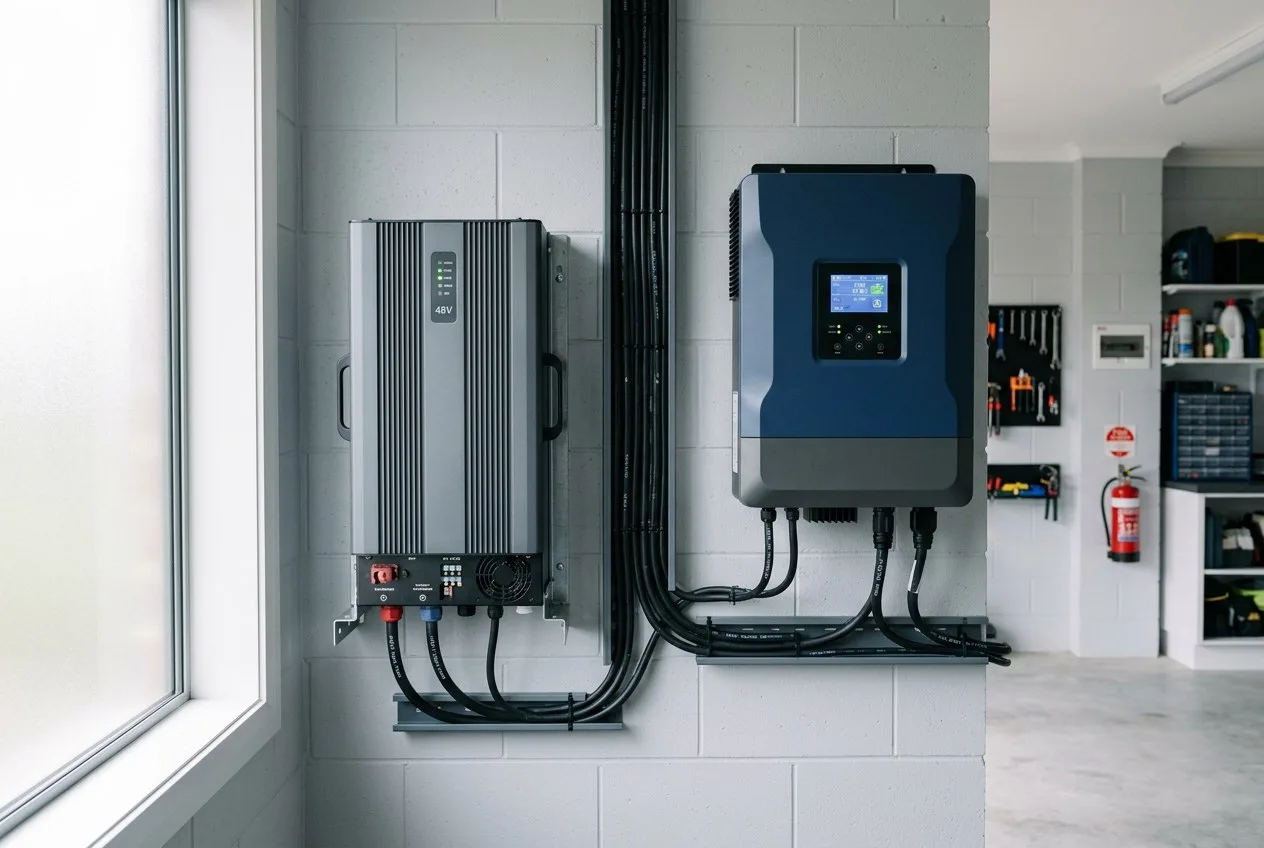
Assumption: 5,000 W inverter, 10 kWh per day. At 48 V, the current at full load is about 5,000 ÷ 0.9 ÷ 48 ≈ 116 A; at 24 V≈ would be 231 A. For 10 kWh of storage, a nominal 208 Ah is required at 48 V, 417 Ah at 24 V. At this size, 48 V is practically standard. You can handle all the steps of an un-grid system In the off-grid installation guide You can find it.
Is it possible to change voltage later?
It is technically possible, but usually not a "minor adjustment", but a re-installation of the system. When switching from 12 V to 24 V or from 24 V to 48 V, the inverter, charge controller, DC protection elements, cables and often the battery arrangement change. It may be possible to reuse existing batteries in series if the batteries are of the same age and capacity; batteries of different ages should not be mixed. Therefore, if there is a possibility of growth, it is often more economical to choose an upper voltage level from the beginning. For inspection and renewal works, the authorized service should make an evaluation with field measurements.
In grid-connected hybrid systems, the picture is slightly different; hybrid inverters mostly operate within the manufacturer's defined battery voltage range, and the choice of battery depends on the manufacturer's compatible product list. If you are deciding between system types Differences between on-grid, off-grid and hybrid systems Check it out.
Decision flow: step by step
- List loads: Write down the power, operating time, and starting current of motor loads for each device.
- Find peak power: Add 20-25% to the total of the loads that can run simultaneously and determine the inverter power.
- Calculate DC current: Subtract the current for each voltage with the formula for inverter power ÷ efficiency ÷ candidate voltage.
- Check the cable: If the voltage drop exceeds approximately 1–2% at the planned distance, increase the voltage or increase the cross-section (target value varies depending on your project standard).
- Verify equipment fit: Compare the voltages supported by the inverter, charge controller, and battery manufacturer.
- Identify the security elements: Plan the DC fuse, switch, surge arrester and grounding according to this voltage.
- Consult authorized personnel: Carry out the project and commissioning work with authorized electrical personnel.
If you need help with UPS, battery and inverter, Bempower team; It provides on-site service in Istanbul and surrounding provinces for the discovery, installation, periodic maintenance and technical service of your existing battery groups. To talk about the status of your battery group or your UPS and inverter needs from the contact page You can contact us. Solar panel installation or project and application procedures are not within the service area of Bempower.
- Batteries and Charge Control in Stand-Alone Photovoltaic Systems — Florida Solar Energy Center (FSEC), 2001. https://www.fsec.ucf.edu/en/publications/pdf/FSEC-CR-1292-01.pdf
- Battery Guide for Small Stand Alone PV Systems, IEA PVPS Task III — IEA Photovoltaic Power Systems Programme, 1999. https://iea-pvps.org/wp-content/uploads/2020/01/rep3_06.pdf
- How to choose a system voltage (12, 24 or 48V)? — Victron Energy Community, 2019. https://communityarchive.victronenergy.com/questions/4051/battery-system-voltage.html
- Battery Bank Voltage Recommendation (12V vs 24V) — Victron Energy Community, 2022. https://community.victronenergy.com/questions/129241/battery-bank-voltage-recommendation-12v-vs-24v.html
- 48V vs 24V Battery Bank: How to Choose the Right System Voltage — Alchemy Industrial, 2026. https://shop.alchemyindustrial.com/blogs/news/48v-vs-24v-battery-bank-how-to-choose-the-right-system-voltage
Resources
