


Central Battery System vs. Emergency Lighting: How Do They Differ from UPS?

When the power goes out in a building, the first need is for people to be able to get out safely and without panicking. The emergency lighting that enables this is often connected to a battery pack that is out of sight. Many people who see the battery pack say "this is a UPS too". There is a similarity in terms of electrical topology: charging unit, battery and inverter. However, the two systems are not the same in terms of purpose, standard, design margins and behavior at the time of failure.
This guide; It explains what a central battery system (CPS, central power supply for safety purposes) is, the regulations and standard requirements for emergency lighting duration, where it differs from the UPS and how to make the right choice. A sample capacity calculation, test and maintenance table, and common mistakes are also included.
Article; It was prepared for building managers, business owners, technical officers, electrical project engineers and purchasing units. Since it is a fire and life safety issue, what is given here is a framework that will help you decide; project, installation and approval processes should be carried out with authorized engineers and institutions.
What is emergency lighting and why does it require a separate system?
Emergency lighting is illumination provided by the fixture's own power or by feeding from a second energy source when normal lighting circuits are interrupted. The definition of the regulation is as follows: lighting given by the luminaire's own power or by feeding from a second source when ordinary lighting is interrupted. The goal is not business continuity, but human safety: to make escape routes visible, to keep exit signs legible and to prevent panic.
Emergency lighting consists of several functions:
- Escape route lighting: It provides minimum illumination at ground level in corridors, stairs and exit routes.
- Outdoor (anti-panic) lighting: It makes it easier to navigate in large halls, open offices and meeting areas.
- Directional fixtures: They are exit signs with white pictograms on a green background.
- High-risk work area lighting: It is the lighting required to safely stop a dangerous process.
To understand why the system is considered separate, it is necessary to see the requirements. The requirements are different from the requirements of a computer or server load.
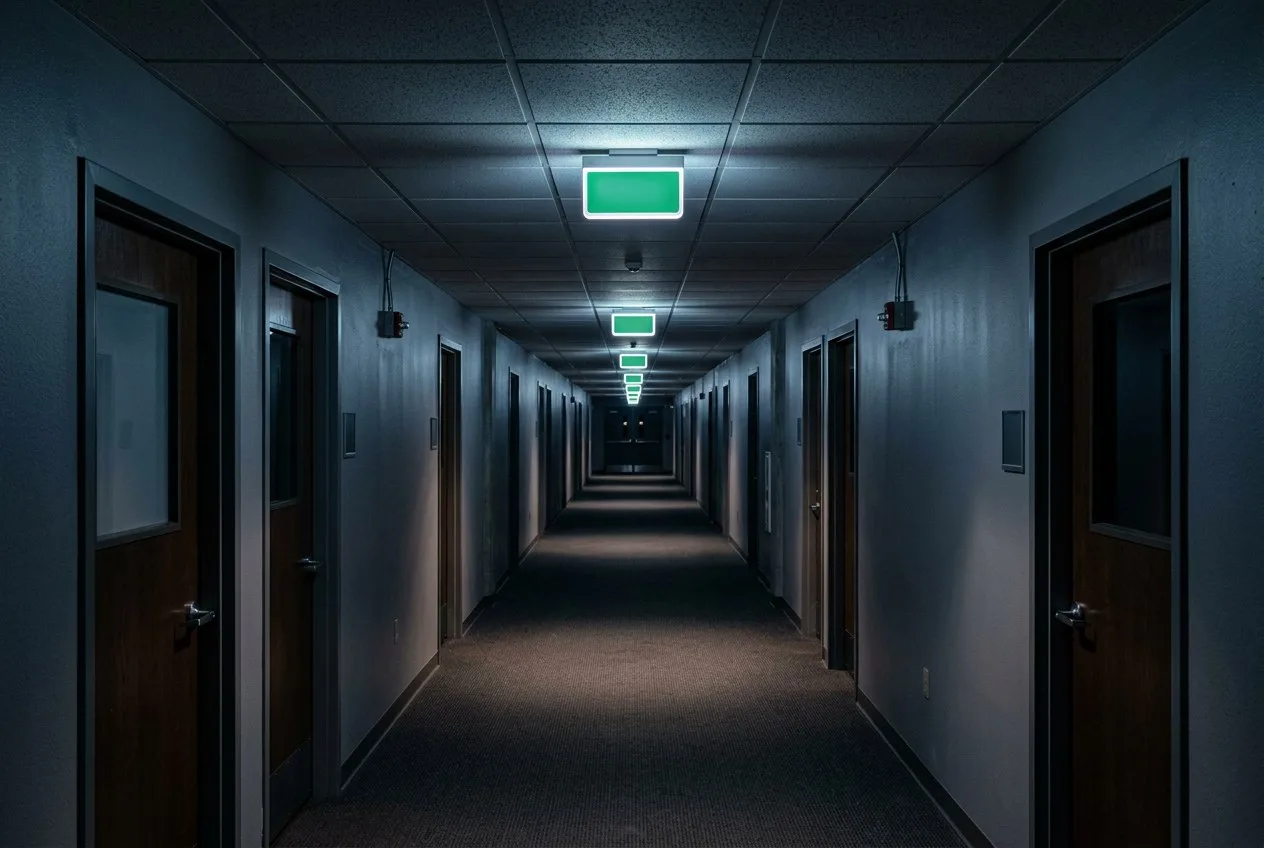
Key requirements for emergency lighting in Turkey
The main framework in Turkey is the Regulation on the Protection of Buildings from Fire. To the text Legislation Information System accessible via; here we only summarize the technical implications. Check the text in force and the corresponding guidance during the project phase, as the regulation can be updated.
| Subject | Approach in the regulation | Practical meaning |
|---|---|---|
| Operating time | Emergency lighting and guidance should be provided for at least 60 minutes when normal lighting is interrupted. For structures with a user load of more than 200, the routing time is at least 120 minutes. | The battery capacity is selected according to its aged condition at the end of this period. |
| Escape route light level | Placement is made on the escape route centerline with an emergency lighting level of at least 1 lux. | The number and placement of luminaires are verified by photometric calculation. |
| Expiry level and smoothness | At any point during the operating period, the level should not fall below 0.5 lux; the highest/lowest ratio should not exceed 1/40. | The battery must also be able to provide sufficient voltage at the end of the period. |
| Diet | Independent luminaires with their own accumulator, charging circuit, mains voltage controller and lamp driver circuit are one of the solutions listed in the regulation. | The central source is another architecture that can be selected instead of the in-armature battery. |
| Accountability and testing | The building owner, manager or building official to whom he/she has delegated written authority is responsible for the periodic control and testing of the system according to the relevant standards. | Testing and maintenance records should be kept. |
The EN 1838 standard used in Europe gives a similar framework. At least 1 hour of time for escape route lighting, and 50% of the required illumination is reached within 5 seconds, and all of it within 60 seconds is typical expectation. EN 1838:2024 release Replaces the 2013 version ; For details, the current text of the standard should be consulted.
What is a central battery system (CPS) and how does it work?
The central battery system is the security source that feeds the building's emergency lighting circuits from the battery bank at a single point. It is referred to as the "central safety power supply system" (CPS) in the standards. EN 50171 specifies the general requirements for central systems that provide independent energy to safety-required equipment. The standard covers systems that are permanently connected to an AC supply voltage not exceeding 1000 V and use batteries as a backup source.
Key Ingredients
- Charging unit (rectifier): It keeps the battery charged and refills it for a certain period of time after discharge.
- Battery group: sequence formed by series-connected cell or monoblocks. Closed-type lead-acid (VRLA) is common; for details VRLA, AGM and Gel battery differences You can check our article.
- Inverter or DC output: It converts the battery voltage into AC or DC voltage to be used by the luminaires.
- Switching (transfer) circuit and monitoring: automatically switches when the mains is gone, signals faults; many products have an automatic test function.
There are two common structures according to the type of output. Some systems are AC input, DC output and supply low voltage (e.g. 24, 48 or 110 V DC) fixtures. Others are static inverter systems with AC input and AC output. The CIBSE Journal summarizes this distinction as follows: GIS is mostly AC input/DC output, while static inverter is a single or three-phase AC input/AC output structure. For UPS's own internal logic How UPS works You can look at the article.
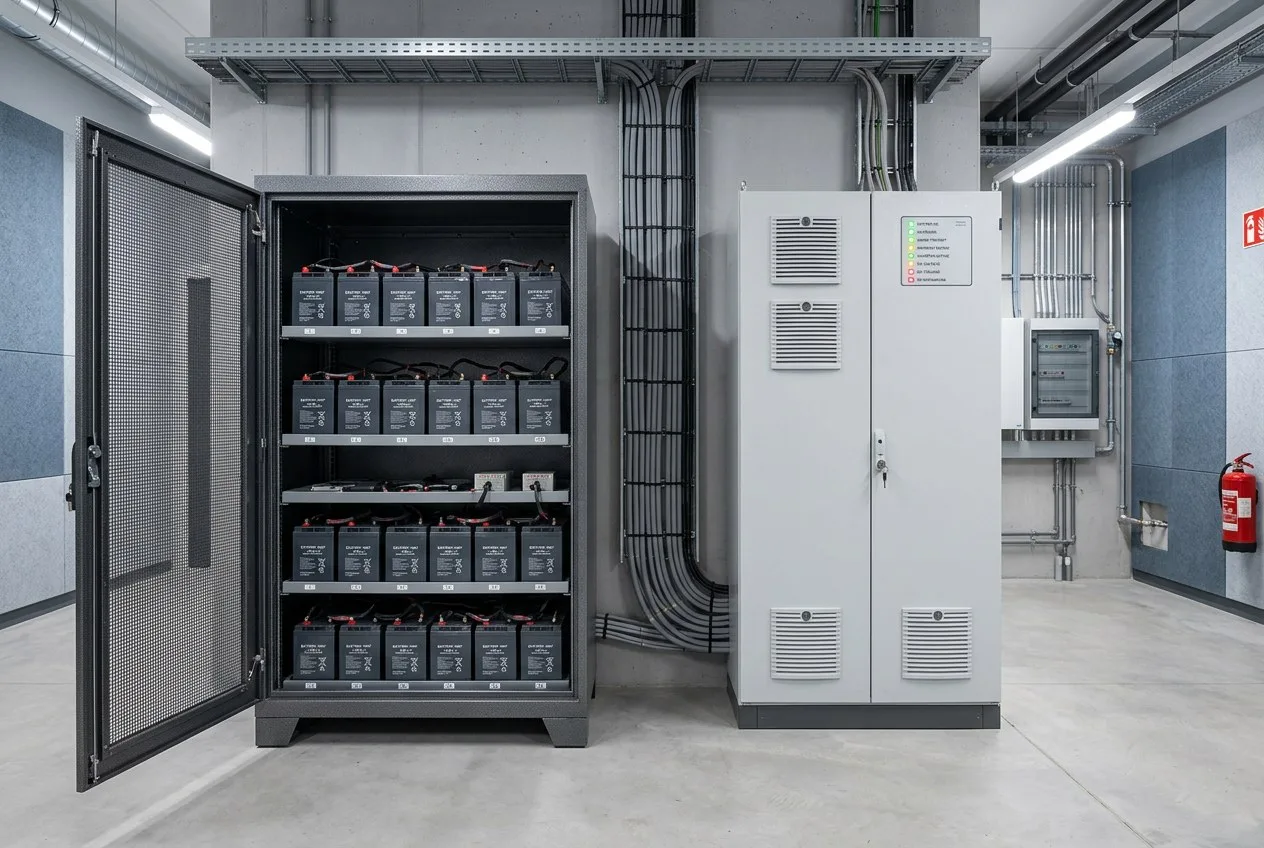
Differences between a central battery system and a UPS
Both are battery-assisted power systems; however, a UPS is mostly designed to protect computing and sensitive loads. According to the CIBSE Journal, the UPS is meant to protect critical electrical equipment, especially IT loads; while the static inverter is designed to keep emergency lighting lit for a specified period. The table below collects typical differences; exact values must be taken from the manufacturer's data sheet.
| Feature | Central battery system (CPS) | Standard UPS |
|---|---|---|
| Primary purpose | Life safety: escape route, orientation, safety equipment | Business continuity: server, network, office device, process |
| Main standard | EN 50171 (central power systems for safety purposes) | EN/IEC 62040 series (UPS product standard) |
| Battery design life expectancy | EN 50171 stipulates a battery life of 10 years in normal operation; factors such as temperature and cycling can shorten this. | Typical battery design life for commercial UPSs is usually around 5 years; field life is usually shorter. |
| Overload allowance | According to Eaton, EN 50171 stipulates that the system can carry 120% load; battery sizing stipulates an additional 25% capacity for aging. | Varies by model and class; a continuous 120% load is generally not expected. |
| Behavior on output failure | Even if there is a short circuit in the load line when there is no mains, it is aimed to clean the faulty arm and continue to feed other circuits. For this, fault current is provided that can open the output protection elements. | In battery mode, if there is a short circuit in the lower current, the UPS may shut down, mostly to protect itself. |
| Battery end voltage | The manufacturer's documentation states that the battery voltage should not fall below 90% of the rated voltage at the end of the discharge. | The end-of-discharge threshold varies by product; capacity is determined by the time/load curve. |
| Load type | Safety loads such as lighting, guidance, fire/smoke, announcement | Computer, server, switch, case, some automation loads |
A CPS should not be loaded with general-purpose computing or industrial load. Under EN 50171, it is expected that the central source is reserved only for safety equipment, and that general-purpose loads such as IT or industrial loads are not connected. Otherwise, capacity and failure protection are unpredictable due to load mixing.
The argument that "it can actually happen with UPS"
There is a correct side: EN 50171 does not exclude the use of UPS. According to CIBSE Journal, a UPS supplying safety systems must comply with EN 62040-1, as well as additional requirements of EN 50171. In other words, a UPS can act as a CPS when it is designed and documented correctly. But this does not mean "let's connect the UPS in the computer room to the emergency lighting". ABB emphasizes that some solutions sold with the claim of "EN 50171 compliant" are actually adapted or scale-up generic products, so careful inspection is required. For the scope of UPS standards UPS standards and certifications can be looked at.
In-armature batteries or central batteries?
The regulation allows each fixture to run on its own battery. The central system, on the other hand, concentrates the batteries in one place. The strengths and weaknesses of the two approaches are different.
| By | Stand-alone (battery-powered) luminaire | Central battery system |
|---|---|---|
| Initial setup | Simple; no additional main wiring line required | Separate cable route, panel and battery space required; fire-resistant wiring may be required |
| Testing and maintenance | Each fixture is individually controlled; ceiling access can be cumbersome | Battery and inverter at a single point; testing and monitoring are centralized |
| Battery environment | Dependent on the fixture's surrounding temperature; warm aisle or attic shortens life | Can be kept in controlled room; temperature management is easier |
| Risk of failure at a single point | Low: failure of one luminaire only affects it | High: the impact of centralized resource failure is wide; redundancy and monitoring become important |
| Appropriate scale | Small-medium buildings, few luminaires | Large buildings, multi-storey buildings, hotels, hospitals, shopping malls, facilities |
The risk of dependency on a single point in the central source is managed by accurate monitoring of the source, regular testing and segmentation where necessary. In places such as hospitals, additional resources and generator switching also come into play; for details UPS and battery systems in hospitals You can look at the article.
How to calculate central battery system capacity? Sample calculation
The purpose of the capacity calculation is to meet the period specified in the regulation in the aged state of the battery. The example below only shows the method; the actual project should be made with the manufacturer's curves and authorized engineer calculation.
Assumptions
- Building: An office floor group with 150 users; target time 60 minutes. For businesses that want to design the duration as 3 hours, the hour multiplier changes in the last step.
- Load: 60pcs 8W LED emergency fixture and 12pcs 3W directional fixture.
- Inverter efficiency: 90% (assumption).
- Battery aging allowance: 25% additional capacity.
- Usable capacity ratio: 80% (assumption) due to the battery's end voltage limit and temperature.
- Battery bank voltage: 48 V DC (assumption).
Step-by-step calculation
- Total load: 60 × 8 W = 480 W; 12 × 3 W = 36 W; total 516 W.
- Power on the battery side: 516 W ÷ 0.90 ≈ 573 W.
- 60 minutes of energy: 573 W × 1 h ≈ 573 Wh.
- Aging: 573 × 1.25 ≈ 716 Wh.
- Available rate: 716 ÷ 0.80 ≈ 895 Wh.
- Capacity at 48 V: 895 Wh ÷ 48 V ≈ 18.6 Ah.
The result is about 19 Ah. However, this value should be interpreted according to how fast the battery discharges. Manufacturers give the battery capacity at different discharge times and the capacity decreases at high current. Therefore, the manufacturer curve checks for 1 hour of discharge current and end voltage; What is battery capacity (Ah) describes this reading. If 120 minutes were targeted, the energy would double in the same calculation (about 37 Ah); it triples in a 3-hour design.
The inverter power is not only determined by 516 W: the current at the first start-up of the luminaires, the power factor and the fault current required to open the output protective elements are taken into account. For this reason, in most projects, a system power above the load is chosen; for the power factor and the VA-W relationship How to calculate UPS power You can look at the article.
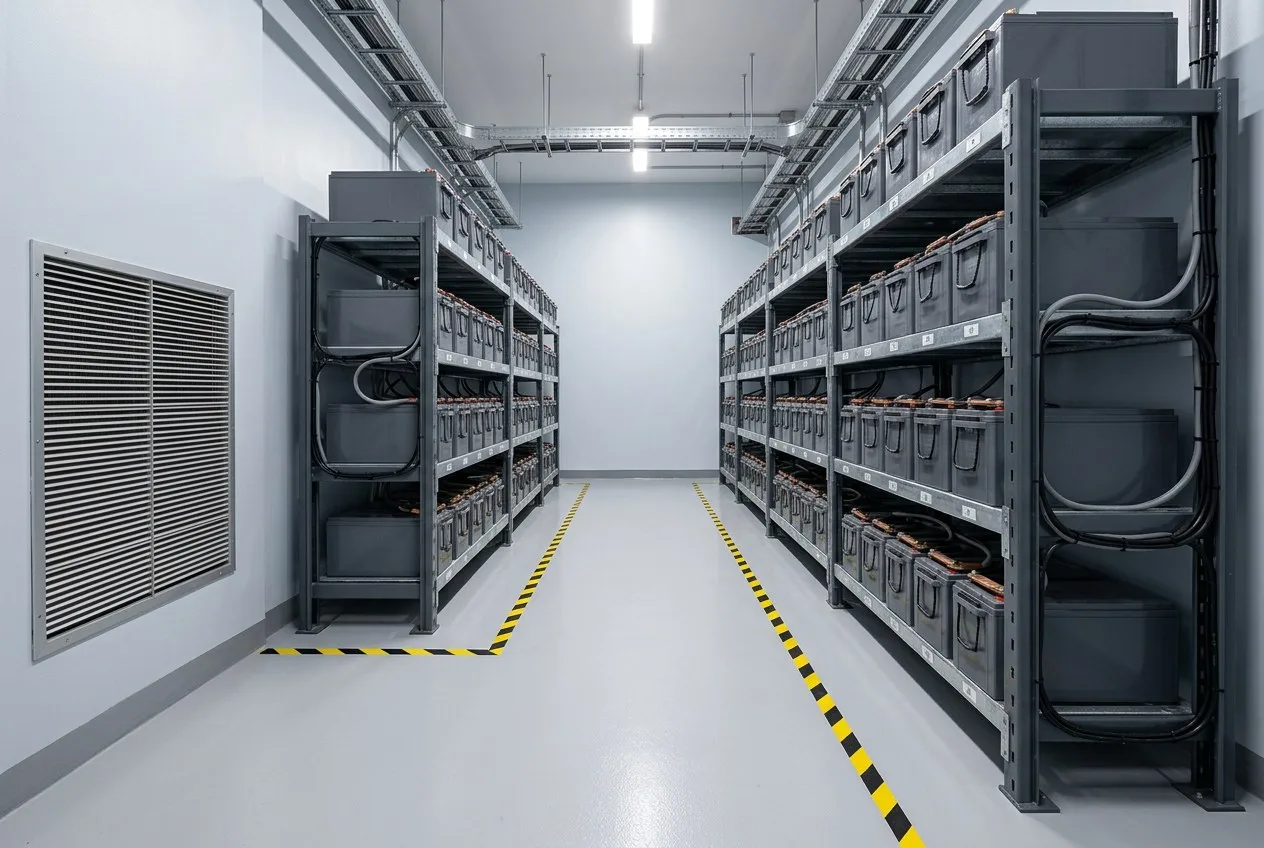
Which system to choose in which case?
| Status | Recommended approach | Point to note |
|---|---|---|
| Escape route and orientation lighting | Cordless fitting or central system in accordance with EN 50171 | Duration, illuminance level, project approval |
| Server, network device, chassis | UPS | Load analysis, autonomy time, bypass |
| Building with both lighting and IT load | Two separate systems: CPS for security loads, UPS for IT | Do not mix loads; separate line and fuse arrangement |
| Fire alarm panel, smoke extraction | Own battery source and, if necessary, central source for safety purposes | The relevant product standard and project requirement (fire alarm systems and UPS) |
| Building with generator | Battery bridging until generator starts; separate priority for safety loads | Transition time and synchronization issues (generator powered UPS) |
Connecting loads that draw inrush currents such as motors, air conditioners or laser printers to the UPS is another issue; similarly, these loads should not be connected to the safety line. About this Inrush problem The article helps.
Battery life, environment and battery room
In the central system, the problem is often not with the electronics, but with the batteries. The temperature, number of cycles and charge voltage setting determine the life. For general information Factors Affecting Battery Life You can look at the article. Common reasons that shorten life are:
- The battery room is hot or the cabinet is located in a sunny, stuffy place.
- Failure to adjust the charging voltage according to the temperature or malfunction of the charging unit.
- No testing for years; loose connections, corrosion, drying or swelling batteries go unnoticed.
- Replacing batteries not one by one, but by mixing them at different ages.
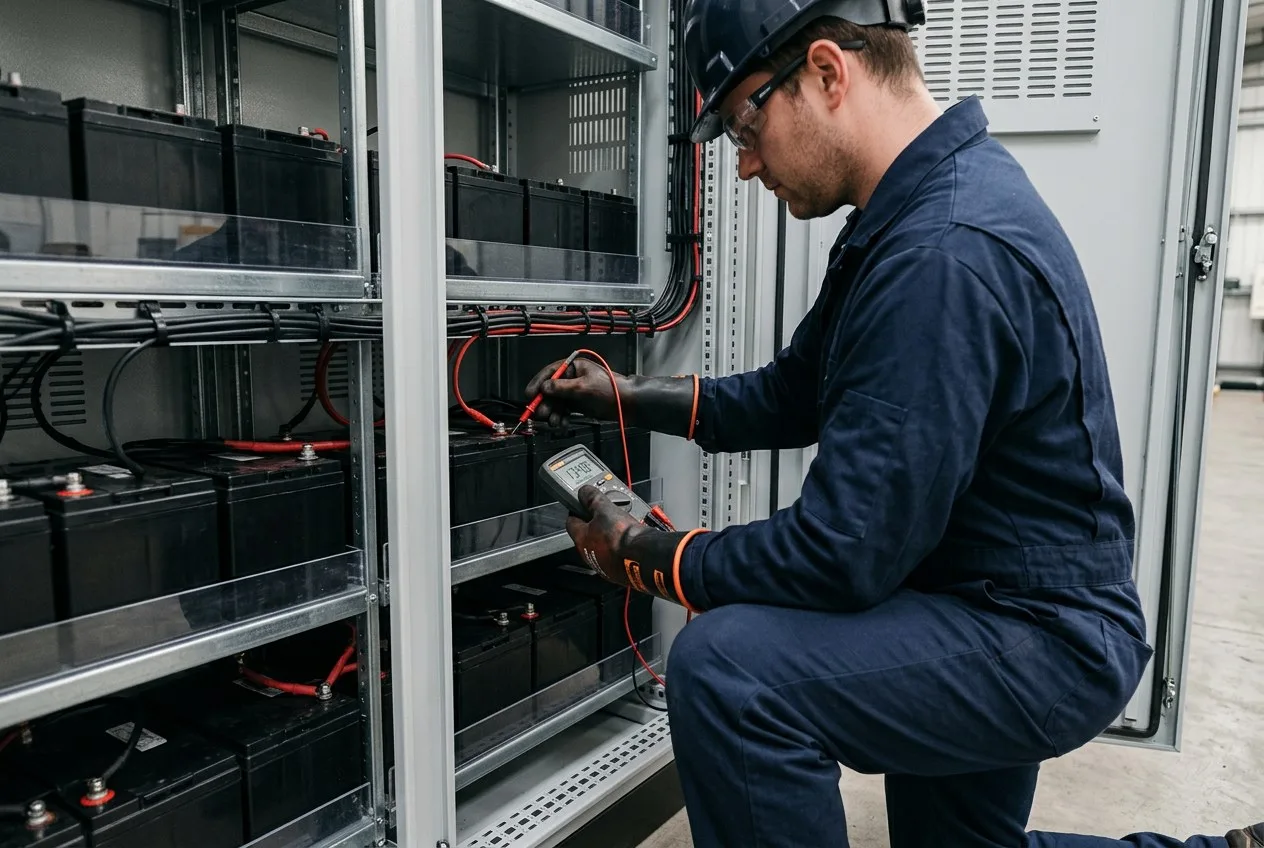
Battery room due to the risk of battery gas, high DC voltage, arc and short circuit; It should be carefully arranged in terms of ventilation, access and marking. For details Battery Room Ventilation and Safety can be a source. Measurement, replacement and connection works in battery groups are high-energy circuits; it should be done by authorized electrical personnel.
Testing, maintenance and registration: Will the system actually work?
The biggest risk of emergency lighting is that it is not noticed to be defective until the moment of need. The regulation leaves the responsibility to the building owner and manager; the system is subject to periodic inspection and testing. The common order in the standard and product manuals is as follows (see project specification and manufacturer's instruction for the exact period):
| Control | Typical frequency | What to do? |
|---|---|---|
| Checking the indicators | Weekly-monthly visual inspection | Charging unit, fault and network indicators; alarm recording |
| Short function test | Monthly | The network is cut off, the lighting of the fixtures and the operation of the transfer are monitored |
| Full-time discharge test | Yearly | The system is operated at load for the target time (60/120 min or project duration); the end voltage is recorded |
| Battery voltage and internal resistance measurement | According to the manufacturer/maintenance plan, usually at least once a year | Weak monoblocks are detected |
| Connectivity and media control | Yearly | Torque, corrosion, temperature, ventilation, thermal camera (Interpreting test results) |
During the discharge test, the building's emergency lighting may remain unprotected; therefore, it should be planned when and with what measure the test will be carried out. About this Planning a battery pack test and Battery discharge test Their writings guide the way. The results should be recorded together with the date, measured values and the intervention made.
Common mistakes
| Error | Conclusion | The right approach |
|---|---|---|
| Connecting emergency lighting to computer room UPS | In the event of a UPS failure or overload, both IT and security lighting are lost | Deploy security loads to a separate and appropriate resource |
| Choosing the battery capacity according to the new battery rating | As we get older, the time drops to less than 60 minutes | Account for ageing, temperature and finish stress allowances |
| Not recording tests | Uncertainty of responsibility in the audit and after the incident | Archiving test report and fault history |
| Settling for only the short test | Its exact durability is unknown | Schedule a full-term discharge test once a year |
| Using the battery room as a storage room | Ventilation and access problem, fire load | Dedicating room only for the battery and related equipment |
| Leaving the system uncommissioned at each battery change | Incorrect connection or setting is not noticeable | To perform commissioning testing after replacement (Commissioning tests) |
Questions to ask during the procurement and project phase
- Is the system designed according to EN 50171, does it have a certificate or test report?
- For what reason was the target time (60, 120 or 180 minutes) chosen; is there a share of aging and temperature in the calculation?
- When there is a short circuit in the output lines, can the system continue to supply other circuits, what fuse/switch size can it clean?
- Is there automatic testing, remote monitoring and fault notification? (For similar structure on the UPS side, see. UPS maintenance agreement.)
- Battery type, expected life and replacement cost; What is the battery room and ventilation requirement?
- If another load (IT, process) is planned to be connected to the same system, why wasn't a separate source considered?
In buildings with both computing and security loads, the lifespan and reliability of the UPS side should also be considered separately. For the UPS side Lifetime of UPS and Industrial UPS Their writing helps in decision-making.

The technical values in this article are typical ranges. Design, certification and official approval processes should be based on the current regulation text, project specification, current version of the standard and manufacturer's data sheet.
How to move forward on the UPS and battery side with Bempower
The electrical design of the emergency lighting project belongs to the authorized project engineer. Bempower assists with the discovery, installation, periodic maintenance and technical service of UPS, battery pack and inverter systems in your building. If you need battery testing, replacement or commissioning from the contact page You can contact us.
- Regulation on Fire Protection of Buildings (2007/12937) — Legislation Information System (mevzuat.gov.tr), 2007. https://www.mevzuat.gov.tr/MevzuatMetin/21.5.200712937.pdf
- Regulation on Fire Protection of Buildings (text of articles 4, 72, 73, 84) — Mimarım Legislation, 2026. https://www.mimarim.com/mevzuat/y%C3%B6netmelikler/binalar%C4%B1n-yang%C4%B1ndan-korunmas%C4%B1-hakk%C4%B1nda-y%C3%B6netmelik
- Guidelines for the Regulation on Fire Protection of Buildings (last updated May 2026) — Republic of Turkey Ministry of Environment, Urbanization and Climate Change, 2026. https://webdosya.csb.gov.tr/v2/meslekihizmetler/2026/05/Binalar-n-Yang-n-Korunmas-Hakk-nda-Y-netmelik-K-lavuzu-20260507112134.pdf
- EN 50171:2021 - Central safety power supply systems — CENELEC / SIST (iTeh Standards), 2021. https://standards.iteh.ai/catalog/standards/sist/4d751b2c-c2bb-4f21-ad41-b8ea8ea9a981/sist-en-50171-2022
- EN 1838:2024 - Lighting applications - Emergency lighting for buildings — CEN (iTeh Standards), 2024. https://standards.iteh.ai/catalog/standards/cen/b80da699-b1d6-4acd-b964-4a2be92745e8/en-1838-2024
- Emergency lighting - UPS or static inverter/CBS? — CIBSE Journal, 2025. https://www.cibsejournal.com/uncategorized/emergency-lighting-ups-or-static-inverter-cbs-the-tale-of-a-penitent-man/
Resources
