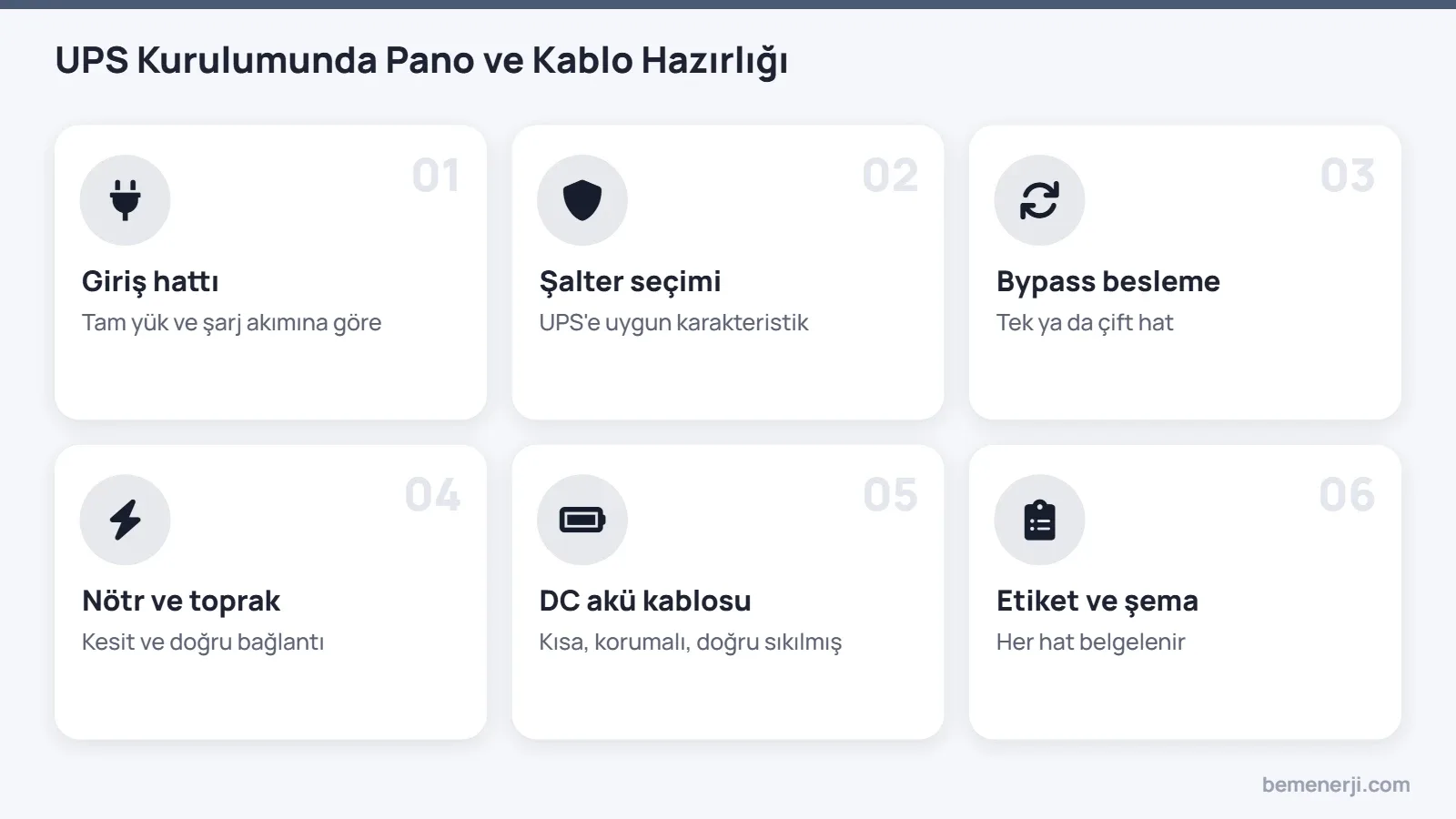
Cabling and Panel Preparation for UPS Installation

When installing a UPS, attention is usually focused on the unit’s power rating and brand. However, a significant portion of on-site issues stem not from the unit itself, but from the electrical wiring leading to and from it: insufficient cable cross-section, inappropriate circuit breakers, shared neutral, and poor grounding. In this article, we discuss the cabling and panel-related preparations that must be made before installation. For general preparations during the site survey phase, Technical Survey Prior to UPS Installation You can also check out our article.
Input Side: Switch and Cable
The UPS input circuit is sized based on the condition in which the unit draws the highest current. This condition refers to the full-load state, which includes not only the load current but also the battery charging current. The manufacturer’s installation manual specifies the input current and the recommended protective device; the cable cross-section is selected based on the current, cable length, installation method, and the allowable voltage drop. For long runs, it may be necessary to increase the cable cross-section; otherwise, the voltage at the UPS input will drop, causing the system to switch to battery mode unnecessarily.
The input circuit breaker must be selected with specifications suitable for the UPS. When the UPS is turned on, it may draw a brief, high initial current; a circuit breaker with the wrong specifications may trip unnecessarily due to this current. For details on protection and selectivity, Short circuits, overcurrent, and selectivity at the UPS output You can check out our article.
Bypass Feed: Single or Double?
In many UPS systems, the bypass line can be a separate power source from the main input line. A single power source (common input) is simpler. Dual power supply, on the other hand, allows the main and bypass lines to come from separate sources; if one fails, the other can continue to operate. Which one is used depends on the UPS’s design and the required level of continuity. What the bypass is used for What is a UPS bypass? This is explained in our article. Planning for a maintenance bypass switch to ensure uninterrupted power supply during maintenance also makes the service provider’s work safer.
Precautions in Neutral and Three-Phase Systems
In three-phase systems, the neutral conductor may carry more current than the sum of the phase currents due to nonlinear loads (such as computer power supplies). For this reason, the neutral conductor is selected with a cross-sectional area equal to or, if necessary, greater than that of the phase conductors. How the neutral is handled at the UPS’s input and output (shared or separate) depends on the device’s design and is specified in the installation manual. For the difference between three-phase and single-phase systems, The difference between three-phase and single-phase UPS systems You can check out our article; regarding the neutral effect of load quality What is power quality? That article is also helpful.
Grounding
Protective grounding is essential for both human safety and equipment operation. The UPS enclosure, as well as the input and output protective conductors, must be connected to the correct points, and the grounding resistance must be measured. Details UPS Grounding We explained this in our article. Poor grounding can manifest as ground fault currents, interference, and unexpected alarms.
DC Side: Battery Cables
The DC cables between the battery bank and the UPS can carry very high currents in the event of a short circuit. For this reason, the following points should be taken into account regarding these cables:
- The distance between the battery bank and the UPS is kept as short as possible.
- The DC line is protected by an appropriate DC protective device (fuse or DC circuit breaker) located near the battery bank.
- The wire gauge is selected based on the battery discharge current; an insufficient gauge causes both overheating and a voltage drop.
- The connection points are tightened to the correct torque value and inspected at regular intervals.
- Positive and negative lines are marked so that they do not overlap.
Series and parallel connection configurations for battery banks battery bank In this article, the conditions in the battery room Battery Room Ventilation and Safety This is explained in our article.
Labeling and Documentation
Once installation is complete, every circuit, switch, and panel should be labeled, and a single-line diagram should be prepared. In an emergency, determining which switch powers what should take seconds rather than minutes. This information is also valuable for future maintenance.
| Chapter | Points to Note |
|---|---|
| Input line | Full load + charging current, cable cross-section, voltage drop |
| Bypass feed | Single or double, maintenance bypass switch |
| Neutral | Nonlinear load, cross-section |
| Grounding | Correct points, resistance measurement |
| DC cable | Short distance, DC protection, torque |
| Documentation | Label and single-line diagram |
Electrical installation work must be performed by licensed and qualified electricians. To plan the installation with us, UPS Installation and Setup You can check out our page.
- IEC 60364 series (TS HD 60364 in Turkey) — Low-voltage electrical installations (as defined by the standard).
- Regulation on Electrical Installations (Turkish legislation, as titled).
- UPS manufacturer's installation guide — a reference for input current, protective devices, and neutral/ground connection types.
Sources
Most Problems Start with the Plumbing
Even a UPS with the correct power rating can cause problems if the cable cross-section is insufficient or the circuit breaker is unsuitable. Preparation begins with the electrical wiring before the device itself.

Input, bypass, neutral, ground, and DC cables are planned and documented with labels and schematics.
Frequently Asked Questions
01Is a separate panel required for the UPS?
02Can we choose the cable cross-section ourselves?
03Why might the bypass supply be separate?
04Why is the neutral conductor chosen to be large?
05Would extending the DC cable be a problem?
Let's Prepare the Setup Correctly
Before installing a new UPS, we can inspect your existing electrical system on-site and work with you to determine the necessary preparations. UPS Installation and Setup Check out our page, Contact Please contact us through this channel.