What is a Battery String? Series and Parallel Battery Connection (UPS Battery Groups)

While a small UPS contains just a few batteries, large systems have entire cabinets full of batteries arranged side by side. These batteries are not connected randomly; they are arranged in a specific configuration to provide the voltage and backup time required by the UPS. In this article, battery bank, we explain the difference between series and parallel connections and what to keep in mind when using these configurations.
Battery String and DC Bus Voltage
The UPS inverter operates at a specific direct current (DC) voltage; this is DC bus voltage ...is called. Since a single battery cannot provide this voltage, the batteries are connected end-to-end, that is, in series. This chain formed by the batteries connected in series battery bank It is called (string).
The number of batteries in the string varies depending on the UPS model and is specified in the manufacturer’s documentation. In some models, the string is split into two at the midpoint and connected to the UPS as two halves—positive and negative; in these systems, the midpoint connection is also made according to the schematic.
Series Connection: Voltage Adds Up
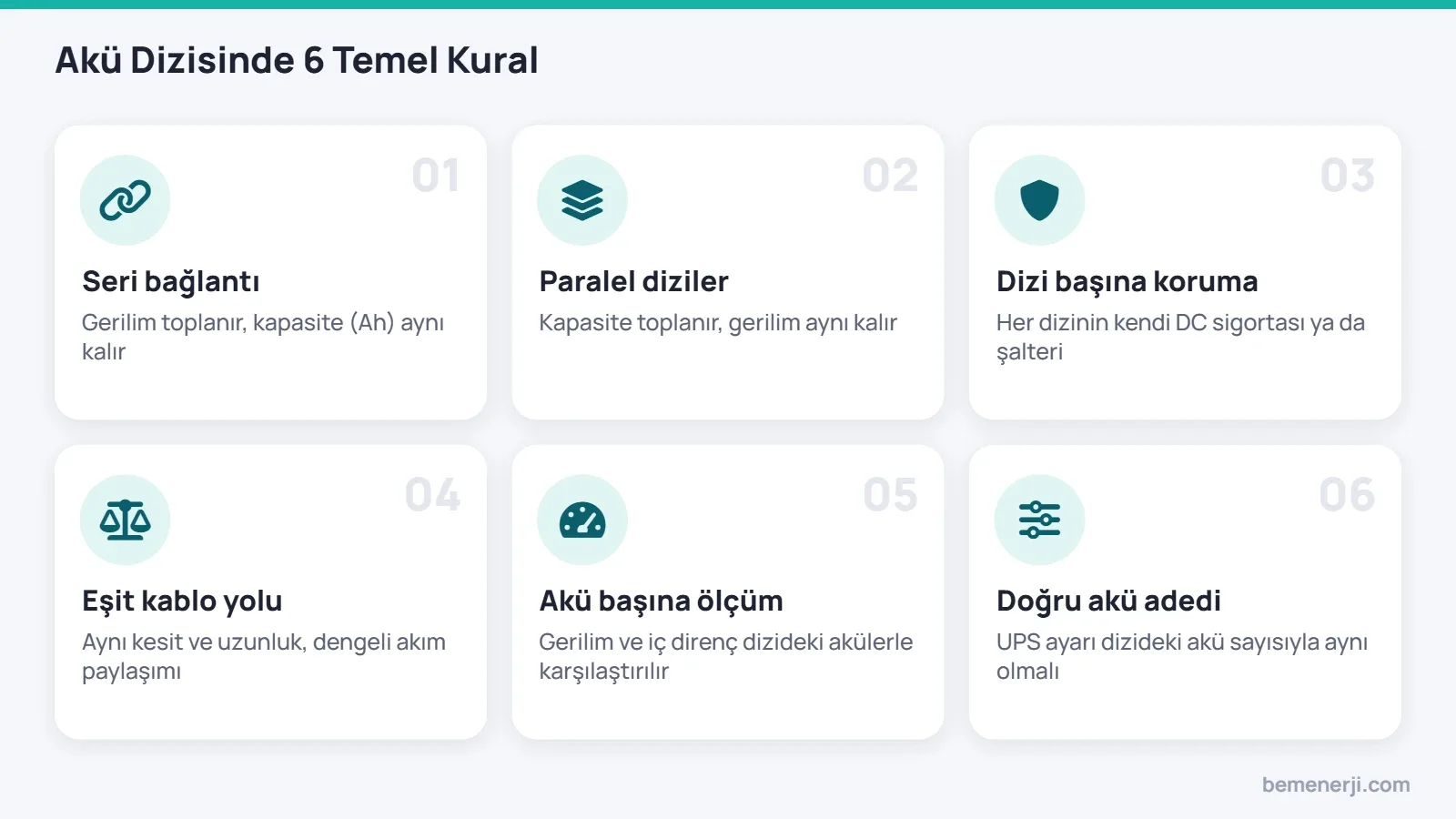
In a series connection, the positive terminal of one battery is connected to the negative terminal of the next. The batteries’ The voltages are added together; the capacity (Ah) remains the same. Energy, on the other hand, is approximately the product of voltage and capacitance: Wh = V × Ah.
| Order | Tension | Capacity | Rated power |
|---|---|---|---|
| Single battery (12 V, 9 Ah) | 12 V | 9 Ah | 108 Wh |
| 20 batteries in series (a string) | 240 V | 9 Ah | 2,160 Wh |
| Two parallel strings of 20 batteries each | 240 V | 18 Ah | 4,320 Wh |
| 20 identical batteries in parallel | 12 V | 180 Ah | 2,160 Wh |
The last line highlights an important point: when the same 20 batteries are connected in parallel, the energy remains the same but the voltage stays at 12 V; a UPS designed for 240 V will not work with this group. For this reason, parallel connections in UPS systems are made at the string level: first, the batteries are connected in series to form strings, and then the strings are connected in parallel.
The energy value in the table is a nominal value. The battery’s Ah rating is specified for a specific discharge time; since UPS batteries discharge much more quickly, the usable energy is less. Your approximate need Power Calculation You can see it with our vehicle.
Parallel Arrays: Capacity Is Aggregated
When sets with the same number of batteries are connected in parallel The voltage remains the same; the capacitance increases. There are two benefits to the two series:
- For a longer period: Capacity increases, and backup time extends. Under the same load, the runtime roughly doubles—and often slightly more; the exact value is calculated based on the load and the battery manufacturer’s discharge table.
- Redundancy: In a single-string system, a failure in a single battery or connection takes the entire array offline. In parallel arrays, when a faulty string is isolated, the other strings continue to power the UPS; only the runtime is reduced.
As capacity increases, the time it takes for the batteries to fully charge also increases. For large battery banks, a separate assessment is made to determine whether the UPS’s charging capacity is sufficient.
Points to Consider in Parallel Series
- Protection per series: Each string must have its own DC fuse or circuit breaker. If a short circuit occurs in one string, this prevents current from flowing into that string from the other strings and allows a single string to be isolated during maintenance.
- Equal cable path: The cross-sectional area and length of the cables running from the series to the UPS are kept equal. The series with lower resistance draws more current, discharges faster, and generates more heat.
- The same battery: All series use batteries of the same type, capacity, and with similar production dates.
- Manufacturer limit: Manufacturers typically set an upper limit on the number of parallel strings; if a longer runtime is required, batteries with higher capacity are considered.
Current imbalance between series connections can manifest itself, particularly during discharge, as heating in the connections; how it is detected Thermal Camera Inspection During UPS Maintenance We explained this in our article.
Weak Battery and Voltage Imbalance in the Series
In a series circuit, the same current flows through all the batteries. Why batteries of different ages aren't connected in the same series Factors Affecting Battery Life As we summarized in our article, the aspect of the matter that is reflected in the measurements is as follows:
- During discharge: A battery with reduced capacity discharges before the others. Since the UPS typically monitors the total voltage of the array, a weak battery can discharge very deeply even while the total voltage is still sufficient.
- Charging: The UPS applies a single total voltage to the battery bank; this voltage is distributed among the batteries based on their internal states. If the voltage of one battery falls below the average, the difference is distributed among the others, causing them to become overcharged.
That is why, when it comes to maintenance, it is not just the sum of the series, but Voltage and internal resistance per battery They are measured, and the batteries are compared with one another. How the defective battery is evaluated What is the internal resistance of a battery? You can find it in our article.
Setting the Number of Batteries in the UPS
In many UPS systems that use an external battery bank, the number of batteries in the bank is entered into the device. The UPS calculates the charging voltage and the end-of-discharge cut-off voltage based on this number; in some models, the number of banks or the total capacity is also entered to estimate the remaining runtime.
If the number of batteries is incorrect, the voltage each battery receives will vary. For example, when a UPS is configured for 20 batteries, the target voltage per battery is roughly 13.65 V. If there are 19 batteries in the string, each receives approximately 14.4 V and becomes overcharged; if there are 21 batteries, each receives approximately 13.0 V and never fully charges. For this reason, the settings must always be checked when a battery is added, removed, or the battery bank is replaced.
A Single Battery or the Whole Set?
The decision to replace individual batteries or the entire set is based on the condition of the batteries and the manufacturer’s instructions. In a relatively new set, a single battery that fails prematurely can be replaced with a suitable new one; however, replacing a single battery in an aged set is not recommended. If capacity needs to be increased, a new set of the same type is planned rather than adding batteries to the old set; if the old sets are nearing the end of their service life, replacing the entire set at once is considered. How to determine when it is time for replacement When should a UPS battery be replaced? We explained this in our article.
Security
A 240-volt battery bank carries a dangerous DC voltage even when the UPS is turned off and can deliver very high current in the event of a short circuit. Battery connections, battery bank isolation, and measurements qualified technical staff It must be performed by a qualified person using insulated tools and in accordance with the manufacturer’s instructions. Do not tamper with the battery compartment or terminals yourself. How to prepare the battery area Battery Room Ventilation and Safety We explained this in our article.
- IEEE Std 1188-2005 — Recommended Practice for the Maintenance, Testing, and Replacement of Valve-Regulated Lead-Acid (VRLA) Batteries for Stationary Applications
- IEC 60896-21/-22 — Stationary lead-acid batteries, valve-regulated types: test methods and requirements
- Product manuals and data sheets from UPS and battery manufacturers (specifications vary by manufacturer)
Sources
Battery Array at a Glance
UPS battery banks consist of strings connected in series and parallel connection of these strings when necessary.

Stability is just as important as connection: identical batteries, equal cable routes, protection per string and the correct battery count setting ensure that the battery pack works as a whole.
Frequently Asked Questions
01Why doesn't the capacity increase in serial connection?
02What can be done to extend the backup period?
03Can a new series be added next to the old series?
04Does the UPS continue to run when a battery in the array fails?
05Can we change the battery number setting ourselves?
Let's Plan Your Battery Pack Together
We carry out the assembly, battery replacement and commissioning of the battery pack for UPS of all brands and models throughout Istanbul and in the surrounding provinces. Replacement process Battery Replacement and Reconditioning, the installation steps UPS Installation and Assembly page. Your UPS model, number of batteries and desired backup time Send us; Let's evaluate your battery layout together.