What Happens If UPS Maintenance Is Neglected? A Chain Reaction Failure Scenario

UPS units run quietly in a corner for years; no one gives them a second thought. This quiet operation gives the impression that maintenance isn’t necessary. However, the UPS’s real job isn’t during normal operation, but the moment the power goes out It’s clear that a device that seemed to be working fine up until that point can suddenly fail at that very moment.
In this article, we provide a conceptual explanation of how a chain of events can unfold in a UPS that has been neglected, and what impact this might have on the business. Why maintenance is necessary What is UPS maintenance? We summarized this in our article.
Why Is the Problem Invisible?
When the mains power is normal, the UPS supplies power to the load either directly or through an inverter; the battery remains in charge. Even if the battery’s capacity has decreased, the fan has slowed down, or a connection has come loose, the load continues to operate. In other words, a failure remains a secret; it is put to the test for the first time when a backup is needed. Moreover, an actual outage puts the device through far more demanding conditions than a scheduled test: the load is full, the duration is uncertain, and there is no one to intervene. A weak link reveals itself precisely at this point.
Visible Signs of Neglect
As a user, there are some signs you may notice even before turning on the device:
- Frequently recurring warnings on the screen or in the monitoring software, and silenced alarms
- The device switches to battery power more frequently than before
- Unusual fan noise, excessive heat in the housing, or a burning smell
- It has been a long time since the last maintenance or battery replacement
- The shutdown duration during the outage was significantly shorter than before
If any of these signs are present, contact technical support immediately—do not wait until the scheduled maintenance date; do not open the cover or touch the batteries.
Domino Effect Scenario
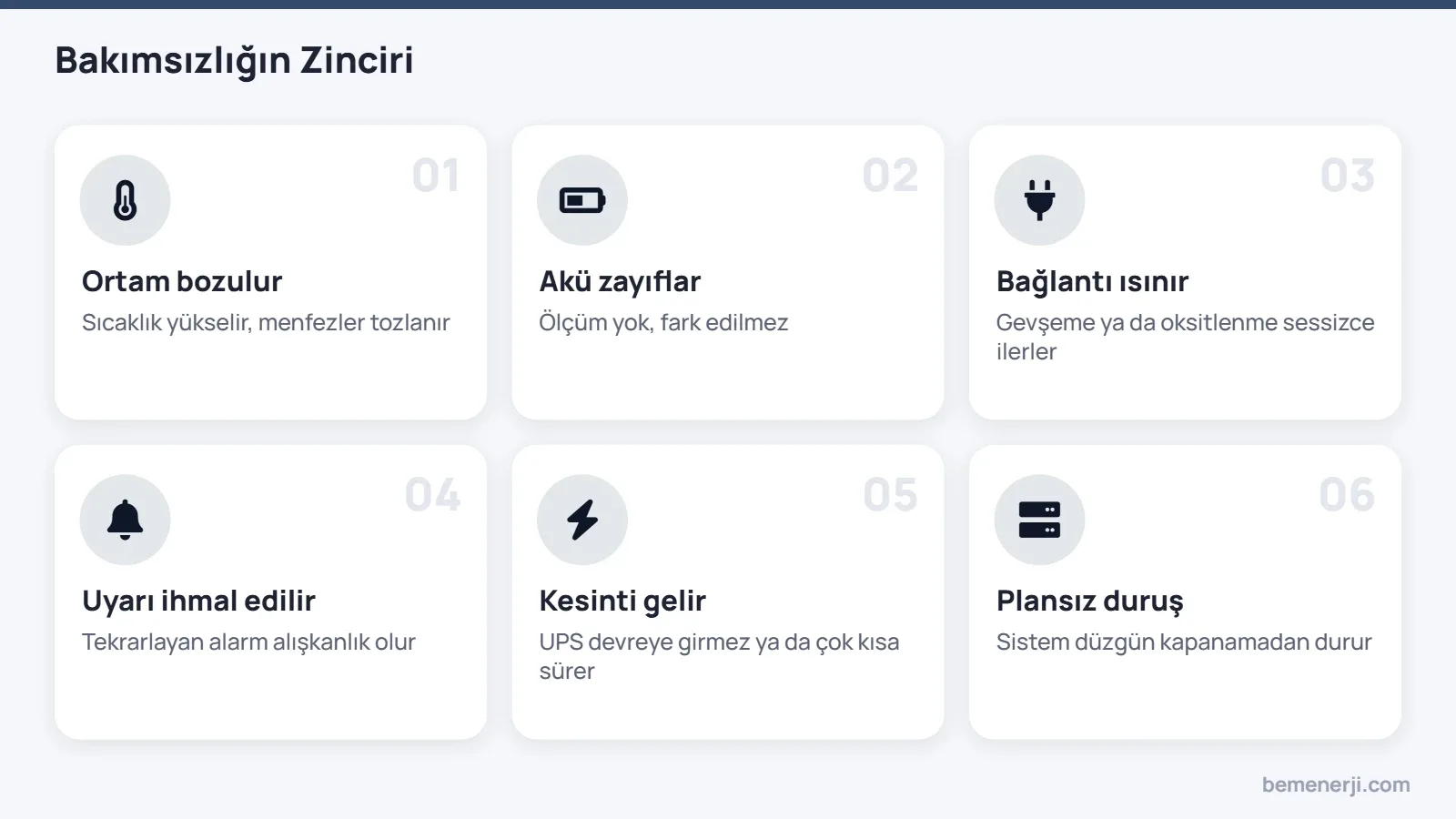
The following sequence is not a rule, but a common example. Each term makes the previous one worse:
- The room heats up, and dust collects in the vents. The condition of the fan and battery deteriorates.
- One of the batteries runs low. Since no measurement is taken, it goes unnoticed; the other batteries in the series are overloaded.
- A connection comes loose or becomes corroded. Heating begins; since there is no thermal control, it is not visible.
- Alerts are silenced. Repeated messages like “battery test failed” become a regular occurrence.
- There will be an outage. A weak battery cannot handle the load, so the UPS shuts down much sooner than expected or fails to activate at all.
- Unplanned stoppage. Servers, production lines, or recording systems come to a halt without shutting down properly.
Why the UPS might not have kicked in during a power outage When the power goes out, the UPS doesn't kick in, the most common causes of malfunctions Why Do UPS Units Fail? We explained this in our article.
The Operating Cost of Unplanned Downtime
A loss isn’t limited to a single item; we aren’t providing specific figures in this article because every business has a different structure. However, we can list the categories that are taken into account:
| Type of loss | How does it come about? |
|---|---|
| Loss of production and services | No sales, production, or services may be conducted during the suspension period |
| Data loss | The record being written is corrupted, the backup is restored, and the last operations are repeated |
| Hardware damage | Sudden shutdowns increase the risk of failure in disks and servers |
| Emergency response | Unscheduled calls, rapid parts procurement, and after-hours work |
| Reputation and Trust | Disruptions to customer service, impact on agreements |
The impact of a failure depends on how critical the system powered by the UPS is; for this context, What is a critical load? You can read the article. The longer the downtime, the greater the loss; steps such as sourcing parts or restoring data from backups can extend this period even further. In practice, postponing maintenance—which may seem inexpensive—is usually insignificant when compared to the cost of a single instance of downtime.
Although the scale may vary, the pattern remains the same. In a small office, this could mean a transaction at the cash register being left incomplete; in a manufacturing plant, a production line coming to a halt; or in a server room, data inconsistencies. Therefore, the decision to perform maintenance should not be based on the cost of the device, but rather on the value of the system they protect It should be provided accordingly.
Where Should We Break the Chain?
At each stage, there is a small intervention that can be carried out in advance:
- Room temperature and vent conditions are monitored regularly.
- Measurements are taken for each battery; a weakening battery is visible in the log. The trend When should a UPS battery be replaced? You can find it in our article.
- Thermal and connection checks are performed on a scheduled basis.
- Alarms cannot be silenced; recurring alerts are forwarded to technical support.
- The switchover to the battery and the backup duration are verified through scheduled tests.
- Consumable parts, such as fans and capacitors, are scheduled based on their age; see UPS Capacitor and Fan Replacement.
An approach that integrates all of these with measurement and recording Preventive and predictive maintenance This is explained in our article. Measurement, testing, and repair work must be performed by authorized technical personnel due to hazardous voltages inside the device.
- IEEE Std 1188-2005 — Recommended Practice for the Maintenance, Testing, and Replacement of Valve-Regulated Lead-Acid (VRLA) Batteries for Stationary Applications
- Product manuals and data sheets from UPS and battery manufacturers (specifications vary by manufacturer)
Sources
Silent Failures Come to Light During Outages
A neglected UPS may seem to operate without issues for years; the real test comes the moment the power goes out.

There is a small adjustment that can be made in advance for each of the rings. You can find the details of each step later in this article.
Frequently Asked Questions
01The UPS is working fine—is maintenance still necessary?
02What does a UPS that hasn't been maintained do during a power outage?
03How much can you save by postponing maintenance?
04Does the absence of any alarms mean there's no problem?
05How often should I have maintenance done?
Let's Take a Look Before a Problem Arises
We perform on-site measurements of UPS systems and battery banks for your critical systems and report any weak links before a failure occurs. The scope of the maintenance visit Periodic Battery and UPS Maintenance On our page, the metric showing the actual backup time Discharge and Load Tests On our page, plans ranging from one to eight visits per year Maintenance Plans You can find it on our website. Your current system Please let us know, let's discuss it together.