


Differences Between Linear Power Supply and Switching (SMPS) Power Supply

When you plug in an appliance, a power supply runs inside that converts the 230 V AC voltage of the mains to the 5 V, 12 V or 24 V DC required by the appliance. There are two well-established ways to do this: a large transformer and a linear regulation that lowers the voltage Linear Power Supply and handling voltage by high-frequency switching switching power supply (SMPS, Switch-Mode Power Supply). Today, the majority of the internal circuits of adapters, computers, cameras and networking devices, industrial cabinets, and even UPSs are SMPS-based; however, linear construction is still indispensable in some areas.
In this guide, we will examine how the two technologies work and where they differ in terms of efficiency, heat, output noise, size, EMI (electromagnetic interference), durability and cost, with numerical examples. Article; It was prepared for home users, business owners, panel and automation managers and purchasing units. For general classification of power supplies Our article on power supply types You can also take a look; here we focus only on the comparison of the two topologies.
What is a linear and switching power supply?
Both structures serve the same goal: to maintain a stable voltage at the output, whether the input voltage changes or the load changes. The difference is in what they do with the excess energy.
Linear power supplyconverts the voltage difference between the input and output into heat on the transition element (usually a transistor or regulator integrated). The resistance of the element is constantly adjusted according to the load; the output remains constant, but the difference is consumed as heat. This way of working is the main reason for the decrease in efficiency when the difference is large.
Switching power supply turns a switch (usually MOSFET) on and off tens of thousands to millions of times per second. Since the switch is either in full conduction or full cutoff, very little power is consumed on it; The output voltage is adjusted by the switch's open rate (duty cycle). Energy; It is stored for a short time in transformers, coils and capacitors and transferred to the load.
The common assessment in the sources is also in this direction: Linear regulators offer simple regulation without a switching solid, while switched structures often reduce conversion losses when the input-output difference or load current grows .
How does a linear power supply work?
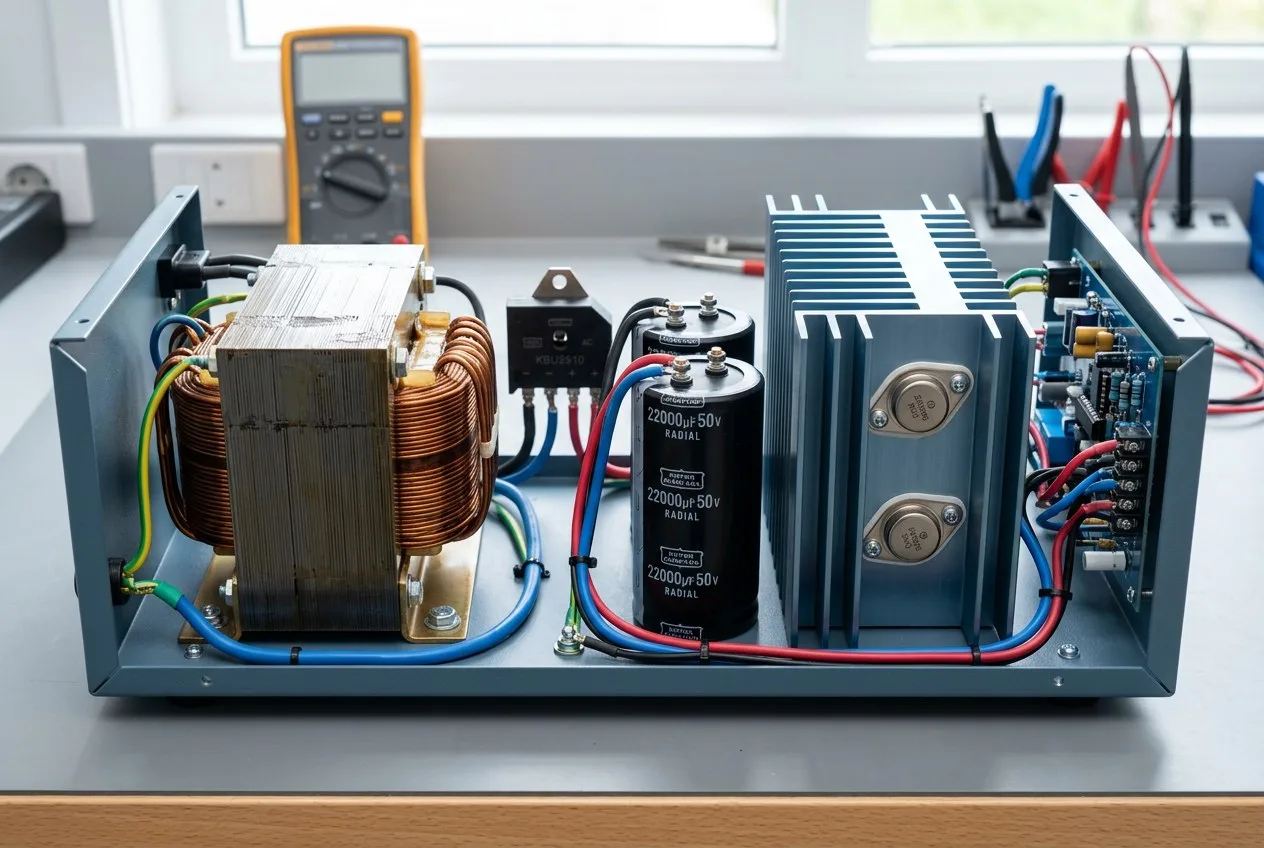
A classic AC-DC linear weld consists of four stages:
- Mains transformer: It reduces 50 Hz 230 V AC to a lower AC voltage with an iron-core transformer and galvanically disconnects it from the mains.
- Rectifier: The diode bridge converts AC to fluctuating DC.
- Filter condenser: It smooths out ripple; as the capacitor value increases, the ripple decreases, but the size and cost increase.
- Linear regulator: It regulates the filtered voltage to constant output; it converts the difference into heat.
Because the mains frequency is low, the transformer core is large and heavy. This is both the most well-known disadvantage of the linear structure and one of the reasons behind its noiseless output: since there is no high-frequency switching in the circuit, no switching-induced component is formed at the output.
The efficiency of the linear regulator is roughly Output voltage ÷ input voltage ratio; i.e. if the input of the regulator is 18 V and the output is 12 V, the efficiency is at most about 67% on the regulator stage alone. Transformer and rectifier losses are added on top of this. Therefore, the total efficiency of a complete linear source remains practically low; a manufacturer's comparison letter typical values in the range of about 30-60% gives. Don't rely on a single number; actual yield varies by load and design.
How does a switching power supply (SMPS) work?
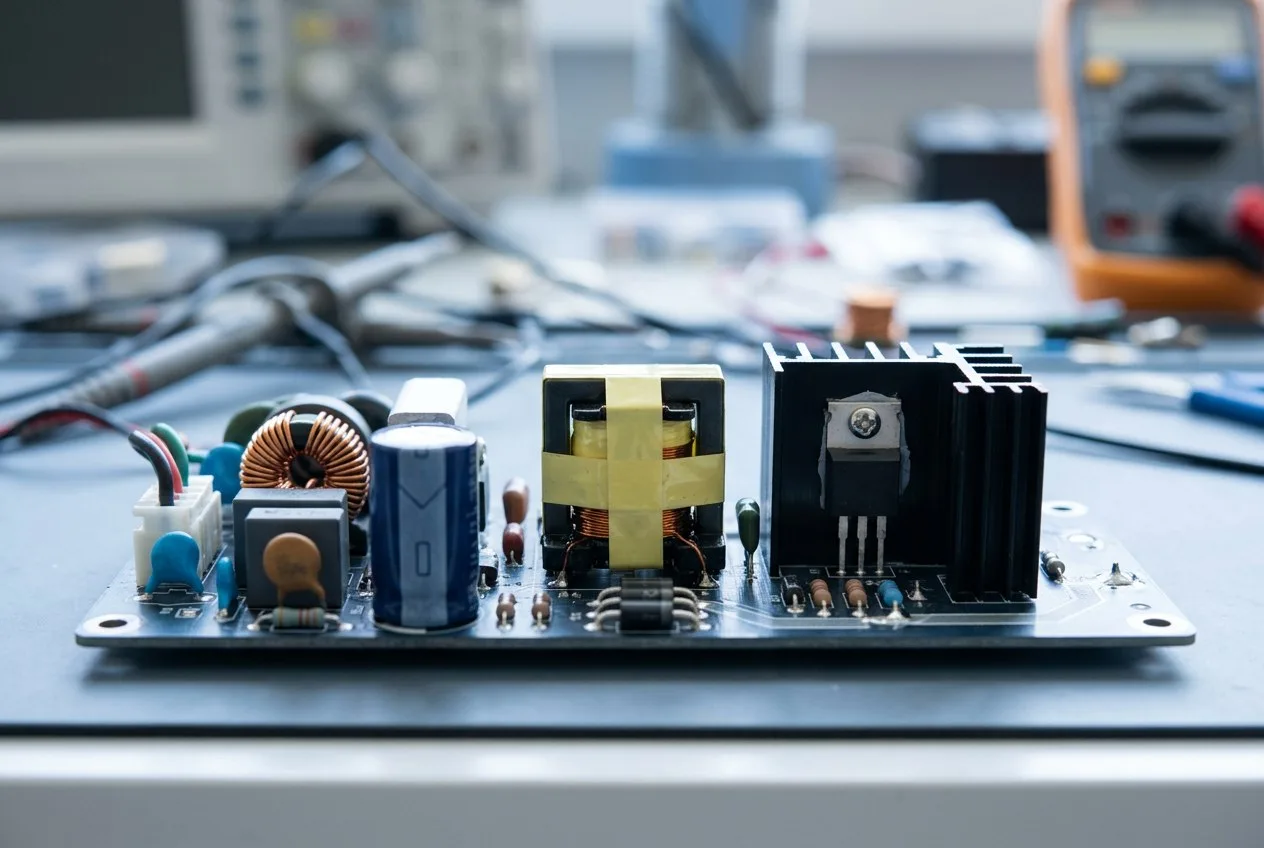
In a typical AC-DC SMPS, the mains voltage is first directly rectified and the high-voltage DC line is created with a large input capacitor. A switch then interrupts this line at a high frequency; the resulting pulses pass through a small ferrite transformer, rectify and filter on the secondary side. The output voltage is measured by a feedback circuit (often optocoupler and reference); the control IC adjusts the duty cycle accordingly.
High frequency causes the transformer and filter elements to shrink. Therefore, SMPS, which gives the same power, is much lighter than its linear counterpart. In sources, a range from tens of thousands of hertz to several megahertz is often referred to for switching frequency; as the frequency increases, the passive elements become smaller, but switching losses and EMI management become more difficult.
Most modern SMPSs also have the following blocks:
- EMI input filter: Limits the device from sending noise to the mains.
- PFC (power factor correction): It matches the current drawn from the mains to the voltage, reducing harmonics and reactive power effect. Why power factor matters power factor in our article, the effect of harmonics In our harmonic article You can find it.
- Protection circuits: Over-current, short-circuit, over-voltage, and over-temperature protections.
Main differences between linear and SMPS (comparison table)
| By | Linear power supply | Switched (SMPS) |
|---|---|---|
| Working principle | Converts excess tension into heat in the transition element | It transfers energy by turning the switch on and off at a high frequency |
| Performance | Low-medium; the entry-exit gap decreases as it grows | High; roughly 80-95% range in most designs |
| Heat generation | High; need refrigerant | Low-medium |
| Size and weight | Large and heavy (50/60 Hz transformer) | Small and light |
| Output noise (ripple) | Very low | Higher; includes switching component |
| EMI propagation | Low | Requires filter and placement |
| Input voltage range | Narrow; mostly single tension | Can be wide (e.g. 90-264 V AC) |
| Load regulation and transient response | Usually very good | Good; depends on the design |
| Circuit complexity | Simple | Complex |
| Suitable power range | Low power | From low to high power |
The values in the table are typical ranges. The exact figures for a particular product are included in the manufacturer's datasheet and depend on the measurement conditions (load percentage, input voltage, temperature).
Efficiency and heat: Difference with calculation example
Let's embody the yield difference. The following calculation uses simplified assumptions to illustrate the concept.
Assumptions: The load draws 12 V and 2 A (24 W). The device is on 24 hours a day, year-round. In linear construction, the regulator input is 24 V; SMPS efficiency is considered 90%. Transformer and rectifier losses are omitted (an optimistic assumption for linear).
| Step | Linear regulator floor | SMPS |
|---|---|---|
| Output power | 12 V × 2 A = 24 W | 24 W |
| Input power | 24 V × 2 A = 48 W | 24 W ÷ 0.90 ≈ 26.7 W |
| Power converted into heat | 48 − 24 = 24 W | 26.7 − 24 ≈ 2.7 W |
| Performance | 24 ÷ 48 = %50 | %90 |
| Annual energy (8,760 hours) | 48 W × 8,760 h ≈ 420 kWh | 26.7 kWh × 8,760 h ≈ 234 kWh |
For the same load, the annual difference turns out to be about 186 kWh. More importantly, in the linear example, 24 W of heat accumulates inside a cabinet; it raises the ambient temperature, shortens the lifespan of surrounding electronic components, and increases the requirement for ventilation. For the actual cost calculation, get the current unit price from your own invoice; we do not provide a tariff figure in this article.
And don't forget that the linear structure can look good in an inverted situation: if the input-output difference is very small (e.g. 5.5 V input to 5 V output), the linear regulator itself works efficiently. Comparison sources also emphasize this point: a linear regulator may be suitable for small voltage drop, modest heat loss or precise analogue supply; as long as dropout, noise and stability conditions are met .
There is also a regulatory aspect. In many countries, minimum average efficiency and no-load consumption limits apply to external power supplies (adapter, charger-type products). According to the definition of the Department of Energy in the USA The outdoor power supply is a comprehensive product that DOE can set energy-saving standards and test methods . At Level VI level, No-load consumption may not exceed 0.100 W for power supplies from less than 1 W to 49 W . For current requirements in Turkey and the EU, the official pages of the relevant institutions should be consulted; these limits have been effective in withdrawing low-efficiency linear adapters from the market.
Output noise and EMI: Linear's strong side
The most well-known disadvantage of SMPS is noise, which is the direct result of switching behavior. Each time the switch is opened and closed, large and discontinuous current pulses are generated. These pulses act in two ways:
- Exit ripple and ringing: On top of the output voltage, a fluctuation in the switching frequency and short-term oscillations are superimposed on the transients. As explained in a technical paper, The dominant type of noise is the switching noise that arises from the switching frequency of the source .
- Transmitted and radiated EMI: Noise can be transmitted over mains and ground lines, or it can be propagated as radio waves. Texas Instruments' application note states that the EMI at the input port comes from a voltage surge arising from discontinuous current and that the core component is the switching frequency tells. Bel Fuse's technical article also states that this type of initiative is SMPS' that it is a result of natural design features specifies.
In linear welding, on the other hand, the output is much cleaner because there is no high-frequency switching. In an example where a manufacturer compares two models with similar output values, the noise value of the linear model is given as approximately 0.5 mVrms, and the switched model is given as approximately 5 mVrms; where the most obvious differences are output noise and physical size highlighted. These two numbers are only an example of a single manufacturer; refer to the "Ripple & Noise" value on the datasheet for your product.
When is noise a problem?
Not all loads are equally sensitive to noise. Relays, contactors, LED drivers, motor drivers, and most digital cards handle tens of millivolts of ripple without any problems. The problem arises with these loads:
- High-resolution ADC and sensitive sensor inputs (measurement error, floor noise)
- Sound prestages and microphone circuits (hum, click)
- RF receivers, oscillators and meters
A technical paper from Analog Devices states that SMPSs have historically been too noisy for such sensitive circuits and often require an additional LDO regulator; however, newer architectures Reduced EMI emissions and outflow ripple tells. In other words, the generalization "SMPS is noisy, linear is clean" stretches according to design quality: a well-designed SMPS can easily meet the requirements of most industrial loads, while a poorly designed linear structure can create heat and regulation problems.
Ways to reduce noise
- Choosing low noise grade SMPS
- Adding LC filter to the outlet or LDO near the load (SMPS + LDO combination)
- Laying power and signal cables separately, using short and proper grounding
- If necessary, to put an additional EMI filter at the mains input; however, an electrical engineer should evaluate the necessity of this
Discussing the impact of EMI on sensitive devices in detail electrical noise (EMI/RFI) article completes this heading. As noted in Bel Fuse's note, even a filtered SMPS does not automatically guarantee eligibility unless the application is designed to reduce EMI.
Size, weight and power density
The size of a transformer is inversely proportional to the frequency at which it operates. Linear welding operating at 50 Hz requires a large iron core; SMPS, on the other hand, uses a small ferrite transformer operating on the order of hundreds of kilohertz. The result is a unit that is many times smaller and lighter for the same output power.
This difference is felt in three places in practice:
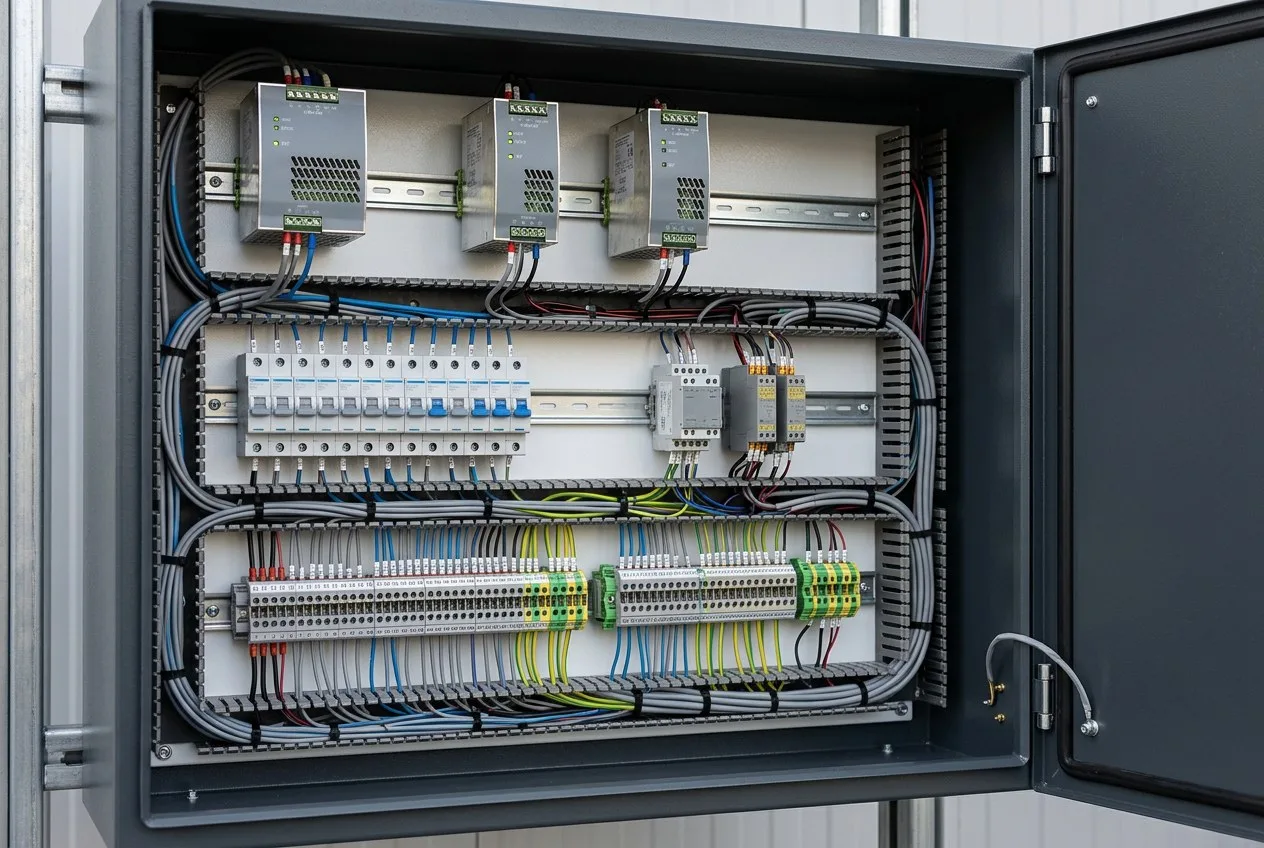
- In-board layout: DIN rail SMPS fits comfortably in narrow cabinets; the equivalent linear unit takes up a lot of space.
- Handling and assembly: A heavy linear weld also puts a strain on the wall or rack carrier.
- Cooling Need: The heat generated by the linear unit requires large heatsinks and airflow; this makes the size even larger.
Reliability, life and failure behavior
Since linear welding is simple, it works with few components. Elements such as transformers and diodes have a long life; the main constraint is usually heating. SMPS, on the other hand, has more components and a more complex control; however, today's industrial SMPSs offer high reliability with a wide temperature range and rich protection features.
Common component that determines life for both types are electrolytic capacitors. The electrolyte dries out over time; high temperature accelerates this process. Therefore, ambient temperature, ventilation, and load percentage are the main determinants of both linear and SMPS life. Refer to the manufacturer's data sheet for expected life and temperature-dependent load derating curves.
Typical signs of malfunction and possible causes
| Symptom | Possible cause (linear) | Possible cause (SMPS) |
|---|---|---|
| Overheating | Input-output difference is large, cooler is insufficient | Fan clogged, dust, high ambient temperature, overload |
| Humming / fluctuating at the exit | The filter condenser is tired | The ESR of the output capacitors is increased, the control circuit is unstable |
| No way out | Fuse, regulator or transformer failure | Protection activated, fuse or switch element failure |
| Output voltage is low | Overload, input voltage low | Current limiting, capacitor aging |
| Periodic on-off (hiccups) | Rare | Overcurrent or short circuit protection triggered repeatedly |
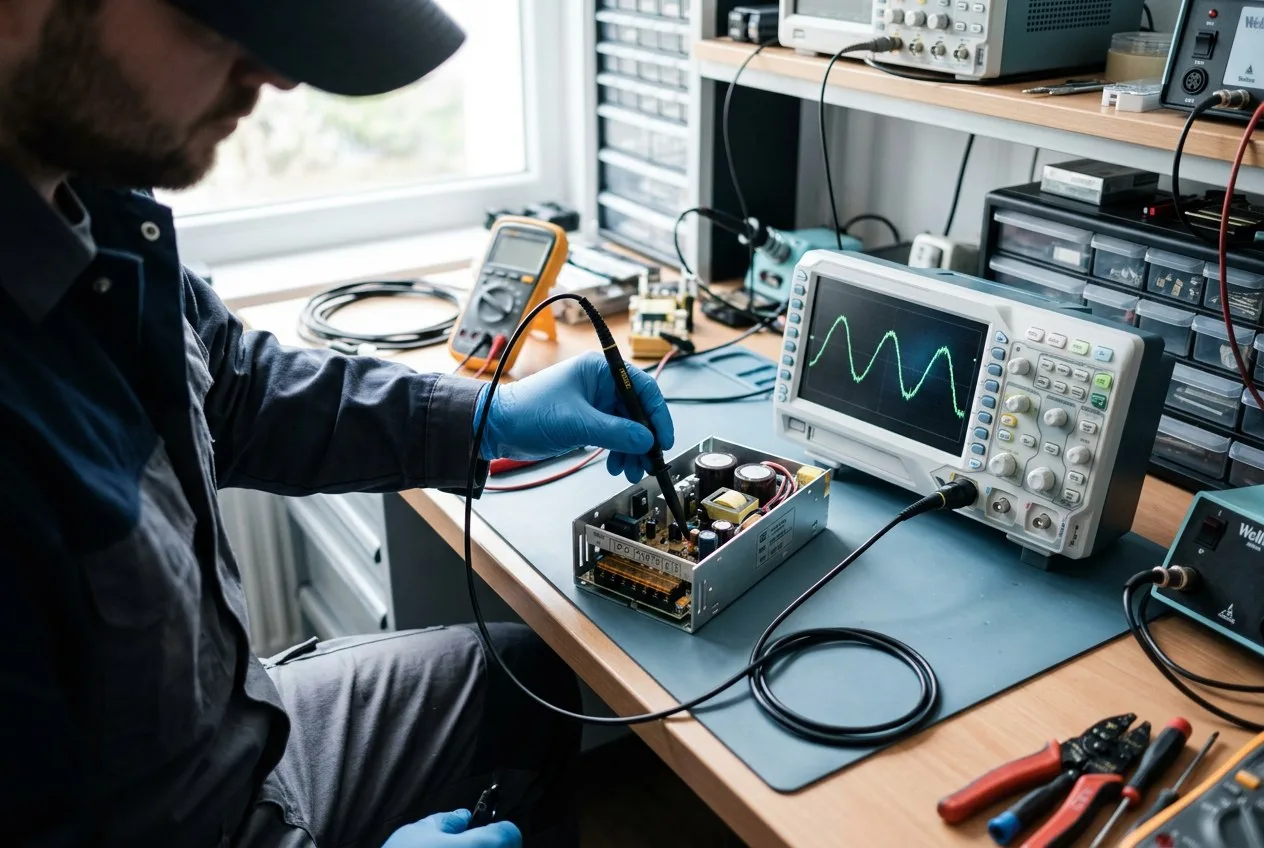
To interpret the symptoms in more detail Power supply failures You can look at it. Safety warning: In mains-connected power supplies, dangerous voltage may remain in the capacitors even after unplugging. Opening the cover, measuring and repairing are the work of authorized electrical personnel or technical service; do not intervene on your own.
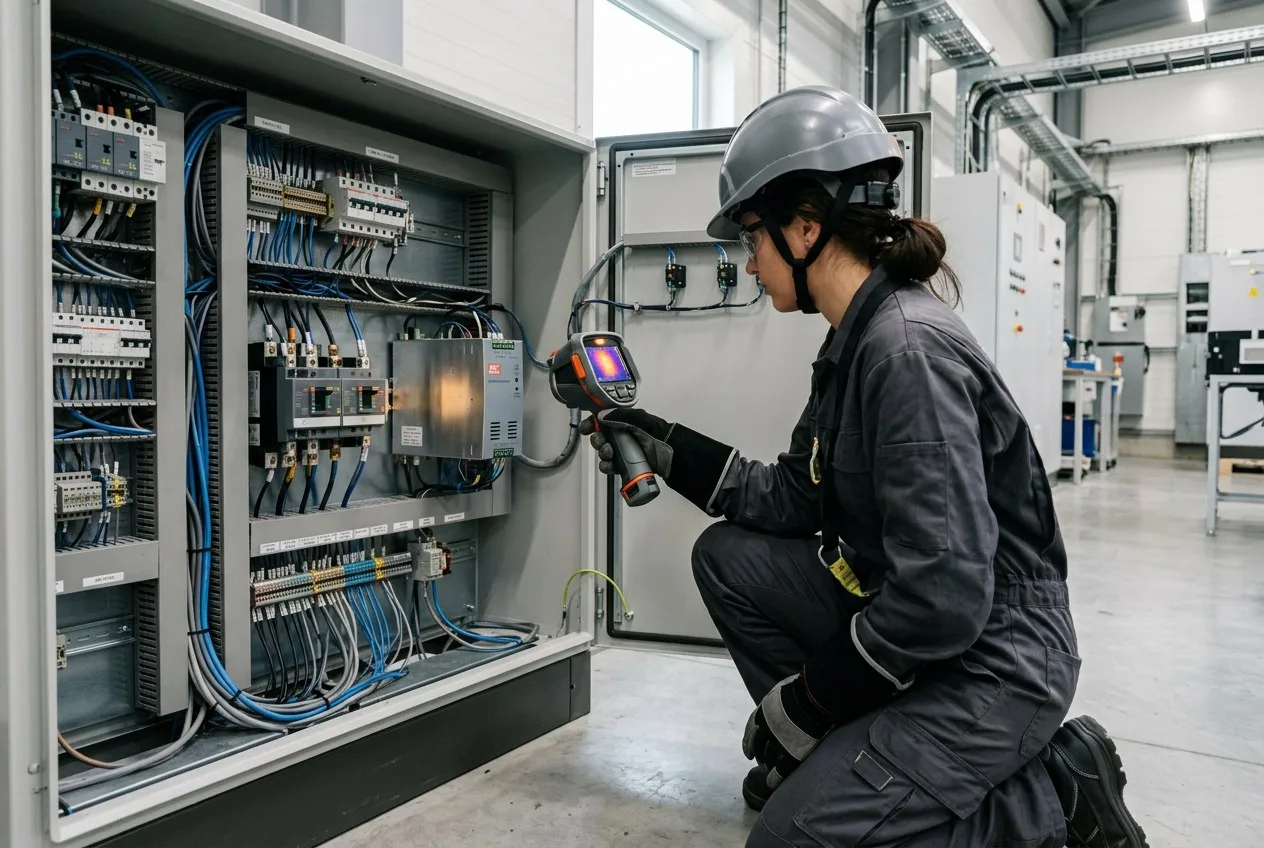
Which in which application? Selection criteria
There is no single "best" technology in selection; the characteristics of the load are decisive. The table below provides a general orientation.
| Application | Which is usually suitable | Reason |
|---|---|---|
| Industrial panel, PLC, sensor supply (24 V DC) | SMPS (DIN rail) | Efficiency, compactness, wide input range, protection features |
| Security camera, network device, LED lighting | SMPS | Power density and low heat; ripple within tolerance |
| Precise laboratory measurement, low-noise analog circuitry | Linear or low-noise SMPS + LDO | Ripple and EMI are critical |
| Audio equipment front floor | Linear or well-filtered SMPS | Hum and interference sensitivity |
| High-power loads (hundreds of W and above) | SMPS | Linear structure impractical due to heat and size |
| Simple low-power supply with small voltage difference | Linear regulator (LDO) can also be | Simplicity, low cost, acceptable loss |
Technical points to look for when choosing
- Power Allowance: Calculate the load strength and take into account the load reduction at ambient temperature; leaving a margin in the continuous full-load operation extends life.
- Input range: A wide input range is an advantage in areas with high grid fluctuation.
- Ripple and noise (mVp-p): Also refer to the measurement bandwidth in the datasheet for sensitive loads.
- Safety and Compliance: The applicable safety standard for information and communication technology equipment is IEC 62368-1. According to the definition of IECEE, this standard is the safety of audio, video, information and communication equipment with a nominal voltage not exceeding 600 V covers. Check the documentation and markings of the product; EMC requirements are assessed separately.
- Protection features: Over-current, short-circuit, over-voltage, and over-temperature protections; PFC if required.
- The need for redundancy: Redundant construction should be considered instead of a single power source for critical loads; for details Redundant Power Supply Systems See our article.
The capacity, efficiency and protection dimensions of industrial selection In the industrial power supply selection guide We also covered.
Common mistakes when working with SMPS
While SMPSs are common and durable, installation and operational errors significantly increase the failure rate.
- Unventilated layout: Placing the power supply on top of each other or adjacent to a wall traps heat. Follow the manufacturer's instructions for clearance and orientation.
- Continuous 100% load: Leaving no growth margin shortens life due to heat and capacitor aging.
- Wrong power supply class: Feeding a load that needs battery charging with a constant voltage source that does not have charging characteristics is risky for the battery and the source. This issue The difference between battery charger and DC power supply We explained it in the article.
- Neglecting voltage drop: In long and thin DC cables, the voltage decreases at load; even if the welding output is correct, the load sees undervoltage.
- Leaving unprotected against mains impacts: Sudden voltage pulses can strain the ground floor of the SMPS; surge arrester and UPS relationship Our article explains this issue.
- Changing the output voltage casually with the adjustment screw: Adjusting without knowing the tolerance range of the load can damage sensitive instruments.
- Buying cheap, undocumented products: Products that are not certified for safety and EMC compliance may present a risk of fire, electric shock, and interference.
With critical loads, it's not just the power supply itself that is the problem; it should also be planned for what happens when there is a grid outage. If your 12 V or 24 V DC devices need to operate without interruption DC UPS solutions You can examine it. Also for structures that convert voltage to another DC level Our DC-DC converter article It will be useful.
UPS and its relationship with battery systems
The rectifier and charge stages in UPSs and rectifiers are also largely based on the principles of switching power electronics. Therefore, the efficiency, heat and EMI properties of SMPSs are directly related to UPS performance. For the logic of structures feeding a DC system from the grid Our article explaining the difference between rectifier and UPS You can read it.
A situation we see in practice is this: If the devices connected to a UPS have their own power source SMPS, these devices often behave as low power factor or harmonic generating loads. This is a point to consider when sizing the UPS; This is why the load type is questioned in Bempower's exploration and sizing studies on the UPS, battery and inverter side. When the power supply itself fails, symptoms appear as heating, humming or sudden shutdown, and measurement is required for accurate diagnosis.
Short checklist for making decisions
Answering the following questions in order leads to the right choice in most cases:
- Is the load drawing hundreds of watts or more? If yes, SMPS is often the only reasonable option.
- Is the load highly sensitive to noise (precision metering, audio, RF)? If yes, consider a low-noise SMPS + LDO or linear solution.
- Will it work in a panel or a closed box? If heat and size are important, SMPS is a criterion in favor.
- Is the mains voltage fluctuating or is there any use abroad? SMPS with wide input range is advantageous.
- No tolerance for interruption? In addition to power source selection, redundancy and UPS/battery design should also be planned.
- Is there document and standards compliance? Verify safety and EMC compliance.
This list is a pre-screening tool. Site-specific details (cable length, grounding, ambient temperature, current harmonic level) can change the result.
Technical support for your power supply, UPS and battery systems
If you want to set up your system in a healthy way against power outages, voltage fluctuations or heating and malfunction problems of power supplies, Bempower; It offers discovery, installation, periodic maintenance and technical service for all brands of UPS, battery packs and inverters. To contact our team providing on-site service in Istanbul and surrounding provinces From our contact page You can contact us.
- Switching vs Linear Power Regulators — Passive Components, 2026. https://passive-components.eu/switching-vs-linear-power-regulators-compared/
- Application Report SNVA489C: EMI filter design for switch-mode power supplies — Texas Instruments, 2013. https://www.ti.com/lit/an/snva489c/snva489c.pdf
- EMI Considerations for Switching Power Supplies — Bel Fuse, 2023. https://www.belfuse.com/resource-library/tech-paper/emi-considerations-for-switching-power-supplies
- IEC 62368-1:2014 Audio/video, information and communication technology equipment - Safety requirements — IECEE, 2014. https://www.iecee.org/certification/iec-standards/iec-62368-12014
- Energy Conservation Program: Test Procedure for External Power Supplies — Federal Register (U.S. DOE), 2022. https://www.federalregister.gov/documents/2022/08/19/2022-15975/energy-conservation-program-test-procedure-for-external-power-supplies
- Energy Efficiency Requirements by Levels — Advanced Energy, 2021. https://www.advancedenergy.com/getmedia/681e1da7-ef41-4b8d-ab0c-04cb6b112af1/pw153kb_ds.pdf
Resources
