Ritar
High Current Batteries (High Rate)
Ritar HR12-850W 12V 260Ah High Current AGM Battery
HR12-850W
Sold out
TCMB foreign exchange selling rate · 25.11.2026: USD 50,64 ₺ EUR 55,40 ₺
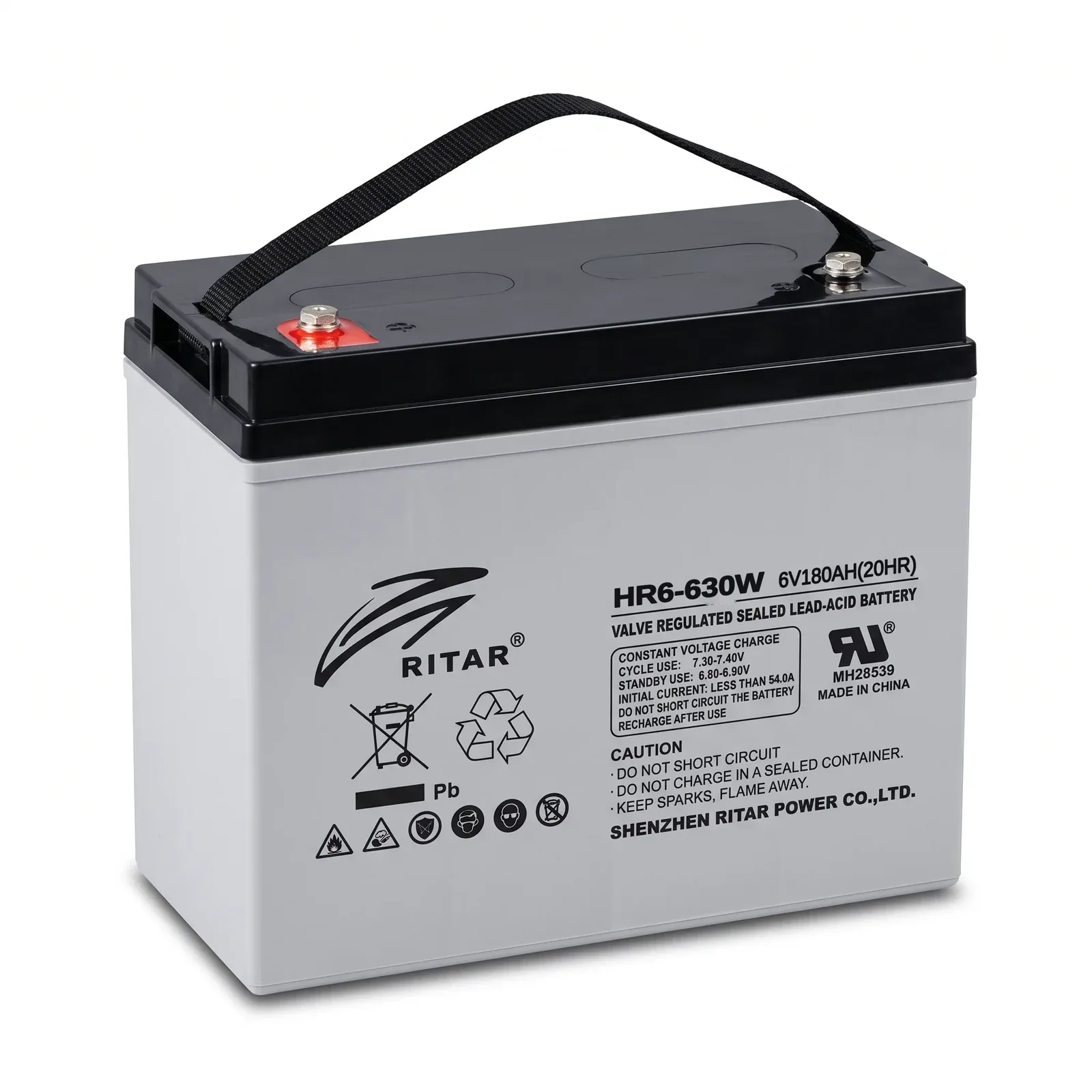
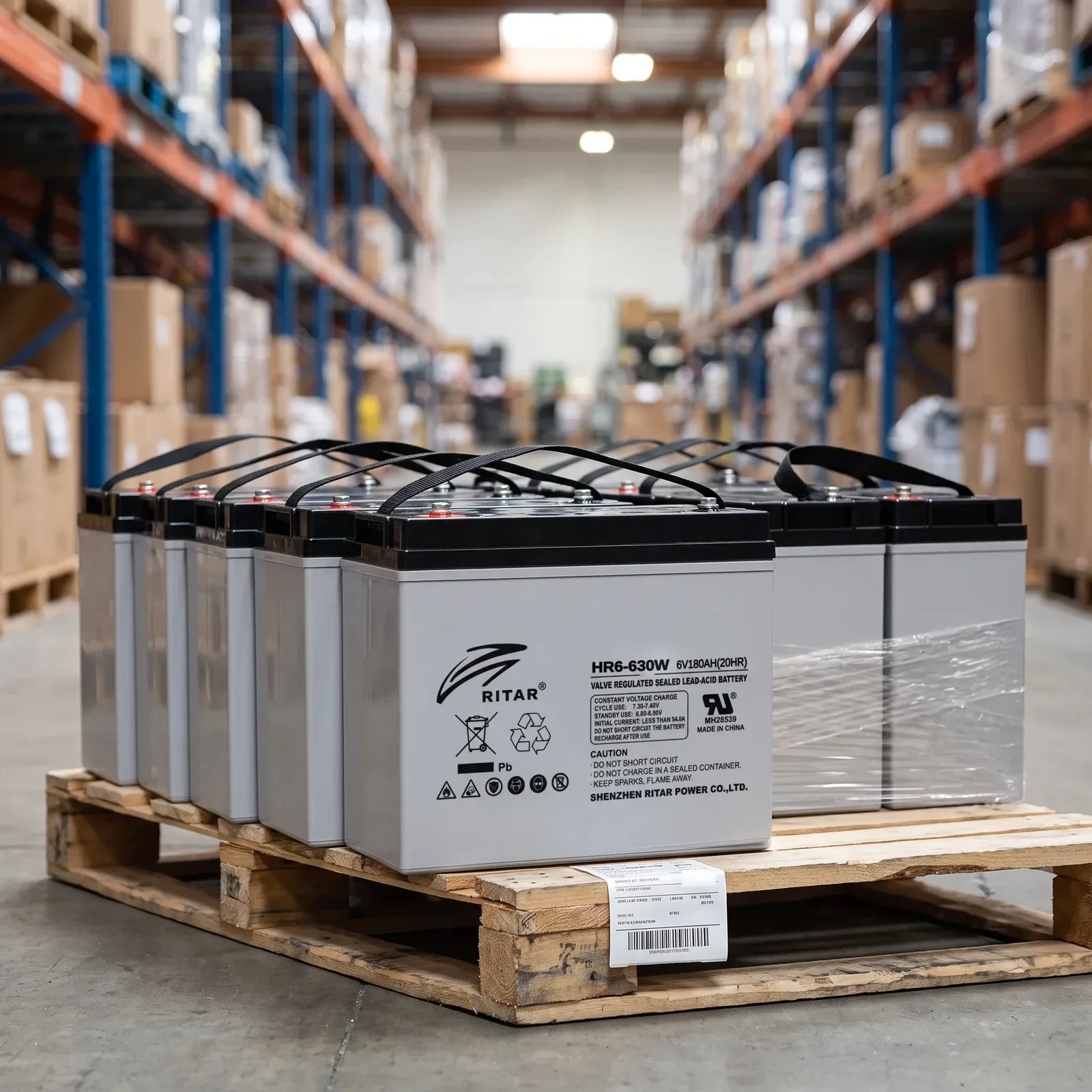


6 V 180 Ah high-current maintenance-free dry type (VRLA-AGM) battery for UPS and telecom battery banks. No water or acid additions required; 15 years design life in buffer use.
 CE
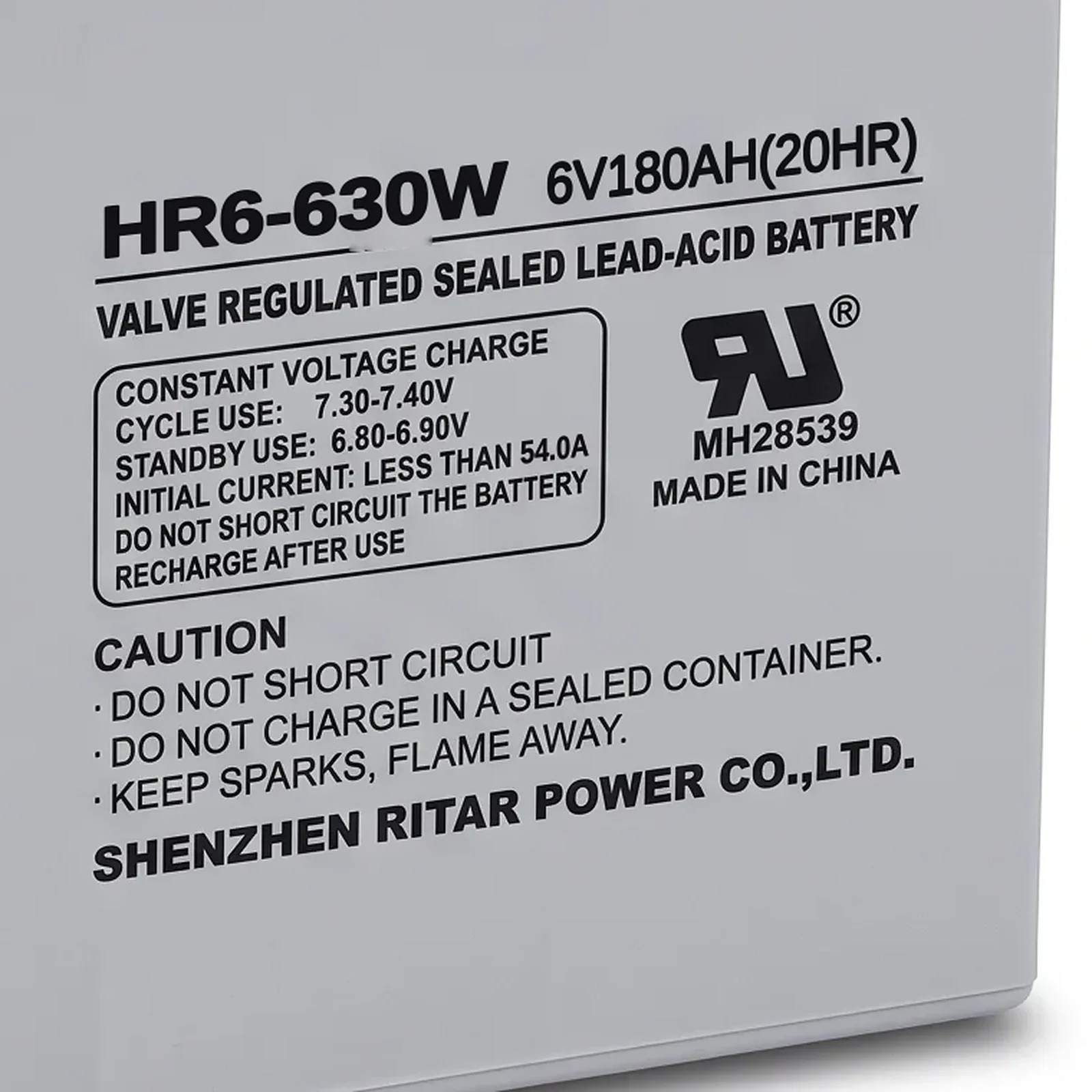
Ritar HR6-630Wis a 6 V 180 Ah dry type battery produced with valve-regulated lead acid (VRLA) technology, whose electrolyte is impregnated with glass fiber separators (AGM). It does not require the addition of water or acid, it does not require maintenance.
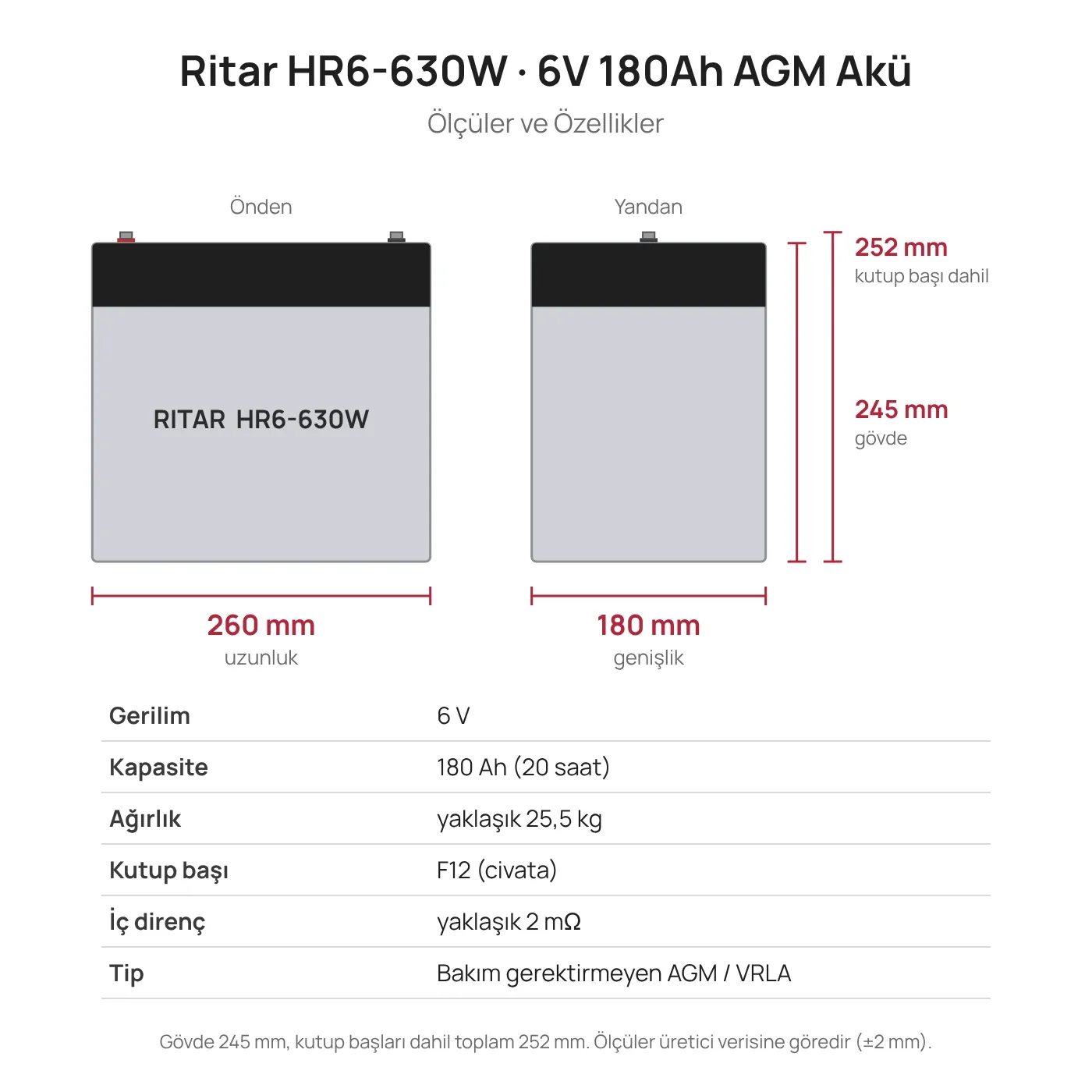
With a size of 260 × 180 × 252 mm and a weight of approximately 25.5 kg, it is used in UPS and telecom battery banks; 12 V is obtained by connecting two batteries in series, increasing the number of batteries for the desired voltage. Its poles are of the M8 bolted (F12) type.
Ritar HR (High Rate) is the series designed to deliver high power in a short time: thanks to the reinforced grid, thick plate and special active material, it has low internal resistance and self-discharge, according to the manufacturer, it delivers about 30% more power than the standard series; it is suitable for high-power standby applications such as data center, UPS and EPS.
6 V 180 Ah batteries, which are activated when the power is cut off. Standby (buffer) use Designed for: the battery is kept fully charged at all times while the device is connected to the mains, feeding the device in case of an outage.
The 15-year design life in the datasheet is for buffer use. In cyclic use, which discharges and fills every day, the life depends on the number and depth of discharge.
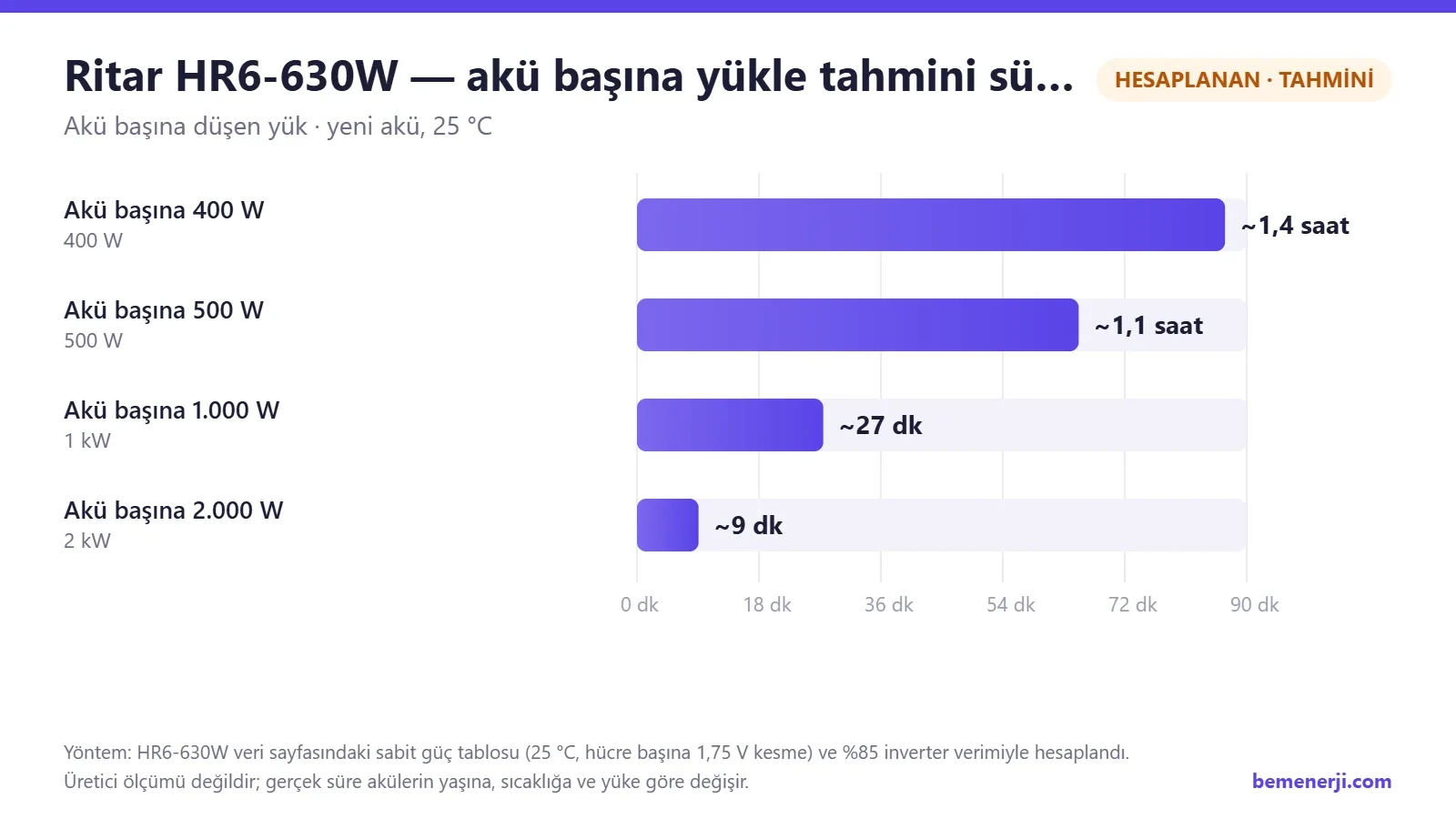
The following times are manufacturer measurement It is not; From the discharge table in the data sheet of this battery Calculated Estimate values. Valid in a 25 °C environment with a new and fully charged battery.
| UPS load per battery | Estimated time |
|---|---|
| 400 W | ~1.4 hours |
| 500 W | ~1.1 hours |
| 1,000 W | ~27 min |
| 2,000 W | ~9 min |
For a group of multiple batteries, divide the total load by the number of batteries and refer to this table. For example, in a group of 20 batteries, a load of 20,000 W is 1,000 W per battery.
How was it calculated? The constant power table in the datasheet (25 °C, 1.75 V cut-off per cell) was used; the inverter efficiency of the UPS when operating from the battery was considered to be 85%. In a group connected in series, each battery gives an equal share of the total power. Detail of the method: How to calculate battery time?
Manufacturer's discharge values (single battery, 25 °C, 1.75 V cut-off per cell — most UPSs disconnect at this voltage):
| Duration | Constant current | The power of the battery |
|---|---|---|
| 5 min | 505 A | 2,931 W |
| 10 min | 381.4 A | 2,245 W |
| 15 min | 298 A | 1,766 W |
| 30 min | 184.9 A | 1,108 W |
| 1 hour | 109.2 A | 628 W |
The actual time varies according to the age of the battery, the ambient temperature and the variability of the load; it is significantly shortened in aged batteries.
Battery replacement and Periodic Maintenance With our services, we measure your batteries and replace them on time.
| Nominal voltage | 6 V |
|---|---|
| Nominal capacity | 180 Oh |
| Battery technology | VRLA – AGM (maintenance-free, dry type) |
| Design life | 15 year |
| Pole (terminal) type | M8 bolt-on |
| Dimensions (L × W × H) | 260 × 180 × 245 mm |
| Total height (with pole) | 252 mm |
| Internal resistance | approximately 2 mΩ |
| Short circuit current | 3600 A |
| Case material | ABS (UL94-HB; UL94-V0 optional) |
| Capacity | 180 Ah — reference capacity (C20) of 20 hours in the data sheet; the manufacturer classifies this model with a power rating of 15 minutes |
| Polar code (manufacturer) | F12 |
| Power rating (manufacturer) | 630 W/cell — up to 1.67 V per cell at 15 minutes of discharge, 25 °C (1890 W per battery) |
| Reference capacity (25 °C) | C10 170 Ah · C20 180 Ah |
| Highest discharge current | 1800 A (5 sec) |
| Peak charging current | 54.0 A |
| Standby (buffer) charging voltage, 25 °C | 6.80 – 6.90 V (temperature correction –3 mV/°C per cell; –9 mV/°C per battery) |
| Equalization charging voltage, 25 °C | 7.30 – 7.40 V (temperature correction –4 mV/°C per cell; –12 mV/°C per battery) |
| Operating temperature | Discharge –20 ... · 60 °C Charge 0 ° · 50 °C · Storage –20 °C °C |
| Recommended operating temperature | 25 ± 5 °C |
| Self-emptying | Up to 3% per month at 25 °C |
| Storage | Maximum 6 months at 25 °C, then refresh charge (more frequent in heat) |
| Dimension tolerance | ± 2 mm |
| Warranty | 2 year |
| Weight | 25,5 kg |
| Status | Zero |
| Stock | Sold out |
Batteries are delivered with their original pole protectors and without any connection to the poles. For withdrawal, the battery must not be used, charged/discharged and the terminals must not be connected; batteries that are installed and used will not be returned or will be deducted from the loss of value. Check the capacity and size suitable for your UPS before ordering; in case of wrong selection, the return shipping is your responsibility.
There are no reviews for this product yet.
If you've used this product, share your experience—be the first to leave a review.
Log in to post a comment.
We use cookies that are necessary for the site to function. If you allow optional cookies, we can improve your experience. Cookie Policy