


UPS and Battery Left in a Flood or Humid Environment: What Should Be Done?

When flood water floods the server room in the basement, roof runoff leaks into the technical room, or a UPS that has been sitting in a damp tank for years does not turn on one morning, the first reflex is often the same: "Let it dry, then we'll give it a try." When it comes to electricity and batteries, this reflex can be one of the most expensive mistakes, both in terms of life safety and the remaining life of the device.
This guide; It explains what to do in the first minutes for UPS, battery pack and inverter systems that have been flooded or in a humid environment for a long time, how the damage is classified, the risks according to the battery types and what the service process covers. It was written for everyone looking for an answer to the question, "Can this device be saved or replaced?", from home users to business owners, from technical responsible to purchasing units.
The steps in the article are for informational purposes only; installation, disconnection and repair operations must be carried out by authorized electrical personnel and technical service. Our aim is not to give you repair instructions, but to provide you with the framework to make the right decision and not to unknowingly put the device at greater risk.
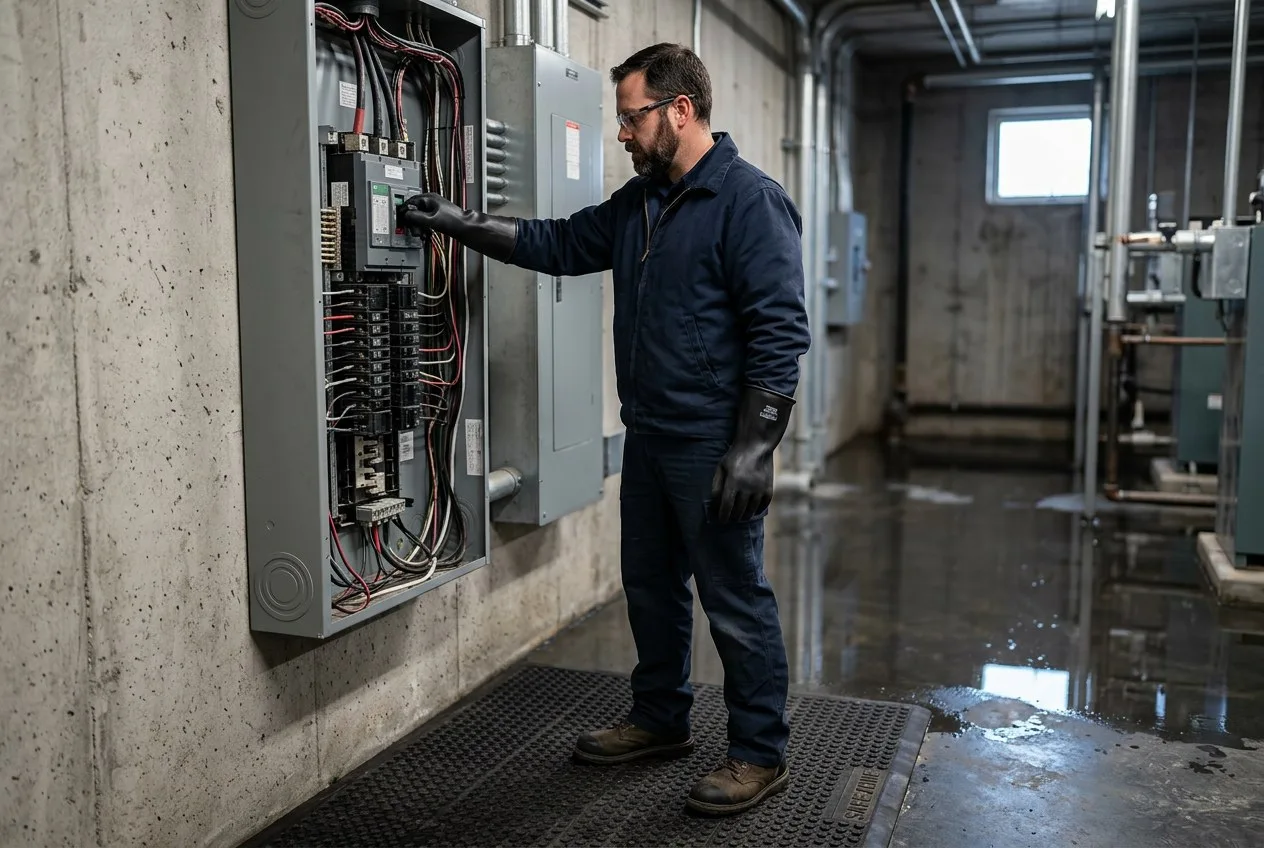
Life Safety First Immediately After Flooding
Before we get to the question of UPS and battery, the environment itself is dangerous. Submerged electrical equipment may still be energized; therefore, it is recommended not to enter flooded areas until the power authority has confirmed that the power has been cut off. AFAD also Not to enter the buildings before the authorities' return warning comes and the building is checked. reminds. The guide of the Insurance Association of Turkey (TSB) is in the same direction: If the electrical installation has come into contact with water, buttons, sockets and electrical devices should not be touched, and installation checks should be carried out by authorized persons.
There is an additional risk specific to a UPS: A UPS with a connected battery will have voltage inside even if the mains is cut off. The capacitors on the rectifier and inverter floor can also remain charged for some time after the device has been switched off. Moreover, when the battery string is connected in series, the DC voltage rises rapidly. For example, if 20 batteries of 12 V are connected in series, the string voltage is approximately 240 V DC, and in a string with 40 batteries, it is approximately 480 V DC. In a wet environment, this level represents a serious risk of electric shock and arcing.
What to do in the first minutes
- Do not enter the water. Do not approach if the water level, current, and energized source inside are unknown. Call 112 if necessary.
- Extract the energy from a dry spot. If the main switch or the associated switchgear is in water or on a wet surface, do not intervene yourself; call the distribution company or authorized electrical personnel.
- Do not touch the devices, do not try to turn them on again. Even pressing the button asking "What is the situation?" can trigger a short circuit in the internal circuit.
- Document when safe conditions are provided. Photograph water level traces, device labels, battery labels, and visible damage. This record is required for both service and insurance.
- Do not throw the appliance in the trash. The TSB guidance recommends not to dispose of the items before the damage assessment is completed; This is one of the common mistakes after floods.
If you want to see the occupational safety framework in detail Occupational safety in UPS and battery work You can look at the article.
How Do We Classify the Damage Level?
Not every "wetting" leads to the same result. Damage on the service side; The type of water (clean, salty, sewage), the level of the water reaches the device, the contact time and whether the device is energized or not. NEMA's directive is also electrical function, degree of flooding, age of equipment and duration of stay in the water as determining factors.
| Status | Typical finding | Recommended approach |
|---|---|---|
| Drip / splash | Water has entered through the top cover or ventilation grill, the lower floors are dry | Cut off the energy, do not turn on the device; let the service perform internal control and insulation measurement |
| Underfloor wetting | Water has reached the input cables, terminals, fans and sub-boards close to the floor | Power module and board evaluation required; most of the time, parts are replaced |
| Partial immersion | Water has entered the cabin, there are traces of mud, crumbs or salt residue | Generally, renovation comes to the fore instead of repair; cost/risk comparison is made |
| Full immersion / salt or dirty water | All cards, power floor, battery connections are submerged under water | Expectation of recovery is low; replacement and safe disposal are planned |
| Condensation / prolonged moisture | Efflorescence on boards, oxide on poles, rust on connectors | Fix the environment and cleaning, connection tightening and testing; damaged parts are replaced |
The categories in this table are a practical distinction; the final decision for each device is made after open cabinet inspection and measurements. No table alone implies a "you can run" permission.
Why Is UPS So Sensitive to Water and Moisture?
A UPS consists of power electronic boards with hundreds of soldering points, a high-voltage DC bus, capacitors, relays, fans, and battery connections. Although the cabinet looks solid from the outside, the internal structure is not designed for water pressure. The ventilation grilles of office-type UPSs are purposely open; so that cooling air can get in.
What does the IP code say and what does it not say?
The IP code seen on the device label or datasheet, It is the protection classification defined by the IEC 60529 (TS EN 60529 in Turkey) standard and It consists of two digits after the letters "IP". The first digit indicates protection against solid objects and dust, and the second number indicates protection against water. A standard enclosed rack or office UPS usually carries only low solids protection and is not flood resistant; therefore, check the specification in the manufacturer's data sheet. Also remember the limits of the IP code: no IP code gives unlimited waterproofing in all conditions; the wrong fitting, gasket or mounting can practically reduce the protection on the label.
Types of damage caused by water
- Instantaneous short circuit: Conductive water bridges energized busbars and card paths; blows fuses, power semiconductors can burn out.
- Delayed corrosion: Even when water is withdrawn, the silt, salt, and minerals left behind lead to corrosion and loss of insulation. Therefore, the NEMA guideline Weakening of insulation due to moisture, debris trapped in components, and substances such as chemicals, sewage, or oil in contaminated floodwater can damage the equipment. specifies.
- Hidden insulation attenuation: Even if the device has been operating for a while, the insulation resistance may have decreased; the fault may occur days later, under load.
- Breakdown of fuses and protection elements: According to NEMA Under the influence of water, the fuse filler material may deteriorate and its cutting ability may decrease. This is the risk that the chain of protection will not be activated when it should be.
If you want to compare it with damage caused by the network or lightning, the control steps of that scenario UPS after lightning and mains strike It is explained in the article; In addition to water damage, the issue of residue and insulation comes to the fore.
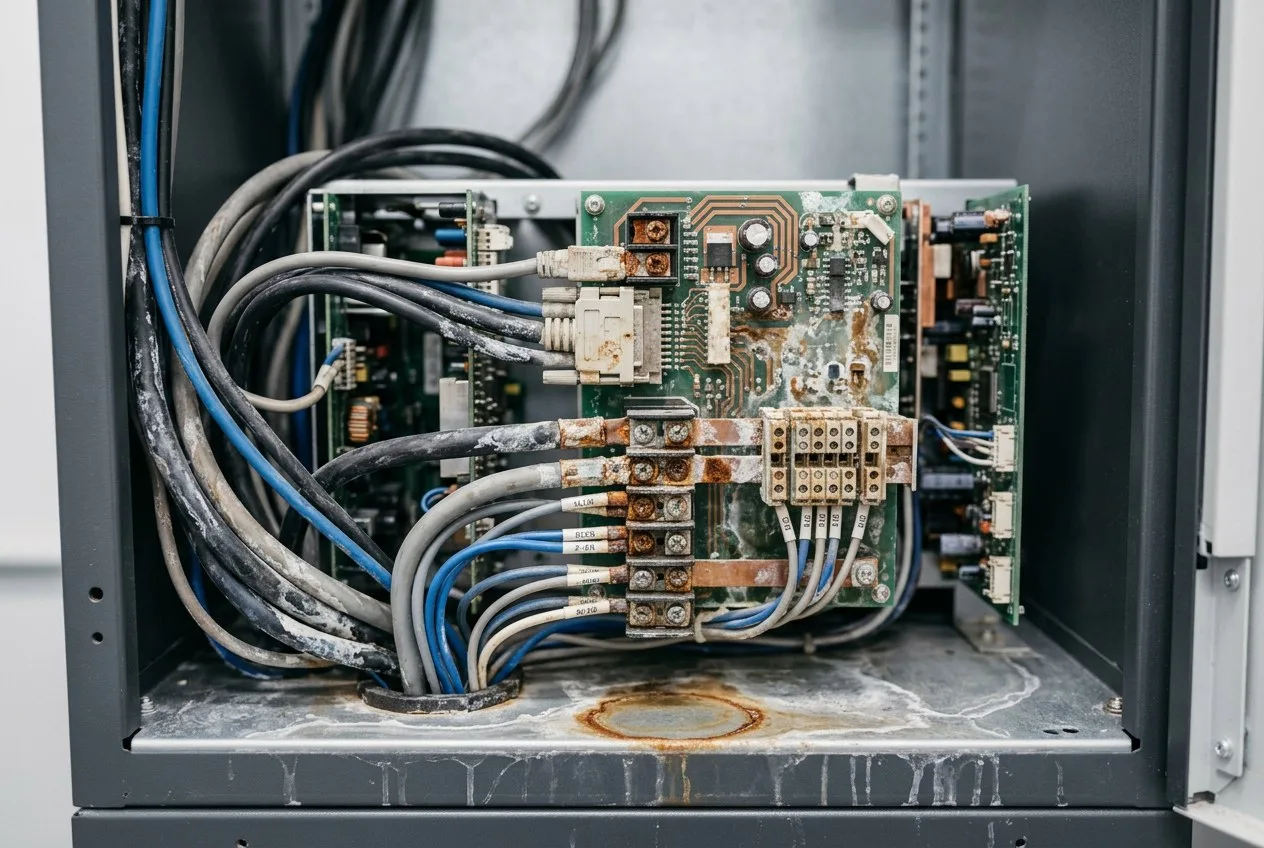
Why "Works When Dry" Is Not a Reliable Approach
We don't want to make light of a heavy process, but here's the truth: Being "dried out" on electronics isn't the same as being "safe." The Minnesota Department of Business and Industry says that electrical equipment that has been exposed to flooding can be cleaned and reused, and if re-energized, that it will pose a constant fire and life safety hazard takes a very strict stance. NEMA, on the other hand, says that some large industrial equipment can only be recovered by consulting the manufacturer and trained personnel. In other words, it is necessary to establish a realistic view between two poles: Small, card-based devices usually change; in large, modular and interchangeable systems, a documented damage assessment in coordination with the manufacturer.
The following logic applies to devices containing electronic components: Even if the fans and boards are working, safety functions such as insulation strength, protection relays and the behavior of fuses cannot be seen from the outside. To summarize with ESFI's warning: Any piece of equipment exposed to water must be inspected by qualified persons before returning to service.
Common mistakes
- Trying to dry the device quickly by blow drying it, heating it or placing it in the sun (residue remains, plastic and cards may be damaged).
- Washing interior boards with alcohol, cleaning spray or water; NEMA points out that incorrect cleaning agents can cause additional damage to equipment.
- Connecting a load to the outlet by saying "Let's try it in bypass"; The bypass line may also have insulation problems.
- Just changing the batteries and not having the UPS checked at all.
- Leaving the heated or smelly device on because it "passes".
In short, instead of trying to figure out why the UPS won't turn on, it's important to secure it first. If the device "won't turn on" or alarms, steps involved UPS won't turn on: possible causes and safe initial checks In the article; However, in cases such as flooding, the steps on that list should not be applied by "trying".
Flooded Battery Group: Risks by Battery Type
The battery pack is both the most valuable and the most dangerous component in flooding. The chemical energy inside the battery does not disappear even if it comes into contact with water; the terminals and series connection cables are easily bridged together with water.
| Battery type | Main risk in water/moisture contact | General approach |
|---|---|---|
| VRLA (AGM/gel) | Corrosion at the terminal and busbar connections; water ingress through the casing crack or valve area; leakage current in the series array | Cut off the energy; let authorized personnel disconnect the string connection; evaluate by capacity and internal resistance test, replace suspicious units |
| Open type (OPzS, aqueous lead-acid) | Diluted or contaminated electrolyte, overflowing acid, ventilation and outgassing | Electrolyte and cell assessment requires specialists; occupational safety is a priority due to the risk of acid flooding and hydrogen |
| Lithium-ion / LiFePO4 | BMS and cell short circuit, delayed heating, possibility of thermal leakage | Do not charge; keep it in the open, away from flammables, at a safe distance; get manufacturer and service guidance |
| NiCd | Leakage at pole connections, electrolyte contamination | Manufacturer/service evaluation; cleaning and testing expert work |
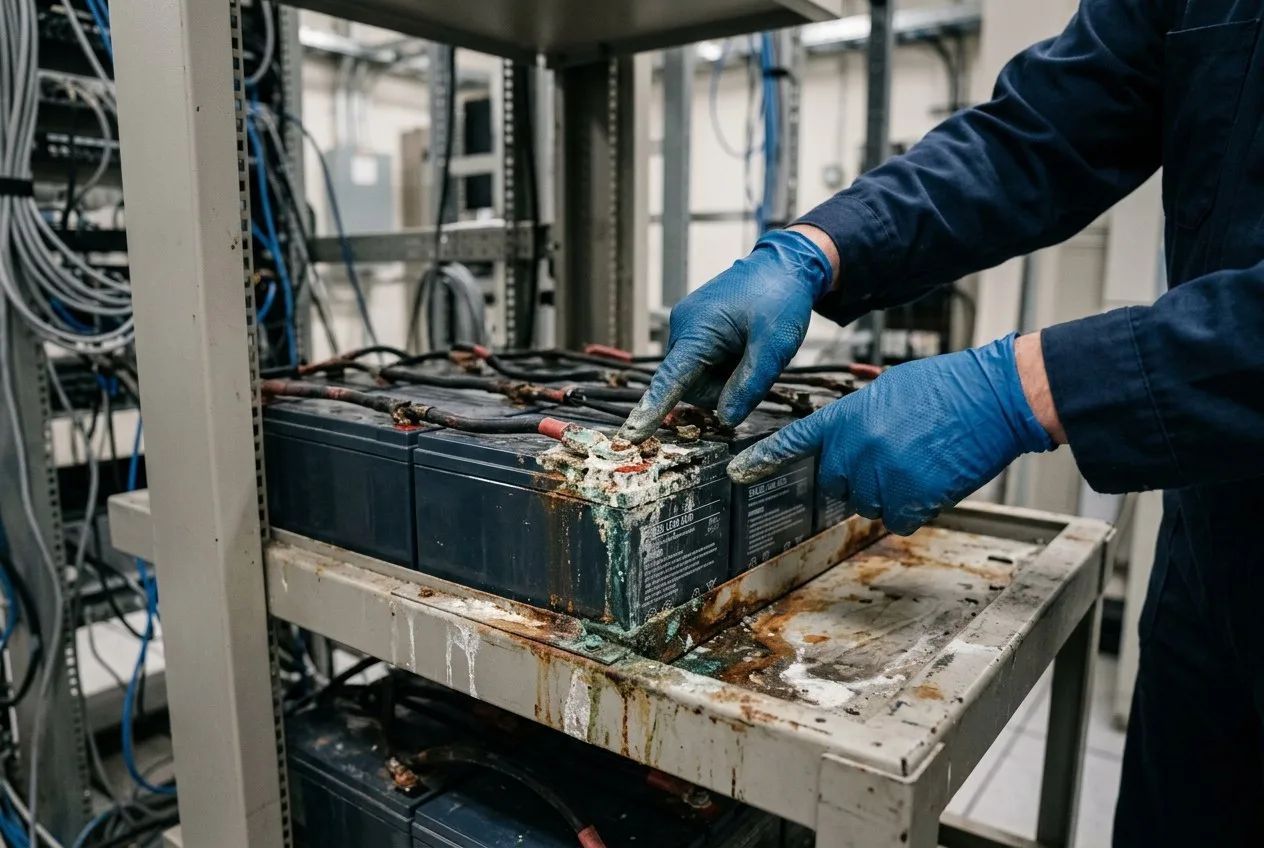
Lead-acid (VRLA) batteries
VRLA batteries are of a "closed" design but are not fully waterproof; the valve area and terminal sealing are limited. A battery with a solid casing and only a wet outer surface can be salvaged with proper cleaning and testing. However, the situation is complicated if there is wetting around the terminal, oxide in the bus connections, or unbalanced voltage between the batteries. Since a single bad battery in a series array affects the entire string, Differences between VRLA, AGM, and gel batteries and the evaluation method are important. For details on the change decision, see also Battery cabinet and assembly The settlement information in the article guides.
Delayed risk in lithium batteries
In lithium-ion and LiFePO4 modules, the outer casing and BMS (battery management system) electronics are sensitive to water and salt. U.S. Fire Administration (USFA), Chemical reactions caused by flooding or liquid contact can lead to battery failure even days later. specifies the directive, to disconnect lithium batteries suspected of being exposed to flooding from the charger, taking it out of the buildings and taking it into the open area and To keep damaged products in a metal or fireproof container, away from debris and structures. recommends. The named distances are for household products in the USA; For a lithium battery cabinet in a UPS rack, the manufacturer's instruction and local fire/expert opinion determine the safe solution. If there is a smoke, hissing or crackling sound, it is necessary to move away and inform the fire department. For technology differences lithium-ion UPS batteries You can look at the article.
What about damaged batteries?
Wet or damaged batteries that have been decided to be replaced cannot be disposed of in the normal trash. Waste management of lead-acid batteries is a separate issue and its details Disposal of old batteries It is explained in the article. For lithium batteries, USFA, not to collect debris, not to put it in garbage or recycling bins clearly warns.
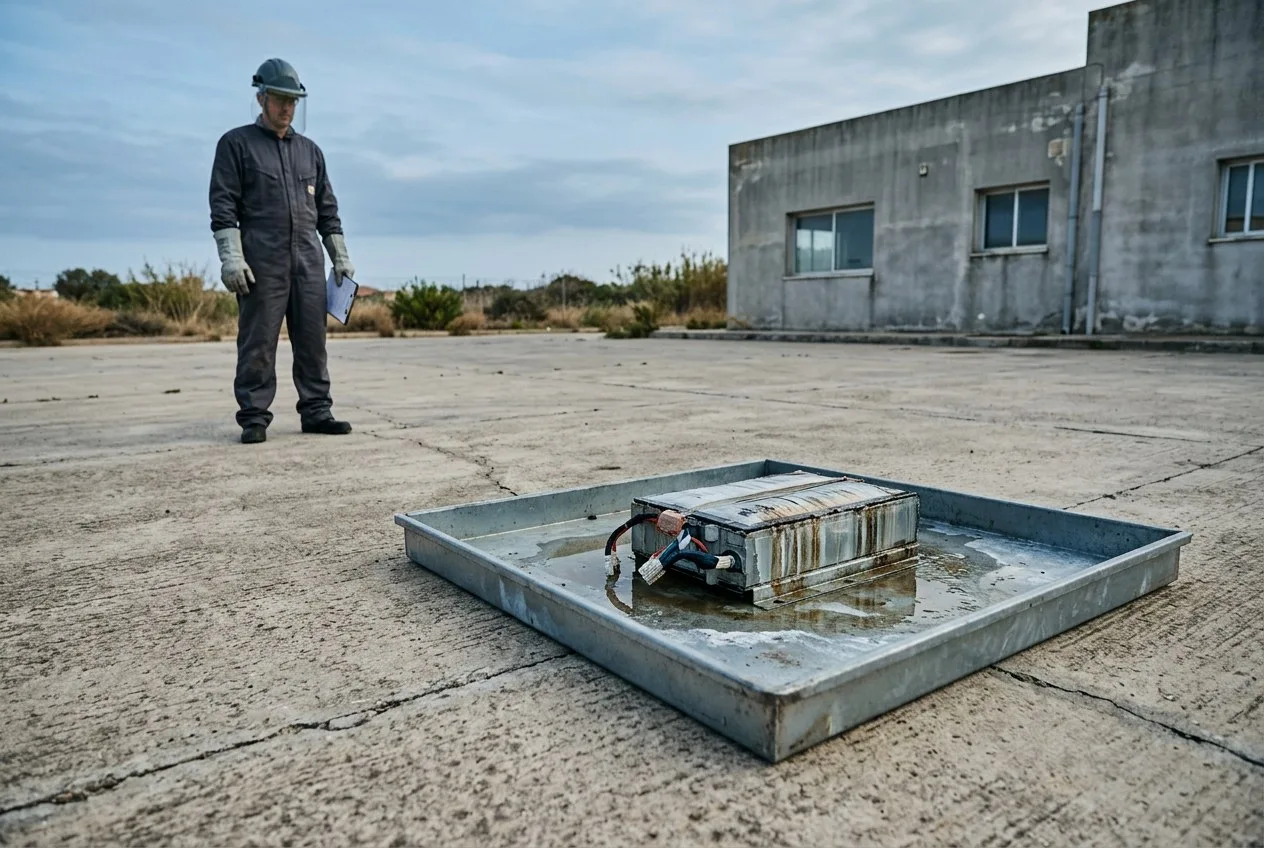
How Does the Service Process Work for a Damaged UPS?
For a UPS that has been flooded, servicing is more of a "damage assessment and decision" process than a routine maintenance. The sequence is usually as follows: complete energy isolation, battery string separation, opening the cabinet to perform a visual inspection, measurements, and then a repair or replacement decision.
- Isolation and safe opening: The mains and battery connections are separated, the DC bus discharge is awaited and verified by measurement.
- Visual inspection: Water lines, mud, salt crystal, bloomed solder, corroded terminal blocks, fan and capacitor condition are searched.
- Insulation and continuity measurements: Insulation resistance and leakage control are carried out with appropriate devices. This process is done when the device is de-energized and by authorized personnel; measurement thresholds are determined according to the manufacturer and relevant standards.
- Board and power module evaluation: Recoverable parts are cleaned or replaced; damaged semiconductors, capacitors, and fuses are replaced.
- Battery evaluation: Voltage, internal resistance, and, if necessary, capacity testing is performed; suspicious units change.
- Gradual commissioning: Verification is done first with no load, then with gradual load, bypass and battery mode transitions.
- Report: Which part changes and why, which measurements result in which values are recorded in writing.
For the general logic of these stages Commissioning after UPS repair The checklist in the article is useful. For post-battery tests Commissioning after battery replacement You can look at the article.
Repair or renovation?
| Question | In favor of repair | In favor of renewal |
|---|---|---|
| Type of water | Clean, short-term contact | Salty, muddy or sewage water |
| Water level | Bottom only, cards high | The power is solid and the cards are submerged in water |
| Device age and condition | Relatively new, parts support continues | Old, hard-to-find model |
| Parts availability | Manufacturer provides boards and modules | Critical card cannot be obtained |
| Function of the device | Not critical, short-term downtime tolerable | Critical load; high reliability expectation |
Those who are looking for a special perspective on older devices for this decision When to renew old UPS can take a look at the article. It is necessary to emphasize a point here: In the cost comparison, not only the repair cost, but also the hidden risk of failure after the repair and the possible interruption cost should be taken into account.
When contacting the service to speed up the evaluation of the work, it is very useful to prepare photos with the brand-model, serial number, number and type of battery, height and duration of the water; list of this information Information to prepare before a UPS service request It was collected in the article.
Humid Environment Creates a Problem Even Without Flooding
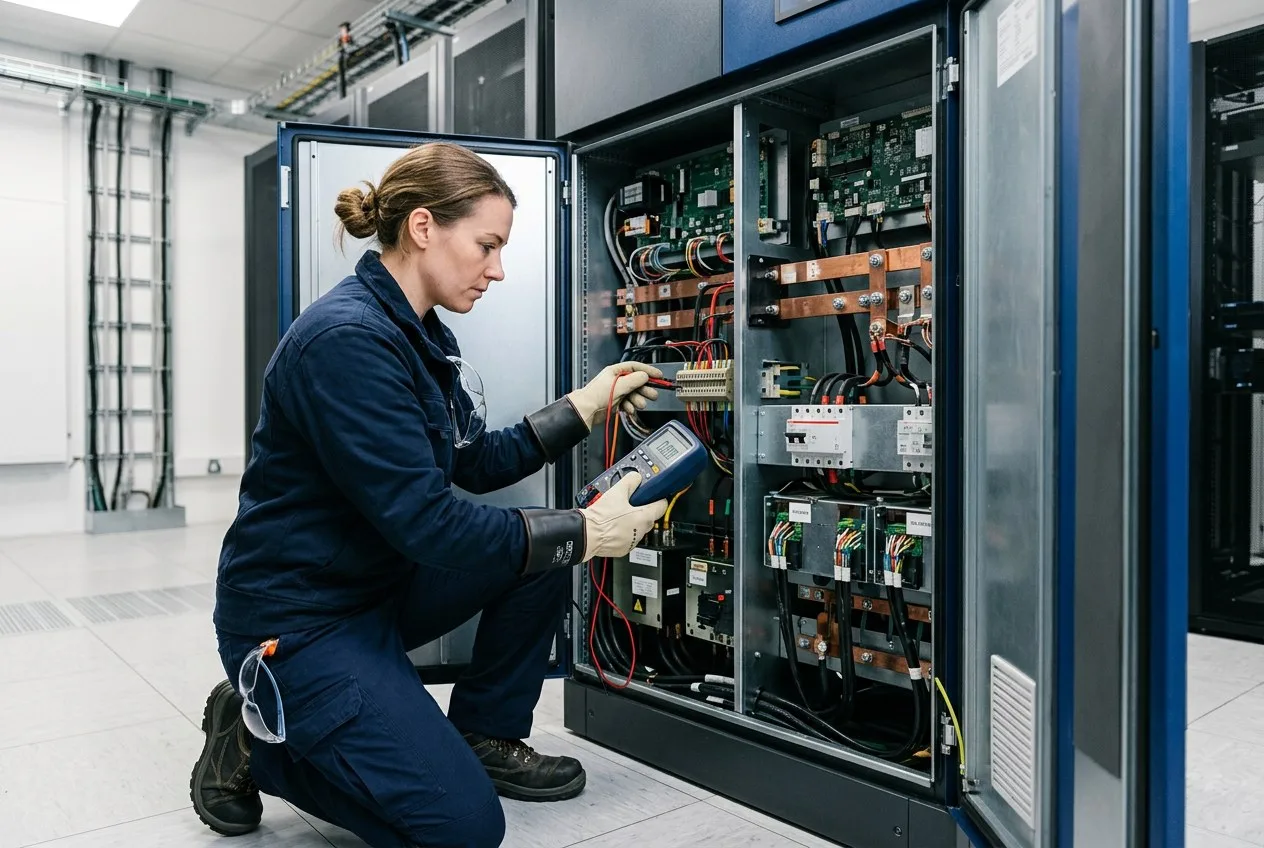
Not all damage is caused by flooding. In humid spaces such as basements, boiler rooms, outdoor construction site containers or summer houses, UPSs gradually become damaged. Moisture alone is not conductive, but when combined with dust and salt, it can form a conductive film on the surface of the card.
How does condensation form? A little calculation
Condensation begins when the temperature of a surface drops below the dew point of the air. Assuming a room temperature of 20 °C and a relative humidity of 60%. Under this condition, the dew point is approximately 12 °C. In a cold season or in a room with constant cooling, if the metal surface of the UPS cabinet or the battery rack remains below 12 °C, water droplets form on that surface. If the humidity rises to 80% in the same room, the dew point rises to about 16-17 °C and the chance of condensation increases significantly. These values are approximate; it is more accurate to measure with a hygrometer.
Many manufacturers specify a non-condensing relative humidity range for the UPS; the number varies by model, so refer to your specific device's datasheet.
| Symptom | Possible cause | What should be done? |
|---|---|---|
| White-green deposit on the poles | Moisture, leaks or gas leaks | Have the battery source inspected; call for service for tightness and voltage balance |
| Color change on cards, rust stains | Long-term moisture, condensation | Reduce the ambient humidity; let the service do cleaning and parts control |
| Random alarm, output fluctuation | Connector oxide, leakage on board surface | Store alarm logs; request connection and insulation control |
| Musty smell, humid air | Lack of ventilation | Improve the environment; schedule controlled dehumidification and regular maintenance |
| The device frequently switches to battery mode | Damp line connections or mains problem | Identify the source of the problem |
To distinguish whether the frequent switching to battery mode is caused by the mains or the UPS UPS frequently switches to battery mode article, and to understand the meanings of voice warnings, Why does UPS beep would be useful. Seeing these symptoms together in a humid environment is a warning to question the environment itself.
Dos and Don'ts
| What to do | Don'ts |
|---|---|
| Informing the authorized electrical personnel or distribution company before entering the unsafe area | Touching a switch, socket or UPS while standing in water |
| Documenting damage with photos and videos | Discarding or disassembling devices without documentation |
| Ensuring that only authorized personnel disconnect battery connections | Disconnecting wires, disconnecting strings on your own |
| Keeping and monitoring lithium batteries in open, non-flammable material | Trying to charge a wet lithium battery or storing it indoors |
| Obtaining a written evaluation from the manufacturer or authorized service center | Linking it back to the critical load because "it's dry, it's working" |
| Keeping alarm and log records | Clearing error codes and restarting the device |
The same logic applies to hybrid inverter or battery inverter systems; since the panel, battery and mains inputs are combined in the same device, water damage can contain energy from more than one source. For the meaning of the respective error codes Hybrid inverter faults and error codes You can look at the article; However, for an inverter that has seen water, safe isolation is the priority, not solving the error code.
Insurance and Documentation: Recording Damage Accurately
In businesses, the UPS and battery system are often insured as a machine or equipment item. According to TSB's flood and inundation guide If there is a relevant coverage in the workplace policy; buildings, fixed installations, commercial goods, machinery, equipment, production lines and electronic devices can be considered within the scope of the policy. The guide also Documentation of flooded areas and damaged items wants; Keeping invoices for cleaning, evacuation and emergency response costs is also recommended.
A practical list of records can be: device label (brand, model, serial number, kVA), battery label and quantity, trace of the water level on the wall, photos of the interior and exterior of the cabin, alarm display, maintenance report and previous measurement records, if any. The coverage of your policy and the claims process depends on the insurance company; inquire directly with your insurer for details.
Settlement and Precautions to Prevent It From Happening Again
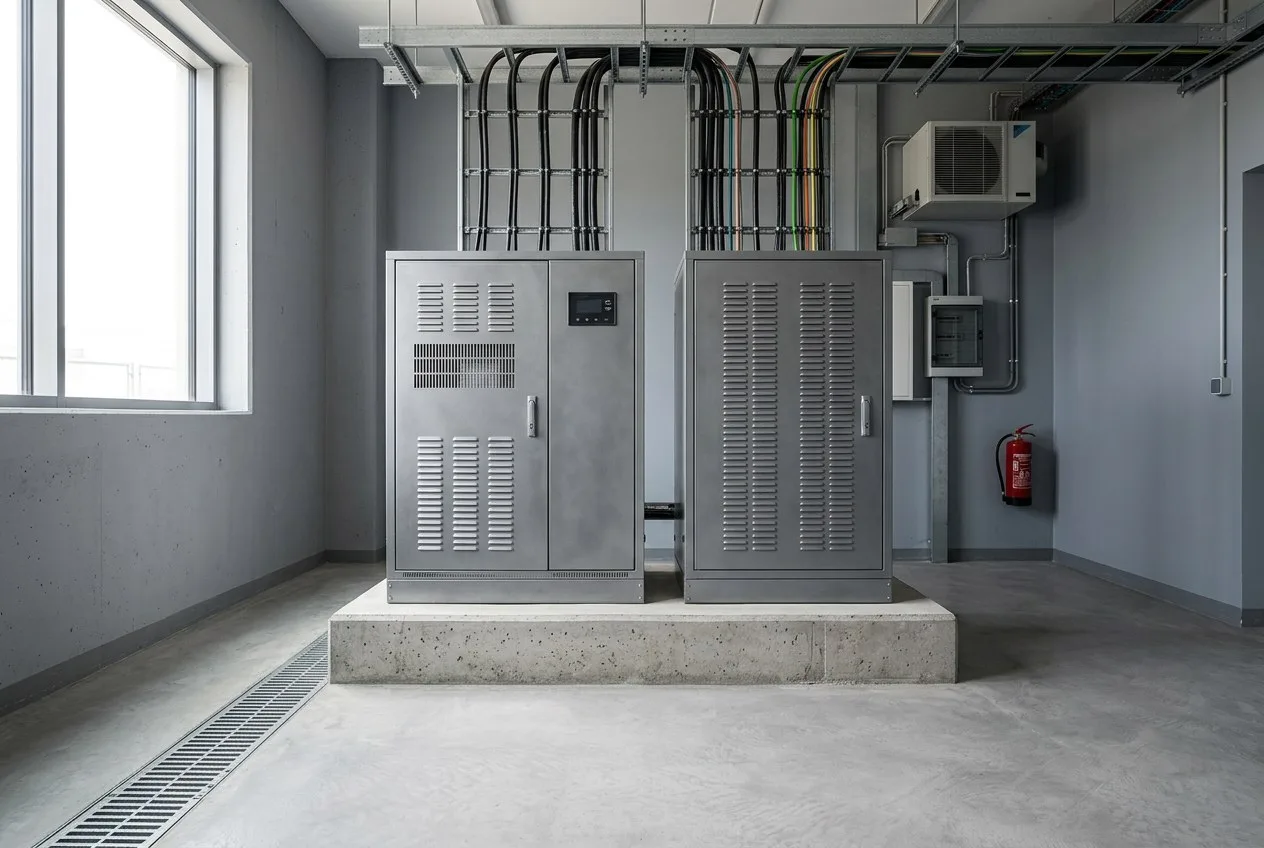
If you are installing or renewing the UPS and battery system for the first time in a building where there is a risk of flooding, the most effective measure is to remove the source and move the device up. Placing the car above the floor, for example on a concrete pedestal, entering the cable from above, and having a drainage channel reduces both water and dust. Remote monitoring of the environment measurement (temperature, humidity, water sensor) with an alarm allows you to catch the event earlier.
- Location: Avoid areas close to basements or storm drains. If necessary, use a pedestal above the water level.
- Water sensor and alarm: A simple ground-level sensor can be connected to a remote monitoring system.
- Ventilation and humidity control: The ventilation requirement of the battery room is a separate issue; Details Battery Room Ventilation and Safety in his article.
- Periodic Maintenance: The pole head, connection tightness, card appearance and moisture traces should be checked at every maintenance.
- Backup plan: Redundant architecture should be considered with the assumption that the UPS will not operate alone in critical loads.
When Should You Call Service Immediately?
If there is one of the following situations, inform the authorized technical service and the fire department when necessary:
- If the UPS or battery system is submerged, water or mud can be seen inside the cabinet.
- If there is swelling, leakage, odor, heating or noise in the batteries.
- If there is a burning smell, spark marks, tarnishing around the cabin or panel.
- If the device works despite seeing water and gives the impression of "no problem"; this does not mean it is safe, there may be a hidden insulation weakness.
- The hybrid inverter, energy storage or lithium battery cabinet is wet.
Quick decision after flooding protects human safety as well as the device. While caution may seem costly, it is often much more reasonable than the cost of an incorrect re-energization in interruption, fire, or injury.
If you have a flooded or humid UPS, battery pack or inverter, contact the Bempower team for survey, damage assessment, battery replacement and periodic maintenance. from the contact page You can reach. We provide on-site service in Istanbul and surrounding provinces; If you share the brand-model, battery information and damage photos of the device, we can speed up the process.
- Guidelines for Handling Water-Damaged Electrical Equipment — NEMA, 2025. https://www.nema.org/docs/default-source/products-document-library/guidelines-handling-water-damaged-elect-equip.pdf
- Evaluating Water-Damaged Electrical Equipment — NEMA (UConn EHS replica), 2016. https://ehs.media.uconn.edu/wp-content/uploads/sites/3238/2024/08/NEMAGuideEvaluatingWaterDamagedElectricalEquipment.pdf
- Flood damaged electrical systems — Minnesota Department of Labor and Industry, 2025. https://www.dli.mn.gov/workers/homeowners/flood-damaged-electrical-systems
- Lithium-Ion Battery Safety After Flooding — U.S. Fire Administration (FEMA), 2024. https://www.usfa.fema.gov/downloads/pdf/publications/lithium-ion-battery-after-flooding-handout.pdf
- Lithium-Ion Batteries: Everyday Convenience, Hidden Fire Risks — U.S. Fire Administration (FEMA), 2026. https://www.usfa.fema.gov/blog/lithium-ion-batteries/
- Flood — Republic of Turkey Ministry of Interior AFAD, 2025. https://www.afad.gov.tr/afadem/sel
- TSB's guide on flood and post-inundation claims processes — Sigortacı Gazetesi (Insurance Association of Turkey guide), 2026. https://sigortacigazetesi.com.tr/tsbden-sel-ve-su-baskini-sonrasi-hasar-sureclerine-iliskin-rehber/
- IP Protection Test: IEC 60529 (TS EN 60529) — European Certification, 2026. https://www.avrupabelgelendirme.com/ip-koruma/
- What is IP Protection Class? IP44-IP67 Differences — Levent Elektrik, 2026. https://leventelektrik.biz/haberler/ip-koruma-sinifi-nedir-nasil-secilir/
Resources
